
What is the Hỏa Thủy Vị Tế hexagram and where does it sit among the 64?
Hỏa Thủy Vị Tế (火水未濟, Unicode symbol ䷿) is the 64th and final hexagram of the 64 I Ching hexagrams in the King Wen sequence, coming right after Thủy Hỏa Ký Tế (hexagram 63). The name has three parts: Hỏa (fire) for the outer trigram, Thủy (water) for the inner trigram, and Vị Tế (未濟) meaning 'not yet crossed', 'not yet complete'. In Wikipedia's list of the 64 hexagrams, this is the last-numbered hexagram, symbol ䷿, closing the entire sequence.
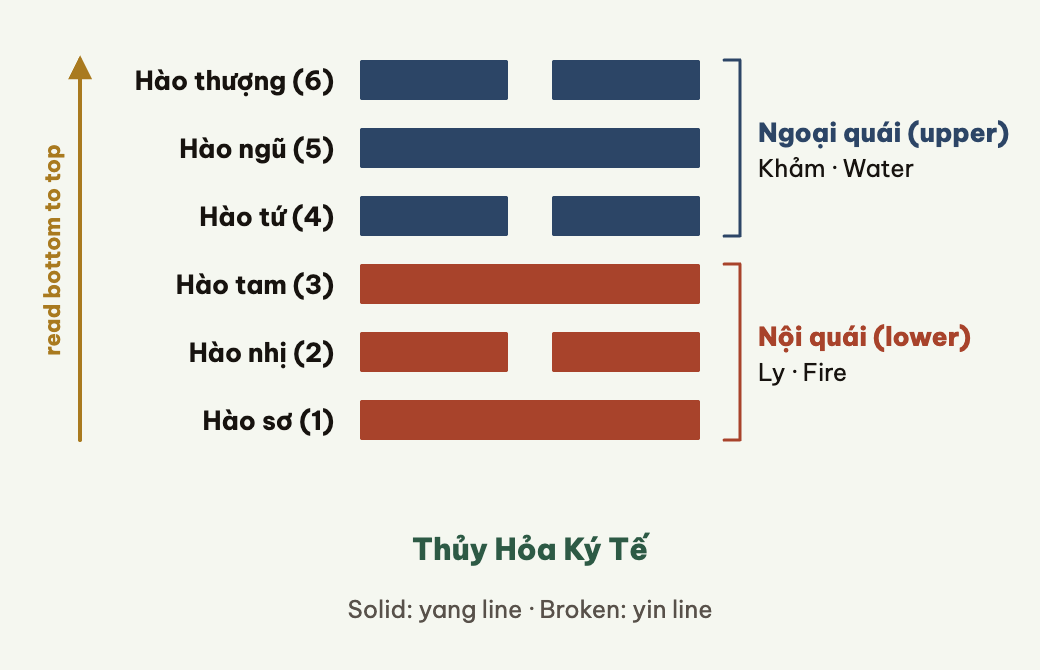
Structurally, the inner (lower) trigram is Khảm ☵ (water, danger) and the outer (upper) trigram is Ly ☲ (fire, brightness). The image is fire above water: fire should rise and water should flow down, but here the two fail to interact productively, so everything remains unfinished. In the eight-palace classification of the I Ching, this hexagram belongs to the Ly palace (Fire element), alongside Bát Thuần Ly, Hỏa Sơn Lữ, Hỏa Phong Đỉnh, Sơn Thủy Mông, Phong Thủy Hoán, Thiên Thủy Tụng, and Thiên Hỏa Đồng Nhân.
Six lines: all out of position, yet all paired
Vị Tế's most distinctive feature is its line structure. The six lines are Sơ Lục (yin), Cửu Nhị (yang), Lục Tam (yin), Cửu Tứ (yang), Lục Ngũ (yin), Thượng Cửu (yang). By the principle of yin-yang positional correctness (yang lines belong in odd positions, yin lines in even positions), all six lines sit in the wrong place: yang lines in even positions, yin lines in odd positions. But by the principle of correspondence (line 1 with line 4, line 2 with line 5, line 3 with line 6), all three pairs correspond, since each pair is one yin and one yang. This is Vị Tế's signature: the stance is skewed, but the relationships still connect. That is why the hexagram governs the time when 'things are not in their right place, but are not yet deadlocked'.
What does the Vị Tế Judgment say?
Original Chinese: 未濟:亨。小狐汔濟,濡其尾,無攸利。
Sino-Vietnamese reading: Vị Tế: Hanh. Tiểu hồ ngật tế, nhu kỳ vĩ, vô du lợi.
Translation: Vị Tế is successful. A small fox nearly crosses the river but wets its tail; nothing is favorable. In the common interpretation, 'successful' here is not a firm promise but a condition: success only if the actor knows how to conserve strength and hold to the Way to the end. The image of a young fox almost reaching the far bank only to wet its tail reminds us that failing at the last moment is the most regrettable kind of failure, and also the most common.
Note: commentaries and schools do not fully agree on the tone of this Judgment. One reading stresses 'successful' to show Vị Tế still has a way out if one is careful. Another stresses 'nothing is favorable' to show the hexagram warns of risk. This article presents both directions and does not pick one as the sole standard.
What does the Vị Tế Image teach?
Original Chinese: 火在水上,未濟;君子以慎辨物居方。
Sino-Vietnamese reading: Hoả tại thủy thượng, Vị Tế; quân tử dĩ thận biện vật cư phương.
Translation: fire above water is the image of Vị Tế. The noble person follows this by carefully distinguishing things and placing each in its proper place. Fire should be below to cook, water above to water and wash; here it is reversed. The time of Vị Tế is when all things are not yet in their right positions, so the first task is not to push forward but to rearrange: each thing to its own place, each person to their post, each task to the right hands.
What do the six line texts of Vị Tế mean?
The six Vị Tế lines describe six stages of an unfinished journey, using the image of the fox crossing the river and the noble person waging war. The table below gives the original Chinese and Sino-Vietnamese readings from HOROS, cross-checked against Wikipedia's list of the 64 hexagrams.
| Line | Chinese | Sino-Vietnamese | Meaning |
|---|---|---|---|
| Sơ Lục (line 1) | 濡其尾,吝 | Nhu kỳ vĩ, lận | Wets its tail, regrettable |
| Cửu Nhị (line 2) | 曳其輪,貞吉 | Duệ kỳ luân, trinh cát | Drags back the wheel, steadfastness brings good fortune |
| Lục Tam (line 3) | 未濟,征凶,利涉大川 | Vị tế, chinh hung, lợi thiệp đại xuyên | Not yet crossed, advancing brings misfortune, but it is favorable to cross the great river |
| Cửu Tứ (line 4) | 貞吉,悔亡,震用伐鬼方,三年有賞於大國 | Trinh cát, hối vong, chấn dụng phạt quỷ phương, tam niên hữu thưởng ư đại quốc | Steadfastness brings good fortune, regret vanishes, rousing to attack the Quỷ Phương, after three years rewarded in the great state |
| Lục Ngũ (line 5) | 貞吉,無悔,君子之光,有孚,吉 | Trinh cát, vô hối, quân tử chi quang, hữu phu, cát | Steadfastness brings good fortune, no regret, the noble person's light, with sincerity, good fortune |
| Thượng Cửu (line 6) | 有孚于飲酒,無咎。濡其首,有孚失是 | Hữu phu vu ẩm tửu, vô cữu. Nhu kỳ thủ, hữu phu thất thị | With sincerity, drinking wine brings no blame. Wets its head, sincerity loses its correctness |
Line 1: wetting the tail right from the start
Sơ Lục is a yin line in the lowest position, barely entering the time of Vị Tế and already meeting danger (Khảm below). The line text uses 'lận' (regrettable), not 'hung' (misfortune). Per the Tiểu Tượng commentary, Sơ Lục is 'nhu kỳ vĩ' because of 'bất tri cực dã', not reckoning the end: weak, lacking talent, yet recklessly stepping into a hard task. In life, this is someone taking a new job without enough information, starting a project without resources, signing a contract without reading the terms. Not yet failure, but one must stop and reconsider.
Line 2: hold back the wheel, keep it slow
Cửu Nhị is a yang line in a yin position, incorrect, but central. This line corresponds with Lục Ngũ above. In the common interpretation, Cửu Nhị has firm talent and sees line 5 in a noble seat but yin and soft, so is tempted to overstep; that would ruin things. The line text advises restraining oneself like dragging back a wheel, holding the central Way for good fortune. This is the first good line in the hexagram. One moving fast who draws this line should heed the text: brake for one beat, recheck the map, move at one's own pace.
Line 3: not yet crossed, but able to cross the great river
Lục Tam is a yin line in a yang position, neither central nor correct. The line text seems contradictory: advancing brings misfortune, but it is favorable to cross the great river. Per HOROS's interpretation, the meaning is that going on alone right now is not good, but with enough companions and preparations, the great task can still be done. Some sources hold that before 'favorable' one should understand a missing 'not': crossing the great river is not favorable, which is the correct reading. Here the schools disagree, and this article does not pick one as standard. What can be said for sure is that line 3 forces the actor to distinguish which tasks to stop and which require mobilizing force to continue.
Line 4: hold to the correct Way, three years to finish
Cửu Tứ is a yang line in a yin position, incorrect, but has firm talent and is at the time of escaping danger (Khảm) to advance into brightness (Ly). The line text advises holding to the correct Way and also rousing the spirit with patience. The image of 'attacking the Quỷ Phương for three years before being rewarded' is an example of a great task needing a long time, not finishable overnight.
Line 5: the noble person's light
Lục Ngũ is a yin line in a yang position, incorrect, but central and in the middle of the outer trigram Ly, meaning it has radiant civil virtue. This line corresponds with Cửu Nhị below. The line text praises twice: first for central virtue and brightness, second for sincere trust in line 2. This is the finest line in the hexagram and also a moral bright spot: in a time not yet finished, one who keeps centrality and sincerity still has a good path.
Line 6: drinking to celebrate but wetting the whole head
Thượng Cửu is a yang line at the top of the hexagram. The line text has two parts: with sincerity, drinking wine brings no blame; but if one wets the whole head, even with sincerity one loses correctness. This is the I Ching's final instruction: do not celebrate too early, do not let a seemingly arrived victory throw you off balance.
Why does the I Ching end with 'not yet complete' rather than Ký Tế?
The answer lies in the Tự Quái, the section explaining the order of the 64 hexagrams. Per the Tự Quái, things cannot come to an absolute end (vật bất khả dĩ cùng), so after Ký Tế (crossed, done) one must necessarily move to Vị Tế (not yet done). In other words, the I Ching does not end at 'everything is complete' but at 'everything opens again'. This is not pessimism but a view of motion: every closed cycle opens a new one, and today's done is tomorrow's not yet done.
Note clearly: the 64-hexagram order above is the King Wen sequence, the commonly transmitted order today. The Mawangdui silk manuscript has a completely different order. This article only notes that difference in principle and does not speculate which hexagram stands last in the silk manuscript when the sources do not confirm it.
How does Vị Tế relate to Ký Tế, and how do the two differ?
According to the site's core calculation, Vị Tế has three special relations: its nuclear hexagram, reversed hexagram, and opposite hexagram are all Ký Tế. This means that if you invert, reverse the lines, or take the middle, Vị Tế all points back to Ký Tế. The two are a yin-yang pair on the same axis of motion: Ký Tế is 'already crossed', Vị Tế is 'not yet crossed'. The table below compares the two hexagrams line by line.
| Line | Ký Tế (hexagram 63) | Vị Tế (hexagram 64) |
|---|---|---|
| Line 1 | Nhu kỳ vĩ, lận (wets its tail, regrettable) | Nhu kỳ vĩ, lận (wets its tail, regrettable) |
| Line 2 | Phụ tang kỳ phất, vật trục, thất nhật đắc (loses the broom, do not chase, in seven days obtained) | Duệ kỳ luân, trinh cát (drags back the wheel, steadfastness brings good fortune) |
| Line 3 | Cao Tôn phạt Quỷ Phương, tam niên khắc chi (King Cao Tôn attacks Quỷ Phương, wins in three years) | Vị tế, chinh hung, lợi thiệp đại xuyên (not yet crossed, advancing brings misfortune, crossing the great river is favorable) |
| Line 4 | Nhu hữu y thường, chung nhật giới (wets the clothes, warns all day) | Trinh cát, hối vong, chấn dụng phạt Quỷ Phương, tam niên hữu thưởng ư đại quốc (steadfastness brings good fortune, rewarded in three years) |
| Line 5 | Đông lân sát ngưu, bất như tây lân chi thược tế (eastern neighbor kills an ox, not as good as the western neighbor's small offering) | Trinh cát, vô hối, quân tử chi quang, hữu phu, cát (steadfastness brings good fortune, noble person's light, with sincerity, good fortune) |
| Line 6 | Nhu kỳ thủ, lệ (wets the head, danger) | Hữu phu vu ẩm tửu, vô cữu. Nhu kỳ thủ, hữu phu thất thị (drinking wine with sincerity brings no blame; wetting the head loses correctness) |
Notably, both hexagrams share the same line 1 (nhu kỳ vĩ, lận) and both have a line 6 about wetting the head. But in Ký Tế, line 6 is 'lệ' (danger), while in Vị Tế, line 6 is 'vô cữu' (no blame) if one knows to stop, and only 'thất thị' (loses correctness) if one overdoes it. Both are warnings, but the degree and handling differ.
Applying Vị Tế in modern life
Vị Tế is not a promise of good fortune or a curse of misfortune but a description of the times. When one draws this hexagram, the querent is usually at a stage where things are not yet in gear, relationships not yet stable, plans not yet ripe. The core advice is: do not push forward yet, rearrange, conserve strength, hold the Way, and prepare for the next cycle.
Sources record a case of a young woman asking about marriage: she drew Lôi Sơn Tiểu Quá changing into Thủy Hỏa Ký Tế, and Vị Tế appeared in the transformation stage. Analysis showed she was entangled with a married man, opposed by many sides; the Thế Thê Tài line met Huyền Vũ, changed into Tử Tôn with triple punishment, then entered the tomb at the Quan Quỷ line. This combination showed she was swept up in blind passion and acted secretly, unlikely to reach a good outcome. This illustrates the 'tiểu hồ ngật tế' in love: haste and lack of reflection lead to trouble. Note this is an example from a reference, not a universal rule.
Sources also record another case: a woman asked about her daughter's high school entrance exam; she drew Thủy Hỏa Vị Tế changing into Hỏa Địa Tấn, and the exam result was poor with changes. The mother was surprised because her daughter was always in the top of her class. Analysis showed the Phụ mẫu Dần wood line was not generated by the month's Thìn earth and was drained by the day's Tỵ fire, so support was very weak. This example shows that even a good student can fail if the hexagram is bad, but it must be stressed: the hexagram only reflects tendency, not absolute fate.
Notes when consulting the Vị Tế hexagram
Two points need clear distinction when consulting this hexagram. First, the Judgment and line texts of Vị Tế in the Zhou Yi are ancient text, different from the oracle verses of separate divination books such as Khổng Minh Thần Toán. Khổng Minh Thần Toán has its own poetic verses for each line of this hexagram, but those belong to a different system, not the Zhou Yi line texts, and should not be mixed. Second, the schools do not fully agree on some lines, especially line 3 with 'advancing brings misfortune, crossing the great river is favorable'. Readers should study both interpretations before applying them to their own situation.
Structure of Hỏa Thủy Vị Tế in one table
| Item | Value |
|---|---|
| Number in the Zhou Yi | 64 |
| Chinese name | 未濟 |
| Upper trigram | Ly (Fire) |
| Lower trigram | Khảm (Water) |
| Six lines, top to bottom | yang, yin, yang, yin, yang, yin |
| Nuclear hexagram | Thủy Hỏa Ký Tế (hexagram 63) |
| Reversed hexagram | Thủy Hỏa Ký Tế (hexagram 63) |
| Opposite hexagram | Thủy Hỏa Ký Tế (hexagram 63) |


