


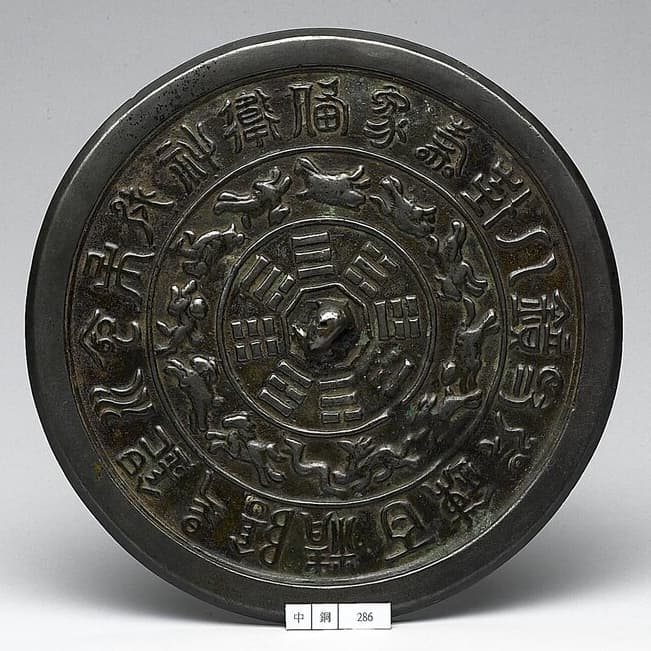
TL;DR: The Shan Huo Bi hexagram (賁, hexagram number 22 in the Zhou Yi sequence) consists of the lower trigram Li (Fire) and the upper trigram Gen (Mountain). The hexagram text reads: 賁:亨。小利有攸往, literally meaning Bi is successful, small advantage in having somewhere to go. Nhật Nguyệt's suggestion: this is the hexagram of adornment, so pay attention to presentation but do not let form overshadow the examination of matters.
What is the Shan Huo Bi hexagram?
Shan Huo Bi (賁) is hexagram number 22 in the Zhou Yi sequence. The hexagram consists of Li (Fire) as the lower trigram and Gen (Mountain) as the upper trigram, hence Shan Huo Bi. The character Bi (賁) means ornament, adornment.
Tradition attributes the drawing of the trigrams to Fu Xi, the naming and writing of the hexagram statements to King Wen, the line statements to the Duke of Zhou, and the Ten Wings to Confucius; modern scholarship does not regard that chain of authorship as proven, and generally places the core text of the Zhou Yi in Western Zhou China, and the Ten Wings around the 5th to 2nd century BCE.
What does the original text of the Shan Huo Bi hexagram say?
Hexagram statement (賁:亨。小利有攸往): Bi: heng. Xiao li you you wang. Close meaning: Bi is penetrating and successful; in small matters it is beneficial to have somewhere to go.
Line Sơ cửu (初九:賁其趾,舍車而徒): Bi qi zhi, she che er tu. Close meaning: Adorning one's toes, leaving the carriage and walking on foot.
Line Lục nhị (六二:賁其須): Bi qi xu. Close meaning: Adorning one's beard.
Line Cửu tam (九三:賁如濡如,永貞吉): Bi ru ru ru, yong zhen ji. Close meaning: Adorned and moistened, if one holds correctness enduringly, good fortune.
Line Lục tứ (六四:賁如皤如,白馬翰如,匪寇婚媾): Bi ru po ru, bai ma han ru, fei kou hun gou. Close meaning: Adorned and yet white, a white horse flying, not bandits but a marriage proposal.
Line Lục ngũ (六五:賁於丘園,束帛戔戔,吝,終吉): Bi yu qiu yuan, shu bo jian jian, lin, zhong ji. Close meaning: Adorning at the mound and garden, a bundle of silk, thin and slight, regret, in the end good fortune.
Line Thượng cửu (上九:白賁,无咎): Bai bi, wu jiu. Close meaning: White adornment, no fault.
What do the Thoán truyện and Tượng truyện of the Bi hexagram say?
Thoán truyện (賁,亨;柔來而文剛,故亨。分剛上而文柔,故小利有攸往。剛柔交錯,天文也;文明以止,人文也。觀乎天文,以察時變;觀乎人文,以化成天下): Bi heng; rou lai er wen gang, gu heng. Fen gang shang er wen rou, gu xiao li you you wang. Gang rou jiao cuo, tian wen ye; wen ming yi zhi, ren wen ye. Guan hu tian wen, yi cha shi bian; guan hu ren wen, yi hua cheng tian xia.
Đại Tượng (山下有火,賁;君子以明庶政,无敢折獄): Shan xia you huo, Bi; jun zi yi ming shu zheng, wu gan zhe yu. Close meaning: Fire below the mountain is Bi; the noble person illuminates the various affairs of governance, and does not presume to judge criminal cases.
The Tiểu Tượng in the source:
- 舍車而徒,義弗乘也: She che er tu, yi fu cheng ye. Leaving the carriage and walking on foot, because by what is right one should not ride.
- 賁其須,與上興也: Bi qi xu, yu shang xing ye. Adorning one's beard, rising together with the one above.
- 永貞之吉,終莫之陵也: Yong zhen zhi ji, zhong mo zhi ling ye. The good fortune of holding correctness enduringly: in the end no one can encroach upon it.
- 六四,當位疑也。匪寇婚媾,終无尤也: Liu si, dang wei yi ye. Fei kou hun gou, zhong wu you ye.
- 六五之吉,有喜也: Liu wu zhi ji, you xi ye.
- 白賁无咎,上得志也: Bai bi wu jiu, shang de zhi ye.
Commentary by Wang Bi and Zhu Xi
Wang Bi's commentary. On the line 剛柔交錯,天文也: "The firm and the yielding interweave and so form a pattern; this is the pattern of heaven." On the line 文明以止,人文也: "To stop things by culture and clarity rather than by awe and force; this is the pattern of humanity." On the line 觀乎天文…化成天下: "Observe the pattern of heaven, and the changes of the times can be known; observe the pattern of humanity, and transformation can be carried out."
On the Sơ cửu line: "At the beginning of the Bi time, with firmness occupying the lower place, the position is empty; turning away from what is not right, one rests content in walking on foot and following one's own will. Therefore one adorns one's toes, leaves the carriage and walks, because by what is right one should not ride in that position." Close meaning: At the start of the Bi time, being firm yet placed below, with an empty position, one sets aside what is not right and is content to walk on foot according to one's own will, and so adorns one's toes, leaves the carriage and walks.
On the Lục nhị line: "It obtains its position but has no response; the third line likewise has no response; both being without response, they draw close to each other, being near and so gaining one another. The beard is a thing dependent on something else, attached to what is above. Following where it stands and attaching to what is above, therefore it is said: Adorning one's beard." Close meaning: The beard is a thing dependent on what is above; it follows the place where one stands and clings upward.
On the Cửu tam line: "It occupies the extreme of the lower body, dwells in its proper position, and draws close to the second line; both dwell in their correctness, harmonize and moisten one another, and so complete their adornment... Enduringly preserving one's correctness, nothing can encroach upon it, therefore it is said: enduring correctness brings good fortune."
On the Lục tứ line: "It has a response at the first line but is blocked by the third; its own advance is difficult, and the two cannot come together in mutual feeling; it cannot obtain free passage. If it wishes to be still, it thinks of the response of the first line; if it wishes to advance, it fears the difficulty of the third. Therefore sometimes adorned, sometimes plain, inwardly harboring doubt and fear... The third is firm and fierce, not to be lightly offended; it is not a bandit but a suitor, and in the end there is no blame."
On the Lục ngũ line: "It dwells in an honored position and is the master of adornment; it is the one whose adornment is at its height. To adorn things with adornment, that way is harmful. To adorn with the mound and garden, nothing is more abundant than this... In what one uses, nothing is better than frugality; being lavish yet able to be restrained, therefore there must first be regret, and only then does one obtain good fortune in the end."
On the Thượng cửu line: "It occupies the end of adornment; when adornment ends it returns to plainness, therefore it rests in its plain substance, does not labor at ornamental refinement, and so has no fault. Taking white as adornment, it has no trouble or sorrow; it is one who obtains its will."
Zhu Xi's commentary (Zhou Yi Ben Yi). On the hexagram statement: "Bi, bi wei fan. Bi means adornment... Inward Li and outward Gen, there is the image of culture and clarity, each obtaining its proper part, therefore it is Bi. The diviner, because the yielding comes to pattern the firm, and the yang gains the aid of the yin while Li is bright within, therefore it is penetrating and successful; because the firm goes up to pattern the yielding while Gen stops without, therefore in small matters it is beneficial to have somewhere to go."
On the Sơ cửu line: "She yin she. With firm virtue and a bright substance, it adorns itself below, giving the image of leaving a carriage that is not the proper way and resting content in walking on foot. The diviner should conduct himself in this way."
On the Lục nhị line: "The second, being yielding and dwelling in central correctness, and the third, being firm yang and obtaining correctness, both have no response and so the second attaches to the third and moves, giving the image of adorning the beard. The diviner should follow the firm yang above and move."
On the Cửu tam line: "One yang dwells between two yin, obtaining its adornment and moistening benefit. Yet one must not sink into what is comfortable, therefore there is the warning of enduring correctness."
On the Lục tứ line: "Po, bai bo fan. Po means white. A horse is what a person rides; if the person is white, then the horse is white too. The fourth and the first are those that would adorn one another, but they are separated by the third and cannot reach their aim, therefore it is white and yet the heart that goes seeking is like the swiftness of a flying horse. Yet the third is firm and correct, not one who is a bandit, but one who seeks marriage, therefore its image is like this."
On the Lục ngũ line: "Xian zai tian fan you yin xian. The fifth, yielding and central, is the master of Bi, honoring the root and valuing substance, obtaining the way of Bi, therefore it has the image of the mound and garden. Yet the yin nature is stingy and grudging, therefore it has the image of a bundle of silk, thin and slight. A bundle of silk is a thin thing, jian jian carries the sense of shallow and small. If a person is like this, though it may invite regret, yet ritual prefers frugality to extravagance, therefore one obtains good fortune in the end."
On the Thượng cửu line: "When adornment reaches its extreme it returns to the root, returning to no color; it is good at making up for excess, therefore its image and divination are like this."
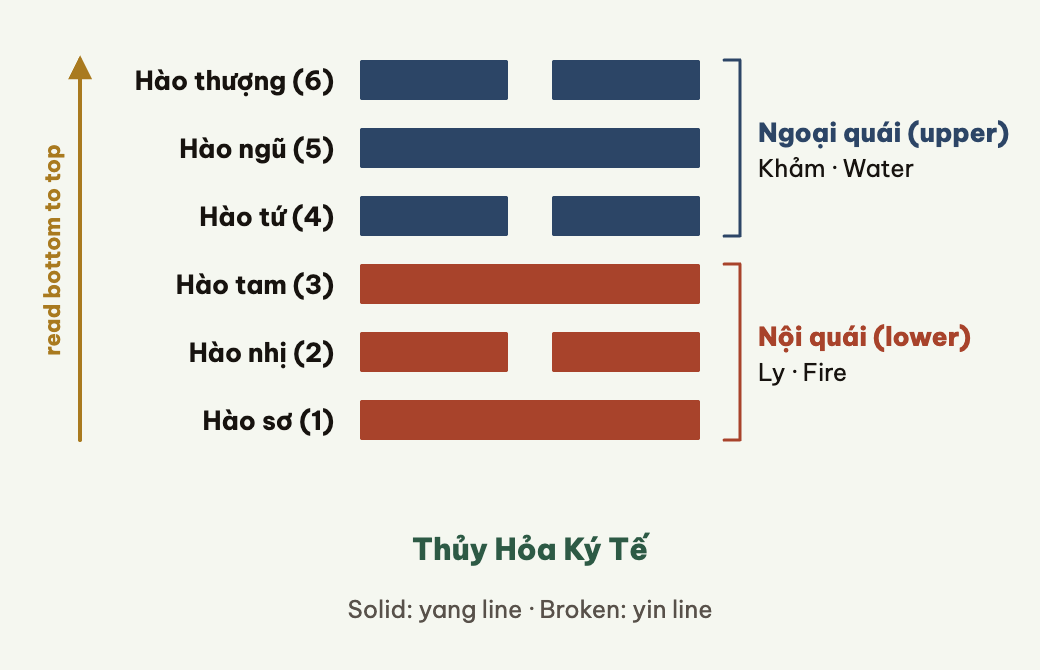
In Nhật Nguyệt's reading, what does the Bi hexagram speak of?
In Nhật Nguyệt's reading, Bi is the hexagram of cultural adornment: setting the brightness of Li beneath the stopping of Gen, so that the beauty displayed has limits and does not spill over everywhere. The Thoán truyện speaks of the pattern of heaven and the pattern of humanity, that is, observing how heaven and earth interweave in order to know the changes of the times, and observing how people become cultured and then stop, in order to transform the world. The Đại Tượng leans toward governance: illuminating ordinary affairs, while not presuming to decide criminal cases on one's own authority.
Placed side by side, the lines show a progression: at the outset, holding to what is right and accepting simplicity (Sơ cửu), then depending on the one above in order to rise together (Lục nhị), then arriving at a point where adornment moistens and one must hold correctness enduringly (Cửu tam), then at the place of doubt, keeping a heart like a white horse galloping forward yet knowing how to tell a bandit from a suitor (Lục tứ), then at the high position, favoring the root and using frugal ritual (Lục ngũ), and finally returning to white, that is, casting off all adornment (Thượng cửu).
When the Shan Huo Bi hexagram comes up in a question about work, how should it be understood?
Nhật Nguyệt's suggestion: the Bi hexagram points toward presentation, image, manner of speech, arrangement. If you are preparing a dossier, a presentation, a personal brand or an introduction session, this is an occasion to pay attention to form. But the Đại Tượng speaks of illuminating ordinary affairs while not presuming to judge criminal cases, so in matters requiring judgment and weighty conclusions, one should be cautious and not let polish crowd out the weighing of the matter.
When the Bi hexagram comes up in a question about love, how should it be understood?
Nhật Nguyệt's suggestion: the Lục tứ line carries the image of a white horse galloping forward and the phrase fei kou hun gou, that is, not bandits but a marriage proposal. This is the image of an obstacle standing between two sides, making those involved both want to advance and hesitate. Wang Bi's commentary on that line states clearly that there is a response with the Sơ line but it is blocked by the Tam line, so that one is sometimes adorned, sometimes plain, with doubt and fear within. Zhu Xi's commentary also says the Tứ line and the Sơ line wish to beautify one another but are separated by the Cửu tam line. In matters of love, this hexagram points toward distinguishing clearly what is a real obstacle and what is merely one's own suspicion.
When the Bi hexagram comes up in a question about money, how should it be understood?
Nhật Nguyệt's suggestion: the Lục ngũ line speaks of a bundle of thin silk and the word lin (regret), with good fortune only at the end. Wang Bi's commentary on this line holds that in what one uses, one should never be too frugal, yet being in an honored position and knowing restraint means the small regret leads to a good result. Zhu Xi's commentary says ritual prefers frugality to extravagance. With money matters, this is a suggestion about spending within limits and prioritizing the root, not a specific investment recommendation.
When the Bi hexagram comes up in a question about health, how should it be understood?
Nhật Nguyệt's suggestion: the Bi hexagram does not speak of illness. The Đại Tượng only says that the noble person illuminates ordinary affairs and does not presume to judge criminal cases. With health, this is not a basis for judging anything; if there is a problem, one should ask someone with expertise.
What is Nhật Nguyệt's suggestion for someone in a leadership position?
Nhật Nguyệt's suggestion: the Lục ngũ line sits in an honored position and is yet the master of adornment; Wang Bi's commentary says that to adorn things with adornment means that way is harmful, and so it turns toward the mound and garden, using a bundle of thin silk. Zhu Xi's commentary says this line honors the root and values substance, obtaining the way of Bi. For a leader, this is a suggestion about favoring the root, keeping ritual frugal, and not leaning on showiness as a foundation.
Quick reference table: the Shan Huo Bi hexagram
| Aspect | Content |
|---|---|
| Position among the 64 hexagrams | 22 |
| Chinese character name | 賁 |
| Symbol | ䷕ |
| English name | Grace |
| Upper trigram (outer trigram) | Gen (Mountain), element Earth, direction Northeast |
| Lower trigram (inner trigram) | Li (Fire), element Fire, direction South |
| Six lines, the first line at the bottom | first yang, second yin, third yang, fourth yin, fifth yin, top yang |
| Image | Fire shining at the foot of the mountain, the scenery shows its outlines clearly. |
| Interpretation | An image of form, adornment and presentation. The ancients held that outward appearance is useful when it goes together with substance. Polishing only the surface means the beauty does not last long. |
The data in the table matches the results of the lookup tools on Nhật Nguyệt.
What should you note about the context and the commentarial tradition?
The line statements of Bi contain sentences carrying the social norms of ancient times, such as the matter of marriage in the Lục tứ line, and the matter of ruler and minister, of those above and those below, in the Lục nhị line and its Tiểu Tượng. This is the historical context of the text, not advice to be imposed on relationships today.
As for the commentarial tradition, Wang Bi lived in the Wei period, Zhu Xi in the Southern Song. The two read Bi differently in several places: Wang Bi emphasizes the force and position of the lines, Zhu Xi emphasizes the body of the hexagram and the work of divination. Both say the Lục tứ line is blocked by the Cửu tam line, but Wang Bi develops further the sense of fear and doubt, while Zhu Xi speaks of the mental state of galloping forward like a white horse.
What is the connection with Yin-Yang philosophy?
The Shan Huo Bi hexagram is presented within the framework of the traditional Yin-Yang theory. The combination of Fire below and Mountain above, together with the pairs of firm and yielding in the Thoán truyện, shows beauty conceived as the result of mutual interweaving and embellishment.
There is a hypothesis that the I Ching belongs to a very ancient civilization in the South, such as the presentation by Nguyễn Vũ Tuấn Anh in certain books. This is one person's hypothesis; mainstream scholarship does not accept it, and places the core text of the Zhou Yi in Western Zhou China, around the end of the 9th century BCE.
Overview article on the topic: What is the I Ching.


