
What layers of text make up a Kinh Dịch hexagram?
Open a hexagram in the Kinh Dịch and you do not meet one continuous passage but several layers of text stacked on each other, each written in a different era. The oldest layer is the Kinh text, comprising the hexagram name, the quái từ (hexagram text, also called thoán từ) about the whole hexagram, and six hào từ about each line. The later layer is the Truyện, that is the Thập Dực (Ten Wings), comprising the Thoán truyện, Great Image, Small Image, Hệ Từ, Văn Ngôn, Tự Quái, Thuyết Quái, and Tạp Quái.
According to Wikipedia, the Kinh Dịch (I Ching, also called Yijing) began as a divination book of the Western Zhou period (roughly 1000 to 750 BCE). Through the Warring States period and the early imperial era (roughly 500 to 200 BCE), it turned into a cosmological text thanks to a series of commentaries named the Thập Dực. By the 2nd century BCE, the Kinh Dịch had entered the Confucian Five Classics.
What order makes sense for reading?
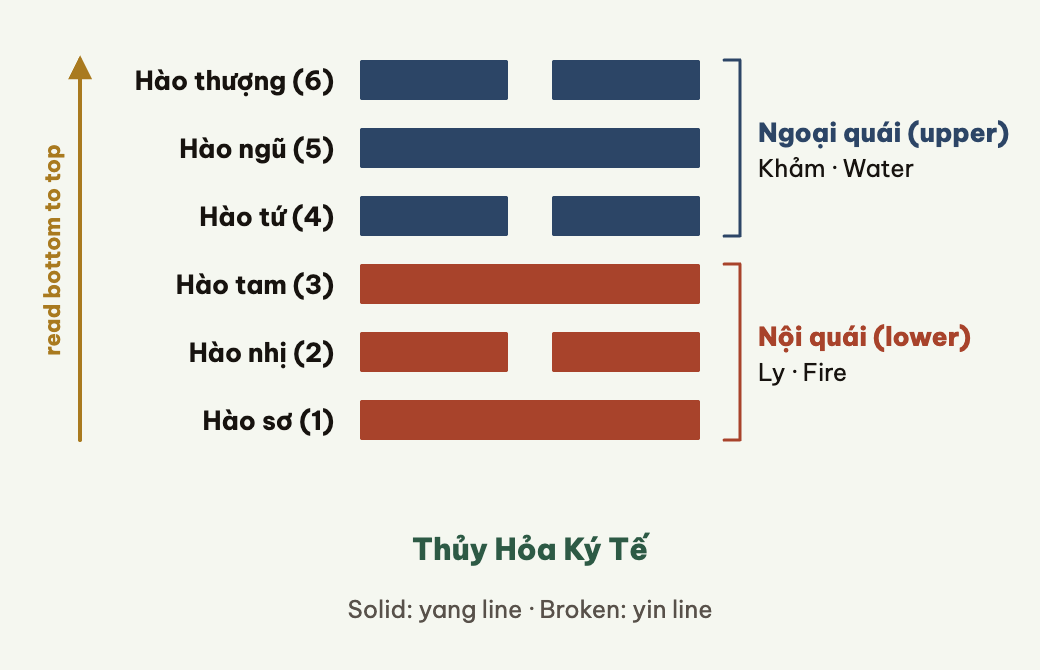
The common reading order, used by most introductory books, is to read from the outside in, from the general to the particular. Read the hexagram name first to know which hexagram you are in and which pair it belongs to. Then read the quái từ, because the quái từ speaks about the whole situation of the hexagram. Next read the six hào từ in order from the bottom up, the first line at the bottom, the top line at the top. Only then read the Truyện layers to understand why those texts were written as they were.
This order has a reason: the Kinh text is the part used for reference when casting, while the Truyện is the explanatory part. If you read the Truyện before the Kinh, you easily impose a later reader's understanding onto ancient wording. Many modern scholars, including authors cited by the Stanford Encyclopedia of Philosophy (SEP), stress that the Kinh text and the Truyện are two textual strata differing in era, purpose, and tone, so they should be read separately and only then compared.
Must you read every layer?
Not necessarily. If you only want to know what the hexagram says for the situation you are asking about, reading the name, quái từ, and hào từ is enough. The Truyện layers are for those who want to understand the mechanism, who want to know why a given line is auspicious or inauspicious. For the two hexagrams Càn and Khôn, the Văn Ngôn layer is long and has its own philosophical value, and many read it separately as an independent essay.
Table of the text layers of one hexagram, using Địa Thiên Thái as a sample
Địa Thiên Thái (地天泰), hexagram number 11 of the 64, is a hexagram that has all the typical text layers. Its structure is Càn within and Khôn without, that is Càn below, Khôn above, three yang lines and three yin lines evenly arranged. According to Horos, the ancients regarded this as the hexagram of the most favorable time in life.
| Layer name | Belongs to Kinh or Truyện | Speaks of the whole hexagram or each line | Example text (Hán Việt) |
|---|---|---|---|
| Hexagram name | Kinh | Whole hexagram | Địa Thiên Thái (地天泰) |
| Quái từ (thoán từ) | Kinh | Whole hexagram | Thái: Tiểu vãng đại lai, cát, hanh |
| Line text, line 1 | Kinh | Each line | Bạt mao nhự, dĩ kỳ vị, chinh cát |
| Line text, line 2 | Kinh | Each line | Bao hoang, dụng bằng hà, bất hà di, bằng vong, đắc thượng vu trung hành |
| Line text, line 3 | Kinh | Each line | Vô bình bất pha, vô vãng bất phục, gian trinh vô cữu |
| Line text, line 4 | Kinh | Each line | Phiên phiên bất phú, dĩ kỳ lân, bất giới dĩ phu |
| Line text, line 5 | Kinh | Each line | Đế Ất quy muội, dĩ chỉ nguyên cát |
| Line text, line 6 | Kinh | Each line | Thành phục vu hoàng, vật dụng sư, tự ấp cáo mệnh, trinh lận |
| Thoán truyện | Truyện | Whole hexagram | Thiên địa giao, Thái; hậu dĩ tài thành thiên địa chi đạo, phụ tướng thiên địa chi nghi, dĩ tả hữu dân |
| Great Image | Truyện | Whole hexagram | Thiên địa giao, Thái; hậu dĩ tài thành thiên địa chi đạo |
| Small Image | Truyện | Each line | Each line has its own comment sentence |
| Văn Ngôn | Truyện | Whole hexagram, only Càn and Khôn | Hexagram Thái has no Văn Ngôn |
This table shows a hexagram can have up to ten text layers. For hexagram Thái, the Văn Ngôn layer does not appear. Only the two hexagrams Càn and Khôn have Văn Ngôn, and this is a point to remember when looking things up.
If you want to see a detailed component table of a hexagram, including its number, ngũ hành, opposite hexagram, and number of yang lines, the article on the 64 hexagrams already has its own table, and you can turn there rather than repeating it here.
Common judgment words and their meanings
In the quái từ and hào từ, some judgment words repeat again and again. Understanding these words correctly is the minimum condition for reading a hexagram. According to Wikipedia and the Stanford Encyclopedia of Philosophy, these words include:
| Character | Hán Việt reading | Common meaning |
|---|---|---|
| 元 | Nguyên | Great, first, the origin |
| 亨 | Hanh | Smooth, favorable |
| 利 | Lợi | Beneficial, suitable |
| 貞 | Trinh | Steadfast correctness, or divination (depending on reading) |
| 吉 | Cát | Auspicious |
| 凶 | Hung | Inauspicious, not good |
| 悔 | Hối | Regret, remorse |
| 吝 | Lận | Slight regret, mild remorse |
| 厲 | Lệ | Danger, need for caution |
| 无咎 | Vô cữu | No fault, not blameworthy |
The four words nguyên, hanh, lợi, trinh often go together as a set. Many books translate this set as the four great virtues of a hexagram. But there is another reading, treating them as four judgments for four different casting situations. This difference affects the whole way hexagrams Càn, Khôn, and many others are understood.
Is the character 'trinh' read as 'divination' or 'steadfast correctness'?
This is one of the biggest disputes in Kinh Dịch studies. The character 貞 (trinh) in ancient Chinese has two meanings. One is divination, that is the act of casting to ask. The other is steadfast correctness, that is the virtue of firmness, holding to the right way. These two meanings lead to two entirely different translations.
For example, with the quái từ of hexagram Thái: Tiểu vãng đại lai, cát, hanh. This sentence has no trinh so it causes no dispute. But with line 3 of hexagram Thái: Vô bình bất pha, vô vãng bất phục, gian trinh vô cữu. If trinh is read as steadfast correctness, the sentence translates as: in hardship, if one stays steadfast, there is no fault. If trinh is read as divination, it becomes: in hardship, if one divines, there is no fault. The two meanings are close but differ in emphasis.
With other hexagrams, the gap is wider. The character trinh appears in the top line of hexagram Thái: Thành phục vu hoàng, vật dụng sư, tự ấp cáo mệnh, trinh lận. Read as holding steadfast, there is regret; read as divination, there is also regret, but with a different shade. Han dynasty commentators usually followed the steadfast correctness meaning, while some modern scholars follow the divination meaning, arguing that the original Kinh text is a divination book and the character trinh in it must carry the divination sense.
Does the theory that Văn Vương wrote the hexagram text and Chu Công wrote the line texts hold up?
Confucian tradition long held that Văn Vương wrote the hexagram text (quái từ), Chu Công wrote the line texts (hào từ), and Khổng Tử wrote the Thập Dực. The book Khổng Minh Thần Toán and many other old books mention this theory as settled fact. One idea repeated is that the original Dịch had only the trigrams and lines, and only with Văn Vương came the texts.
But modern scholarship does not accept this theory. Wikipedia cites Edward Shaughnessy, who places the Kinh text in the late 9th century BCE, that is before Văn Vương under traditional chronology. That means the hexagram texts existed before Văn Vương lived, or at least cannot be firmly tied to one specific figure. As for the Thập Dực, Wikipedia notes that as early as the Northern Song, Âu Dương Tu (1007 to 1072) and Tư Mã Quang (1019 to 1086) doubted that Khổng Tử was the author. By the Qing, Diêu Tế Hằng (1647 to 1715) and Khang Hữu Vi (1858 to 1927) reinforced this. Twentieth-century sinologists advanced arguments rejecting the traditional theory.
In other words, the theory that Văn Vương wrote the quái từ, Chu Công the hào từ, and Khổng Tử the Thập Dực is a legend with cultural vitality, not a confirmed historical event. This article follows the modern scholarly view, treating the Kinh text and the Truyện as two textual strata differing in era and authorship.
Another hypothesis on the origin of the Thoán texts
The book Thuật số Lạc Thư (Kỳ Môn Độn Giáp nguyên thủy) offers a quite different hypothesis. According to this book, the Thoán texts belong to the Lạc Việt people, not to Văn Vương. The book argues that the Lạc river region was where the Lạc Việt people lived, that they captured intellectuals of the Văn state and held them to learn the Kinh Dịch and Lạc Thư numerology, and that the Zhou later built up the story of Văn Vương being imprisoned at Dũ Lý and writing the Thoán từ. The book also holds that the Hào texts may have been added by the Zhou, since by the principle of how doubled hexagrams form, one could not have written texts for each line from the start.
This is one author's hypothesis, not a view recognized by international scholarship. This article mentions it so readers know such a view exists, without asserting it is correct. Books such as Wikipedia and the Stanford Encyclopedia of Philosophy do not mention this hypothesis when discussing the origin of the Kinh Dịch.
How does reading a hexagram with moving lines differ from reading a static hexagram?
When casting, you may get a hexagram with no moving lines, or with a few moving lines. The reading differs. The traditional rule is presented as follows: if there are no moving lines, rely on the quái từ and hào từ of the original hexagram. If there is one moving line, that line is the governing line. If there are two moving lines, the upper is primary, the lower secondary. If there are three moving lines, the quái từ of the original hexagram is primary. If four or more lines move, rely on the remaining static lines, with the lower line as the master.
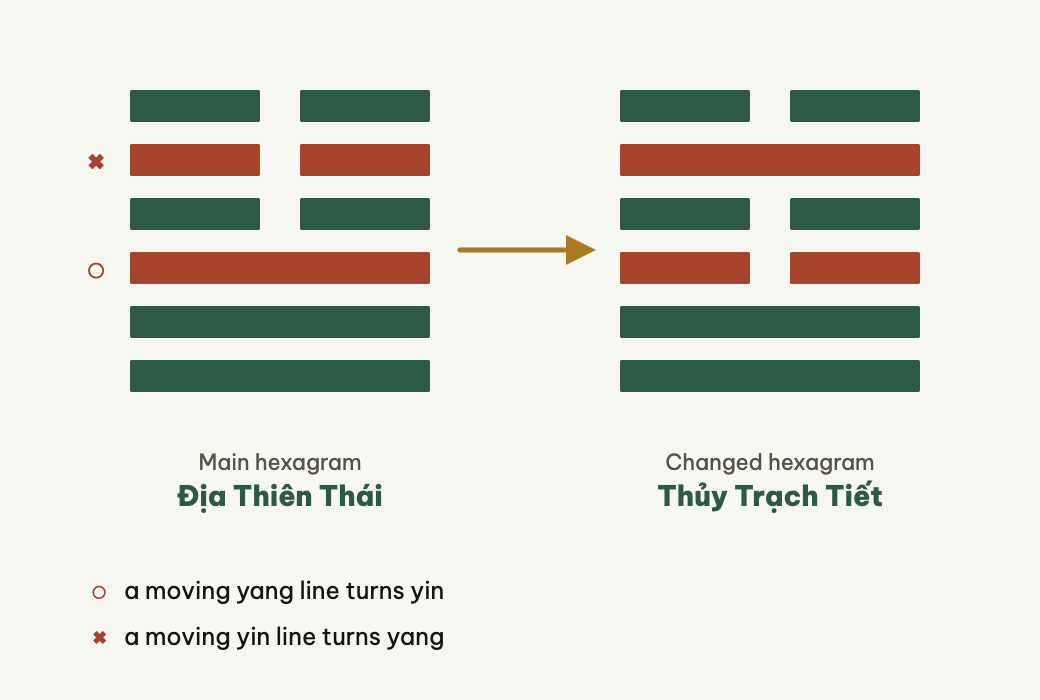
This rule is not uniform across books. Some other books hold that when three or more lines move, one should also look at the changed hexagram, that is the new hexagram after the moving lines switch yin and yang. Readers should know there are several rule systems and pick one to follow, rather than mixing them.
Why separate Kinh and Truyện when reading?
Separating Kinh and Truyện keeps you from confusing the voices of two eras. The Kinh text is a divination book, short in tone, concrete, full of everyday images such as pulling up thatch grass, wading a river, a city wall collapsing into the moat. The Truyện is a philosophical text, long in tone, abstract, fond of drawing moral lessons. For example, the first line of hexagram Thái has the line text Bạt mao nhự, dĩ kỳ vị, chinh cát, meaning pulling up thatch grass, the roots come together, things of the same kind draw each other along, advancing is auspicious. The Great Image of hexagram Thái instead says Thiên địa giao, Thái; hậu dĩ tài thành thiên địa chi đạo, phụ tướng thiên địa chi nghi, dĩ tả hữu dân, meaning heaven and earth in harmony is hexagram Thái, the ruler accordingly skillfully helps the way of heaven and earth come to fruition, assists the favorable order of heaven and earth to guide the people. One side is a concrete image, the other a political lesson.
The book Phong thủy cổ đại Trung Quốc: lý luận và thực tiễn, volume 2, also mentions the use of hexagram names and the Thoán and Tượng texts in palace architecture, showing these two text layers were used by later generations for very different purposes. The Giao Thái hall takes its name from hexagram Thái, with the sense of heaven and earth in harmony, yin and yang in balance.
How long does it take to read one hexagram, and where should you start?
There is no fixed answer. For a beginner, reading the name, quái từ, and six hào từ of one hexagram may take ten to twenty minutes. Reading the Thoán truyện, Great Image, and Small Image as well may take another half hour. For someone used to it, skimming a hexagram takes a few minutes, but reading one carefully to understand it still takes half a day.
Start with hexagrams of clear structure such as Thái, Bĩ, Ký Tế, Vị Tế. These four have all the typical text layers and many translations for comparison. Once familiar, you can read more complex hexagrams such as Càn, Khôn, Truân, Mông.


