
What are the six line positions, and why must they be numbered from the bottom up?
A hexagram in the I Ching consists of six lines, read from the bottom upward, named in order First, Second, Third, Fourth, Fifth, Sixth. In textbooks and in casting tools, the yin-yang nature is usually written alongside: a yang line is called jiu, a yin line is called liu. Thus "jiu wu" means a yang line in the fifth position, while "liu er" is a yin line in the second position.
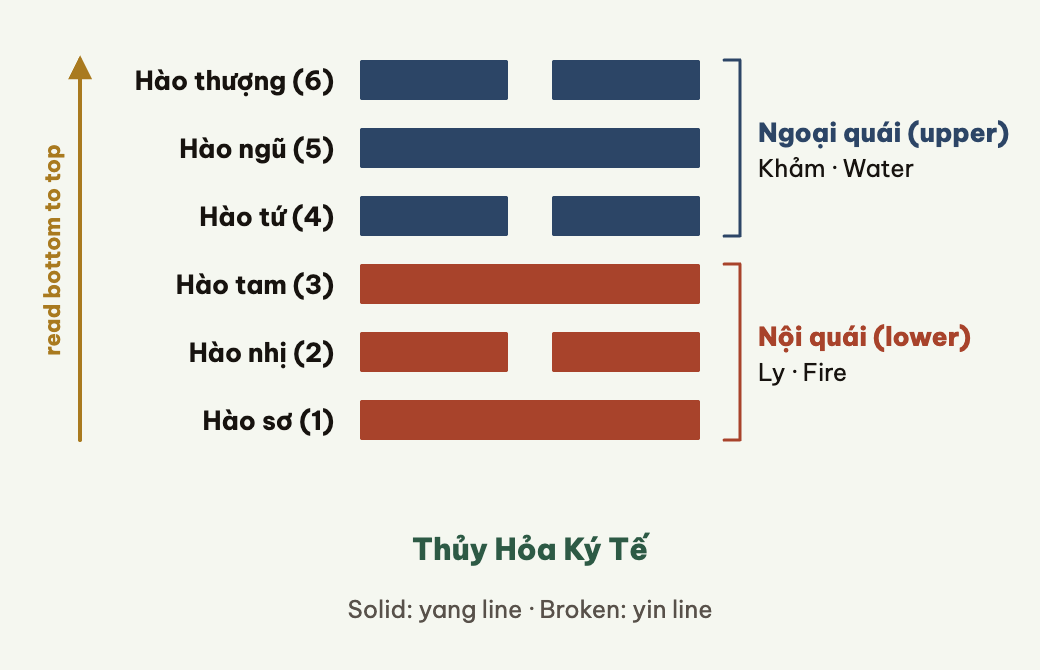
Numbering from the bottom up is not an arbitrary convention. In the view common to the tradition, the bottom line is the root, the foundation, and the top line is the tip, the place of the utmost extreme. When interpreting a hexagram, one follows the movement from the bottom up: from what is just beginning to what has taken shape and become clear. Reading the order wrongly means reading the whole movement of the hexagram wrongly.
Table of the six line positions: yin-yang, the heaven-earth-human tiers, and commonly assigned social roles
Each line position has a fixed yin-yang property, and the tradition commonly assigns it a tier of meaning. The table below gathers the most common assignments.
| Position | Name | Property | Three Powers tier | Commonly assigned social role |
|---|---|---|---|---|
| 1 | First | Yang position | Earth | A scholar newly entering life, foundation, beginning |
| 2 | Second | Yin position | Earth | A great minister in the provinces, one who works directly |
| 3 | Third | Yang position | Human | A mid-level official, the borderline between inner and outer |
| 4 | Fourth | Yin position | Human | A close attendant, one near a superior |
| 5 | Fifth | Yang position | Heaven | The leader, the king, the head |
| 6 | Sixth | Yin position | Heaven | The utmost extreme, one who has left the position or retired |
This assignment of social roles is an interpretive convention, not hard data. Many books use it as a suggestive frame for picturing a situation, rather than asserting that the fifth line in every hexagram is a king in the political sense. Some books also assign lines 3 and 4 to the Human tier, lines 5 and 6 to the Heaven tier, and lines 1 and 2 to the Earth tier, exactly as in the table above.
What is de wei (de zheng)?
De wei, also called de zheng, is when a yang line occupies an odd position (1, 3, 5) or a yin line occupies an even position (2, 4, 6). The opposite is called shi wei or bu zheng.
The mechanism behind it is simple: odd positions are considered yang positions, even positions are considered yin positions. A yang line carries a firm nature, a yin line carries a yielding nature. Firmness placed in a firm spot, yielding placed in a yielding spot, is called "being in the right place". This is a matching of properties, not a complex arithmetical calculation.
It must be said clearly: de wei is a descriptive label of position, not a pronouncement of fortune or misfortune. A line in correct position can still be warned against by its line text, and a line out of position can still be praised. This is where many beginners go wrong.
What is de zhong, and why are the second and fifth lines valued?
De zhong is when a line sits at the middle position of the inner trigram or the outer trigram, that is, lines 2 and 5. Line 2 is the middle of the inner trigram (the lower trigram), line 5 is the middle of the outer trigram (the upper trigram). A line that is both de zhong and de wei, for example jiu wu (a yang line in a yang position, and at the middle of the outer trigram), is regarded as the finest position among all six lines.
According to the book Tuyen tap bai viet Kinh Dich chon loc so 8, jiu wu possesses both de zhong and de zheng, and moreover sits at the central seat belonging to the outer trigram; ancient books call this "the heavenly position", the seat of a sage who holds ruling power. Yet that book also stresses: what makes jiu wu special is not only its lofty rank, but also the virtue bound to it; one who sits high without virtue, even bearing the name jiu wu, is in the end merely a tyrant. In the same vein, Tuyen tap bai viet Kinh Dich chon loc so 5 records that the fifth line is the position of the Son of Heaven, of the leader, and when it is yang it carries a firm and strong nature, and being in a central and correct position it is called "de zhong de zheng".
How does ying between lines 1 and 4, 2 and 5, 3 and 6 work?
Ying is the relation between three pairs of lines symmetrical about the centre of the hexagram: line 1 with line 4, line 2 with line 5, line 3 with line 6. The two lines in a pair correspond when their yin-yang natures differ. If their natures match, it is called "wu ying" or "bu ying".
The easiest example to picture is Water over Fire, Ji Ji. This hexagram consists of the inner trigram Li (line 1 yang, line 2 yin, line 3 yang) and the outer trigram Kan (line 4 yin, line 5 yang, line 6 yin). Considering the three pairs:
- Pair 1-4: line 1 yang, line 4 yin, natures differ, they correspond.
- Pair 2-5: line 2 yin, line 5 yang, natures differ, they correspond.
- Pair 3-6: line 3 yang, line 6 yin, natures differ, they correspond.
All three pairs correspond. That is why Ji Ji is regarded as the hexagram of a rare harmony of positions.
Conversely, Fire over Water, Wei Ji has the inner trigram Kan (line 1 yin, line 2 yang, line 3 yin) and the outer trigram Li (line 4 yang, line 5 yin, line 6 yang). Considering the three pairs:
- Pair 1-4: line 1 yin, line 4 yang, natures differ, they correspond.
- Pair 2-5: line 2 yang, line 5 yin, natures differ, they correspond.
- Pair 3-6: line 3 yin, line 6 yang, natures differ, they correspond.
All three pairs also correspond. The noteworthy point is that Wei Ji, though all six lines are out of position (yang lines in even positions, yin lines in odd positions), still has its three pairs fully corresponding. This shows that de wei and ying are two independent axes of assessment, not substitutes for each other.
Table of line positions in Ji Ji and Wei Ji
Ji Ji and Wei Ji are the classic example pair because they are entirely opposed in de wei. The table below compares them line by line.
| Line | Ji Ji (Water over Fire) | De wei? | Wei Ji (Fire over Water) | De wei? |
|---|---|---|---|---|
| 1 (First) | Yang | Yes | Yin | No |
| 2 (Second) | Yin | Yes | Yang | No |
| 3 (Third) | Yang | Yes | Yin | No |
| 4 (Fourth) | Yin | Yes | Yang | No |
| 5 (Fifth) | Yang | Yes | Yin | No |
| 6 (Sixth) | Yin | Yes | Yang | No |
Ji Ji has all six lines in correct position. Wei Ji has all six lines out of position. But to look only at this table and conclude that Ji Ji is wholly good and Wei Ji wholly bad would overlook the line texts and the correspondences. In fact, the line texts of Ji Ji still contain warnings about caution after the work is done, and the line texts of Wei Ji still point out the path of a completion left unfinished. A good position does not exempt one from risk, a bad position does not block every opportunity.
Bi, cheng and qi: the relation between two adjacent lines
Bi is the relation between two lines lying next to each other. Two adjacent lines of the same yin-yang nature are called bi, understood as two people of the same side, easy to lean on each other. Two adjacent lines of different nature are called "bu bi", or in some books "bi er bu shen".
Cheng and qi are two ways of viewing the same adjacent pair, depending on which line is above which:
- Qi (also written cheng) is when a yin line lies above a yang line. The image is yielding above firm, likened to a soft person sitting on top of a strong one.
- Cheng is when a yin line lies below a yang line, or put another way, a yang line lies above a yin line. The image is firm above yielding.
In many books, qi (yin above yang) is seen as the unfavourable posture, because yielding is not strong enough to control the firm, while cheng (yang above yin) is usually seen as the more favourable posture. Even so, this too is only one layer of labels, and must be set beside the line text, de wei, de zhong and ying to form the full picture.
Where the schools disagree: the meaning-and-principle school values line positions, the image-and-number school and Liu Yao almost ignore them
This is a point that must be stated clearly to avoid absolutising line positions.
The meaning-and-principle school, with names such as Wang Bi and Cheng Yi, places great weight on line positions. For them, a line's position is part of the moral structure of the hexagram, helping to draw ethical and political lessons. De wei, de zhong, ying, bi, cheng and qi are tools for interpreting meaning.
The image-and-number school, and especially the Liu Yao method used in divination practice, almost ignores these labels. According to Tuyen tap bai viet Kinh Dich chon loc so 6, each time a line moves, the Five Elements property of that very line and of the trigram containing it are both carried along; from that movement, the other lines interact on the basis of Five Elements relations. In this way of interpreting, one attends to the moving line, the Shi line, the Ying line, the generating and overcoming of the Five Elements, and the Heavenly Stems and Earthly Branches of the day and hour, rather than taking de wei or de zhong as the main axis. In the same book, in another passage on line positions relating to office, there is mention of the Shi line harmonising with the Year line and of the Shi line generating the Year line, but this usage leans toward generating and overcoming relations and the Kong Wang state rather than the classical de wei label.
In other words, the same six-line system, but each school draws on a different layer of information. A reader of the I Ching should know which school they are reading by, so as not to mix standards.
"Zhong is more precious than zheng" is a viewpoint, not a law
A fairly common saying is "zhong is more precious than zheng", meaning de zhong is more important than de wei. This is an interpretive viewpoint, not a hard law of the I Ching. Some books lean toward exalting de zhong, holding that being at the middle, even if the nature is not yet right, still leaves room to manoeuvre. Some books exalt de wei, holding that the right place is the foundation. Some books place the two factors on equal footing and consider ying, bi, cheng and qi as well.
So when reading an interpretation containing the phrase "zhong is more precious than zheng", one should understand it as that writer's way of arguing, not a theorem every school must follow.
What is the purpose of the site's casting tool printing these labels?
When casting a hexagram, the tool shows which position among the six lines the moving line occupies. Printing the labels de wei, de zhong and ying alongside helps the reader quickly grasp the positional structure of the hexagram without having to calculate it. These labels are descriptive tools, not pronouncements of fortune or misfortune. A line in correct position can still be a warned line, a line out of position can still be a praised line. The value of the label lies in helping place the line correctly within the six-line picture, so that the line text and interpretation can be read more accurately.
Grasping the six line positions also helps one understand why the same line text, when moving in different positions, gives a different impression. A moving line in the fifth position is usually read in the context of the central seat of power, a moving line in the first position is usually read in the context of a beginning still tender. That is why the position labels are printed in the tool.


