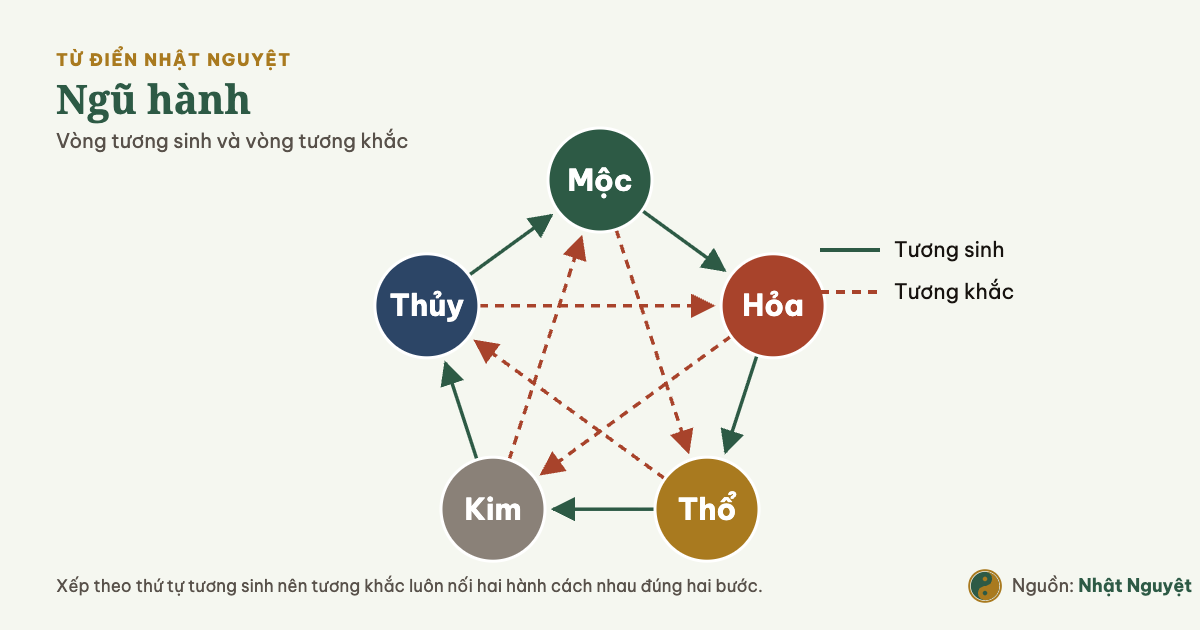
What are the Five Elements?
The Five Elements (五行) refers to five elements: Metal, Wood, Water, Fire, and Earth. These are not five concrete materials but five symbolic categories, each associated with a set of attributes, seasons, directions, colors, and states of movement. This system appeared in ancient Eastern thought and is widely used in feng shui, the I Ching, traditional medicine, and traditional divination.
Origin and usage
The Five Elements emerged from the need to describe the world with simple, observable rules. From five basic factors, ancient people built two relational axes: generation and overcoming. Generation is a nurturing chain: Wood generates Fire, Fire generates Earth, Earth generates Metal, Metal generates Water, Water generates Wood. Overcoming is a controlling chain: Wood overcomes Earth, Earth overcomes Water, Water overcomes Fire, Fire overcomes Metal, Metal overcomes Wood.
In practice, the Five Elements are used to classify colors, directions, materials, numbers, heavenly stems, earthly branches, and even personality traits. For example, a Metal person is often described as clear, logical, and firm; a Wood person is associated with growth and flexibility. Nayin articles such as Sea Gold, Furnace Fire, or Sand Earth show that each element is further divided into different nuances depending on the stem-branch pair.
Distinction from easily confused concepts
The Five Elements differ from Yin and Yang. Yin and Yang are the basic opposing pair, while the Five Elements are five categories operating within that pair. Each element has a yin or yang nature, for example, Geng is Yang Metal, Xin is Yin Metal. The Five Elements also differ from the Eight Trigrams. The Eight Trigrams are eight hexagrams, each also assigned an element, but the trigrams describe hexagram structure and situations, while the Five Elements describe generative and overcoming relationships between categories.
It should be noted that the Five Elements in feng shui and divination are traditional knowledge for reference, not scientifically verified. Readers should approach it as a cultural symbolic system, not as a proven natural law.
Application in life
The Five Elements are applied when choosing colors, materials, desk directions, feng shui stones, or interpreting the nayin of a birth year. However, the degree of application and interpretation may vary among practitioners and schools. The important thing is to maintain a reference mindset and avoid absolutism.