Why do you need to know the special configurations on the Xuan Kong chart?
In Xuan Kong Flying Star, beginners usually stop at two concepts: Wang Shan Wang Xiang (both the mountain star and the facing star are in command) and Shang Shan Xia Shui (the mountain star is in period but the facing star is out of period, or the reverse). In practice, however, other configurations appear interwoven on the chart, and these decide much of the fortune or misfortune of a period. The four groups most often mentioned are:
- Fu Yin and Fan Yin: the inauspicious group, governing stagnation or reversal.
- He Shi: the auspicious group, able to rescue a declining chart when a prosperous facing cannot be established.
- Lian Zhu San Ban Gua: an auspicious group with a warning, prospering first and failing later.
- Qi Xing Da Jie: a powerful group that seizes the qi of future periods, but demands strict conditions.
This article follows the conventions of Xuan Kong studies common in Vietnam, cross-referenced with the Zhong Zhou school and with Shen Zhu Reng's Zhai Yun Xin An (translated by Le Viet Anh). Where schools disagree, the article says so clearly.
How do Fu Yin and Fan Yin differ?
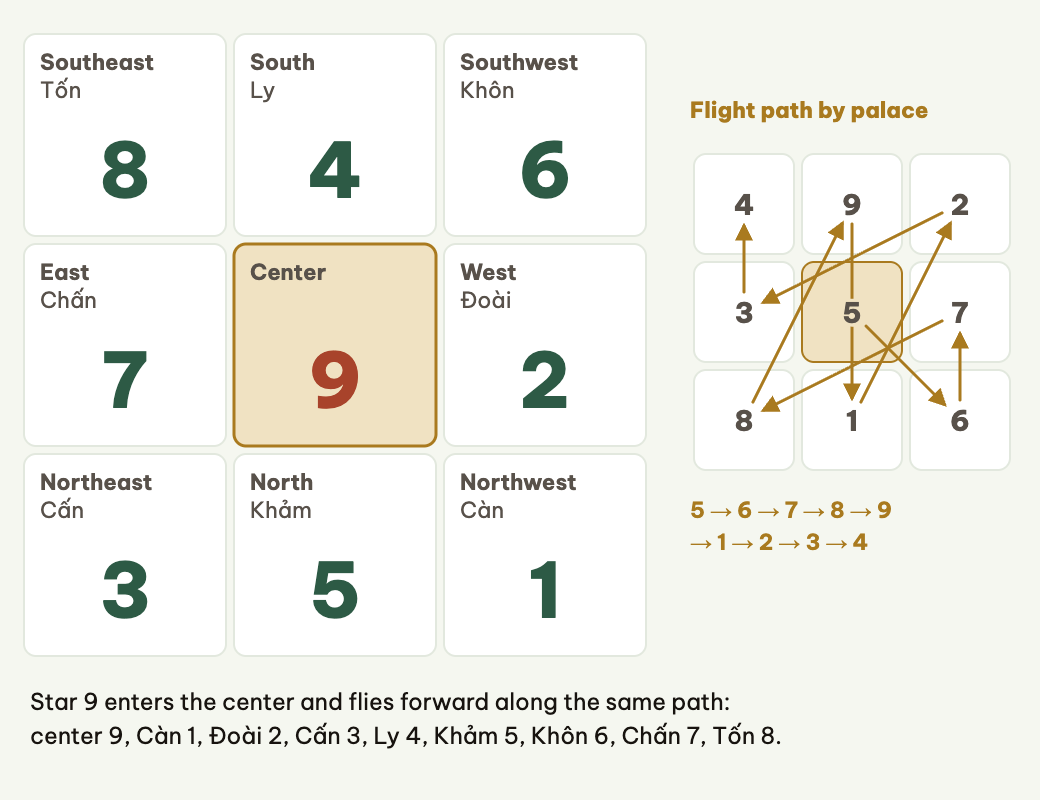
Fu Yin is the phenomenon of the chart standing still, not flying. Fan Yin is the phenomenon of the chart flying in reverse or deviating from its original Luo Shu position. Both are classed as inauspicious, but the mechanism of harm differs.
A reference text describes full-chart Fu Yin as occurring when the mountain star and facing star enter the central palace and fly in the forward direction, leaving all nine palaces unmoved, as in the original Luo Shu. Fan Yin occurs when a palace's mountain star or facing star opposes its original Luo Shu number, or when some palaces on the chart commit Fu Yin.
Two levels must be distinguished: full-chart Fu Yin and partial Fu Yin. Full-chart Fu Yin is the whole chart standing still, affecting the entire dwelling. Partial Fu Yin occurs only in a few palaces, affecting specific rooms or areas. Similarly, Fan Yin has both full-chart and partial forms.
Why are Fu Yin and Fan Yin considered inauspicious?
Fu Yin governs stagnation, deadlock, and repeated work without progress. Fan Yin governs reversal: matters thought finished must be redone, people leave and return, wealth comes in and goes out.
However, the Qi Men Zhi Gui, part 33, discussing Fu Yin in Qi Men, notes that although Fu Yin is static, it can sometimes favor movement. Specifically, if one selects the Jiu Tian Fu Yin, Zhi Fu Fu Yin, or Kai Men Fu Yin, these three types of Fu Yin greatly favor marching, encamping, and crossing dangerous ground. This is a note from Qi Men, not Xuan Kong, but it shows a general principle: an inauspicious phenomenon is not absolutely inauspicious in every context.
In Xuan Kong, Fu Yin and Fan Yin remain unfavorable for residence, but the severity depends on which palace the configuration appears in and whether stars of Sheng Qi or Jin Qi accompany it.
What is He Shi and when can it be used?
According to Shen Zhu Reng's Zhai Yun Xin An, He Shi is the phenomenon of two numbers on the chart summing to 10, or two numbers in opposite palaces forming 10 along the Zi Wu Mao You axis. The book also uses the term Tian Xin Shi Dao for the center of the nine palaces, that is, Wu Huang in the central palace, the meeting point of Sun and Moon.
When a dwelling has full-chart He Shi, meaning every opposite pair sums to 10, then according to Zhai Yun Xin An the whole chart is ventilated. The book says: "the whole chart is ventilated, the two qi of yin and yang, Wu and Ji, have joined, so if the mountain prospers the facing also prospers, and vice versa." That is, when He Shi appears, whether at mountain or facing, it can bring simultaneous development.
Can He Shi rescue Shang Shan Xia Shui?
Zhai Yun Xin An holds that if a house has the Tian Xin Shi Dao configuration, even if it falls into Shang Shan Xia Shui, the whole chart will prosper as long as a suitable Sheng Qi or Jin Qi star appears. Many houses seem to commit serious feng shui errors yet still bring luck to their owners, and this is the reason.
The book also gives examples: sitting Zi facing Wu with Gui Ding Fen Zhen, in period 7, the whole chart is He Shi. Although Zi with Gui in period 7 is not in command, because the numbers match Tian Xin Shi Dao the qi of the hexagram is ventilated and becomes prosperous. Another case: period 5, Gen with Yin, water at Kun palace, water at central palace, Gen mountain number 8, Kun facing number 2, 2 and 8 form Shi Dao, indicating rapid prosperity.
Is He Shi an absolutely auspicious configuration?
No. According to Zhai Yun Xin An, if the terrain prevents establishing a facing in command, one should try to establish a facing matching Tian Xin Shi Dao; even without prosperity, this can rescue decline. The phrase "rescue decline" shows that He Shi is a stopgap, not a full replacement for a prosperous facing.
Lian Zhu San Ban Gua: good first, fails later?
The phenomenon in which every palace on the chart contains combinations of consecutive numbers, forming sequences such as 1-2-3, 2-3-4, 3-4-5, up to 9-1-2, is called Lian Zhu San Ban Gua. The Zhong Zhou school holds that Lian Zhu San Ban Gua is a dangerous configuration; although a compatible dragon may prosper at first, great failure follows. Therefore this configuration should be especially avoided.
San Ban Gua must be distinguished from other phenomena such as Fu Yin and Fan Yin. Both Fu Yin and Fan Yin are dangerous chart types bringing severe disaster. Lian Zhu San Ban Gua is the phenomenon of consecutive numbers spread across the chart, forming a logical sequence but harboring the risk of later decline.
Why does Lian Zhu San Ban Gua carry a warning?
Because the continuity of the numbers creates a strong flow of qi, but that flow has no stopping point. When the period changes, the flow can reverse and carry wealth away. This is why the Zhong Zhou school classes Lian Zhu San Ban Gua as one to avoid, even though in theory it is an auspicious configuration.
Qi Xing Da Jie: a powerful configuration with strict conditions
In Xuan Kong Flying Star, Qi Xing Da Jie is a method whose main purpose is to "seize" the prosperous qi of future periods, according to a reference text. Concretely, in the Lower Yuan (periods 7, 8, 9), by applying Qi Xing Da Jie one can draw in prosperous qi belonging to the Upper Yuan (periods 1, 2, 3) or the Middle Yuan (periods 4, 5, 6).
Wealth and official position are often the domains governed by the Er Wu Ba (2, 5, 8) combination. In literature and art, the Yi Si Qi (1, 4, 7) combination is in prosperity. In the San Liu Jiu (3, 6, 9) combination, nobility is advocated.
Qi Xing Da Jie, according to old texts such as Tian Yu Jing, is described as "the Seven Stars of the Big Dipper go to seize the robber." The movement of the stars backward by seven positions relates to the formation of special number combinations. For example, San Bi (3) counted back seven positions gives Liu Bai (6), and Liu Bai (6) counted back seven positions gives Jiu Zi (9). In a given period, when these three stars (3, 6, 9) gather in suitable palaces, they form a combination and the Qi Xing Da Jie configuration takes shape.
How do true Da Jie and false Da Jie differ?
This is where schools have argued longest. Qi Xing Da Jie in Xuan Kong studies is divided into two main types: true Da Jie and false Da Jie. The distinction rests on the position and interaction of the stars in the Li group (Li, Qian, Zhen palaces) and the Kan group (Kan, Dui, Xun palaces).
When the number combinations of Qi Xing Da Jie, specifically San Ban Gua, appear in palaces of the Li group (Qian, Li, Zhen), that is true Da Jie. For the Zhong Zhou school, "true spirit revealed" is this, meaning the most genuine and powerful expression of the method. Material from the Zhong Zhou school stresses: "Recognize the father-mother San Ban Gua, that is the true spirit revealed; the Big Dipper's seven stars go to seize the robber, the Li palace must combine." Hence true Da Jie forms through the key role of the Li palace.
False Da Jie, meanwhile, is when the number combination appears in the Kan group (Kan, Dui, Xun). The Kan palace has a method of false Da Jie, but the Zhong Zhou school does not use it. Other schools may use it, with differing degrees of strength.
Is Qi Xing Da Jie an absolutely auspicious configuration?
No. Qi Xing Da Jie, according to a reference text, truly forms only when Shuang Xing Hui Zuo or Shuang Xing Hui Xiang appears. This is the prerequisite and cannot be changed. The configuration cannot form if either factor is absent. In the upper volume of Zhong Zhou Xuan Kong, according to Nam Phong's commentary, the Shuang Xing Hui Xiang method is emphasized exclusively. To use Shuang Xing Hui Zuo, several further conditions must be added.
The text also stresses that Qi Xing Da Jie is a pinnacle feng shui configuration, requiring deep knowledge and strict adherence to conditions. It is not a miracle to be used at will, but a subtle blending of li qi, land period, and loan dau. The configuration can only reach full effect when these factors gather completely.
Quick-reference table of 24 sitting-facing directions in periods 8 and 9
The table below lists special configurations that may appear on the chart for the 24 mountain directions in periods 8 and 9. Note: this is a theoretical reference table, based on the calculation core built from LapTinhBanHK. Actual results also depend on external landform and other factors.
| Sitting-Facing | Period 8 | Period 9 |
|---|---|---|
| Zi Wu | Partial He Shi | Partial Fu Yin |
| Gui Ding | Partial Fan Yin | Full-chart He Shi |
| Chou Wei | Partial He Shi | Partial Fan Yin |
| Gen Kun | Partial Fu Yin | Partial He Shi |
| Yin Shen | Full-chart He Shi | Partial Fu Yin |
| Jia Geng | Partial Fan Yin | Partial He Shi |
| Mao You | Partial He Shi | Full-chart Fan Yin |
| Yi Xin | Partial Fu Yin | Partial He Shi |
| Chen Xu | Partial He Shi | Partial Fu Yin |
| Xun Qian | Partial Fan Yin | Full-chart He Shi |
| Si Hai | Full-chart He Shi | Partial Fan Yin |
| Bing Ren | Partial Fu Yin | Partial He Shi |
This table is for reference only. Determining the specific configuration requires detailed calculation for each fen zhen and each case.
When can a rescue configuration be used?
Rescue configurations are those able to neutralize or reduce the ill effects of inauspicious configurations. He Shi is the strongest rescue configuration, able to rescue Shang Shan Xia Shui if a suitable Sheng Qi or Jin Qi star is present. Qi Xing Da Jie can also serve as a rescue configuration in some cases, but demands stricter conditions.
However, a rescue configuration cannot change a bad external landform. If the dragon vein is declining, the water mouth unsuitable, or the loan dau has many flaws, the rescue configuration only reduces harm and cannot fully reverse it. The principle of "form and principle combined" means that no matter how beautiful the chart, the external terrain must match for full effect.
Where do the schools disagree?
There are at least three main points of debate:
- True Da Jie and false Da Jie: the Zhong Zhou school uses only true Da Jie in the Li group, not false Da Jie in the Kan group. Other schools may use both, with differing degrees of strength.
- Fu Yin and Fan Yin: some texts hold that Fu Yin is inauspicious only when full-chart, others that partial Fu Yin is enough to cause harm.
- Lian Zhu San Ban Gua: the Zhong Zhou school classes it as one to avoid, but some other schools hold that if the dragon is compatible it can still be used in the early period.
This article does not assert which school is absolutely correct. Readers should consult multiple sources and check against reality.
Conclusion
Fu Yin, Fan Yin, He Shi, Lian Zhu San Ban Gua, and Qi Xing Da Jie are special configurations on the Xuan Kong chart. Each has its own conditions of appearance, its own mechanism of fortune or misfortune, and its own limits. No configuration is absolutely auspicious or absolutely inauspicious. A rescue configuration can reduce harm but cannot change a bad external landform. Where schools disagree, this must be stated clearly to avoid misunderstanding.