What is a Xuan Kong Flying Star chart and why must it be built step by step?
A Xuan Kong Flying Star chart is a nine-palace diagram, each palace containing three numbers: the period star, the mountain star, and the facing star. This diagram is used to describe the distribution of qi according to time (the period) and according to direction (mountain and facing) of a house. According to Wikipedia, Xuan Kong Flying Star is the integration of yin and yang, the interaction of the five elements, the eight trigrams, the Luo Shu numbers, and the 24 mountains, using time, space, and objects to build a chart for analyzing the good or bad qi of a building. This lineage was popularized in the Qing dynasty by Shen Zhu Reng with the book Zhai Yun Xin An (translated by Le Viet Anh).
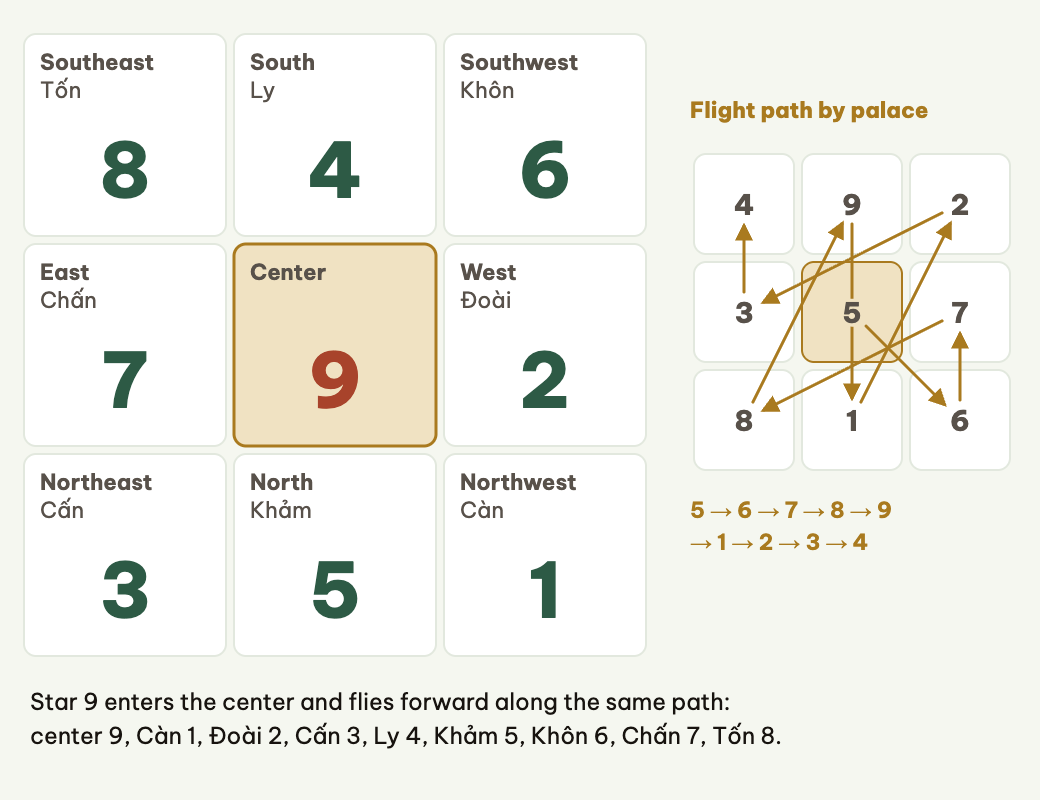
The three layers of stars are not set at the same time in the same way. The period chart always flies forward, without considering yin or yang. Only the mountain chart and the facing chart must consider the yin or yang of the San Yuan Long to decide forward or reverse flight. This is the point that makes many beginners set it wrong right from the second step.
Why does the period chart always fly forward while the mountain and facing charts must consider yin and yang?
The period star is the star of the time period; it is not attached to a specific mountain, so it has no yin or yang to consider, and therefore it always enters the center and flies forward along the Luo Shu path. In contrast, the mountain chart takes the number of the sitting palace and the facing chart takes the number of the facing palace; these two numbers are attached to specific mountains, so the yin or yang of the San Yuan Long of that mountain must be considered. The book Zhai Yun Xin An clearly records the San Yuan Long rule as follows:
- Earth Yuan Long: yang is Giáp, Canh, Nhâm, Bính; yin is Thìn, Tuất, Sửu, Mùi.
- Heaven Yuan Long: yang is Càn, Khôn, Cấn, Tốn; yin is Tý, Ngọ, Mão, Dậu.
- Human Yuan Long: yang is Dần, Thân, Tỵ, Hợi; yin is Quý, Đinh, Ất, Tân.
Yang flies forward, yin flies reverse. Note: this is the yin-yang convention of Xuan Kong, different from the way the 24 mountains are divided into yin and yang in Tam Hợp. The book Zhai Yun Xin An also records that the 12 earthly branches are arranged clockwise according to the 12 solar terms, with six opposing pairs Tý Ngọ, Mão Dậu, Thìn Tuất, Sửu Mùi, Dần Thân, Tỵ Hợi, and the 10 heavenly stems are placed according to the yin-yang five elements of the direction: Giáp yang wood sits to the left of Mão, Ất yin wood sits to the right of Mão, Bính yang fire to the left of Ngọ, Đinh yin fire to the right of Ngọ.
What order does the Luo Shu flight path follow?
According to Wikipedia, the stars always move in this order: down to the lower right (northwest), to the right middle (west), down to the lower left (northeast), up to the upper middle (south), down to the lower middle (north), up to the upper right (southwest), to the left middle (east), up to the upper left (southeast), then back to the center. This is the flight path of the nine stars on the Luo Shu chart, and it is the path used for the period chart, the mountain chart, and the facing chart alike.
In other words, when a number enters the center, its next number (in the cycle from 1 to 9) goes into the northwest palace, then west, then northeast, then south, then north, then southwest, then east, then southeast. Reverse flight goes backward along this order.
Building a Period 9 chart for a house sitting Tý and facing Ngọ: step by step
This is a complete example to see how all three layers of stars are set. A house sitting Tý and facing Ngọ means the back of the house faces north (mountain Tý) and the front of the house looks south (facing Ngọ).
Step 1: set the period chart
Period 9 has period star 9. Place the number 9 in the center palace and fly forward along the Luo Shu path. The resulting Period 9 period chart:
| Palace | Southeast | South | Southwest |
|---|---|---|---|
| 5 | 1 | 3 |
| Palace | East | Center | West |
|---|---|---|---|
| 4 | 9 | 7 |
| Palace | Northeast | North | Northwest |
|---|---|---|---|
| 8 | 6 | 2 |
Step 2: take the number of the sitting palace to set the mountain chart
The sitting palace is the north palace. In the period chart just set, the north palace carries the number 6. So take the number 6 into the center palace of the mountain chart. The sitting mountain is Tý. According to the San Yuan Long convention above, Tý belongs to the Heaven Yuan Long and is yin. Yin flies reverse. The mountain chart flies reverse from the number 6:
| Palace | Southeast | South | Southwest |
|---|---|---|---|
| 7 | 2 | 9 |
| Palace | East | Center | West |
|---|---|---|---|
| 8 | 6 | 4 |
| Palace | Northeast | North | Northwest |
|---|---|---|---|
| 3 | 1 | 5 |
Step 3: take the number of the facing palace to set the facing chart
The facing palace is the south palace. In the period chart, the south palace carries the number 1. So take the number 1 into the center palace of the facing chart. The facing mountain is Ngọ. Ngọ belongs to the Heaven Yuan Long and is yin, so it also flies reverse. The facing chart flies reverse from the number 1:
| Palace | Southeast | South | Southwest |
|---|---|---|---|
| 2 | 6 | 4 |
| Palace | East | Center | West |
|---|---|---|---|
| 3 | 1 | 8 |
| Palace | Northeast | North | Northwest |
|---|---|---|---|
| 7 | 5 | 9 |
Step 4: combine the three layers of stars into a complete chart
Combine the period star (large, center), the mountain star (small, left), and the facing star (small, right) into each palace. According to the presentation in Zhai Yun Xin An, the number written large in the palace is the heavenly star of the period, the small number on the left is the flying star of the mountain chart, and the small number on the right is the flying star of the facing chart. We get:
| Palace | Southeast | South | Southwest |
|---|---|---|---|
| 7 5 2 | 2 1 6 | 9 3 4 |
| Palace | East | Center | West |
|---|---|---|---|
| 8 4 3 | 6 9 1 | 4 7 8 |
| Palace | Northeast | North | Northwest |
|---|---|---|---|
| 3 8 7 | 1 6 5 | 5 2 9 |
Reading the configuration from the Period 9 chart sitting Tý and facing Ngọ
Period 9 takes star 9 as the prosperous star. For a house sitting Tý and facing Ngọ, star 9 is in the center palace, not in the sitting palace or the facing palace, so this is not the configuration of reaching both mountain and facing (the prosperous star arriving at both sitting and facing at the same time). This configuration is also not double stars meeting at the facing (the prosperous star and the mountain star both arriving at the facing) or double stars meeting at the sitting (the prosperous star and the mountain star both arriving at the sitting).
The configurations reaching both mountain and facing, double stars meeting at the facing, double stars meeting at the sitting, and upper mountain lower water are the four configurations most mentioned in Xuan Kong books. Reaching both mountain and facing is when the prosperous star flies to both the sitting palace and the facing palace at the same time, usually regarded as the ideal configuration for both people and wealth. Upper mountain lower water is the opposite case: the prosperous star of the facing flies to the sitting palace, and the prosperous star of the mountain flies to the facing palace, usually regarded as depletion. Double stars meeting at the facing is when the prosperous star and the mountain star of the current period both fly to the facing palace. Double stars meeting at the sitting is when the prosperous star and the mountain star of the current period both fly to the sitting palace.
It must be emphasized: this is a reading based on li qi (pattern principles). Many Xuan Kong books hold that li qi is only half, and that the form aspect (the surrounding mountain and water terrain) decides the actual fortune. A beautiful chart without suitable terrain may still fail to manifest, or even backfire.
Why is the number 5 entering the center a point where books often differ?
When the mountain star or the facing chart falls on the number 5, that is, the number 5 enters the center, it no longer belongs to a specific trigram to look up yin and yang, so a separate convention must be used. The book Zhai Yun Xin An records: "2, 5 enter the center, controlling inward, auspicious; 9, 1 enter the center, generating outward, inauspicious; 6 enter the center, controlling outward, inauspicious" for the group of Nhị Hắc, Ngũ Hoàng, Bát Bạch Earth destiny. Other destiny groups (Tam Bích Tứ Lục Wood, Lục Bạch Thất Xích Metal, Cửu Tử Fire, Bát Bạch Water, etc.) also have their own tables, and each table gives different auspicious or inauspicious results when the number 5 enters the center.
Some books take the number 5 and place it in the Khôn palace or the Cấn palace to look up yin and yang; other books stipulate that 5 entering the center always flies forward. There is no absolute consensus among the schools on this point. Readers should know which convention this article follows before applying it, rather than assuming there is only one correct way.
Table of the 24 mountains with Yuan Long and yin-yang according to the Shen lineage
The table below is built by the site's calculation core, compiling the 24 mountains by San Yuan Long and yin-yang used for Xuan Kong. This table differs from the yin-yang table of the 24 mountains used in Tam Hợp, so they should not be mixed.
| Mountain | Yuan Long | Yin-Yang |
|---|---|---|
| Tý | Heaven | Yin |
| Ngọ | Heaven | Yin |
| Mão | Heaven | Yin |
| Dậu | Heaven | Yin |
| Càn | Heaven | Yang |
| Khôn | Heaven | Yang |
| Cấn | Heaven | Yang |
| Tốn | Heaven | Yang |
| Giáp | Earth | Yang |
| Canh | Earth | Yang |
| Nhâm | Earth | Yang |
| Bính | Earth | Yang |
| Thìn | Earth | Yin |
| Tuất | Earth | Yin |
| Sửu | Earth | Yin |
| Mùi | Earth | Yin |
| Dần | Human | Yang |
| Thân | Human | Yang |
| Tỵ | Human | Yang |
| Hợi | Human | Yang |
| Quý | Human | Yin |
| Đinh | Human | Yin |
| Ất | Human | Yin |
| Tân | Human | Yin |
This table is only correct for houses with a cardinal facing; what about deviating houses?
The chart table at the end of the article is only correct for houses with a cardinal facing, that is, houses whose sitting and facing fall entirely within one mountain, also called xia gua. When a house deviates by more than three degrees, meaning the sitting or facing crosses into the neighboring mountain, many books use the substituted gua instead of directly using the original mountain. The handling of deviating houses is not consistent among books: some take the deviating mountain as the main mountain, some use a substitute trigram, and some only allow deviation within a certain degree limit. Readers need to consult the convention of their own book before interpreting.
The Luo Shu and the 24 mountains behind this method
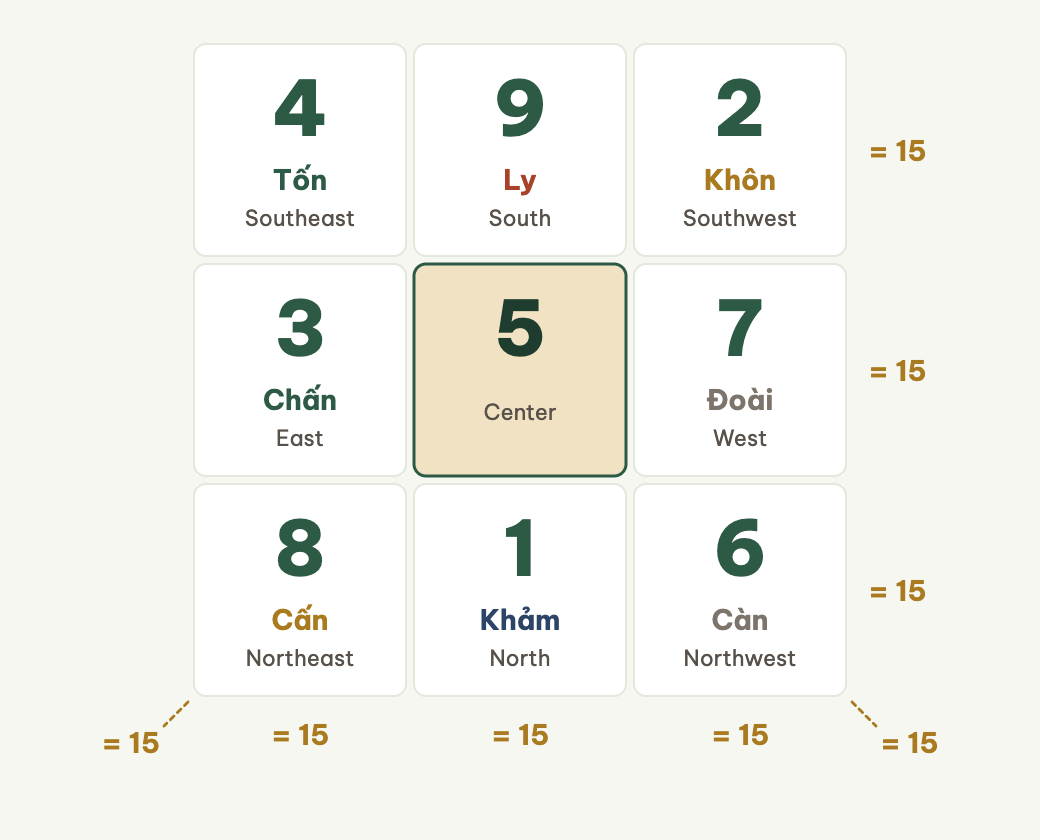
The numbers used in the chart are the numbers of the Luo Shu. According to Wikipedia, the Luo Shu is a third-order magic square, where the sum of the three numbers in each row, each column, and each diagonal equals 15. The number 5 is at the center, and the sum of two cells symmetric through 5 always equals 10. Legend says that King Yu in ancient times was controlling floods when a divine turtle emerged from the Luo River with the Luo Shu pattern on its shell. The Luo Shu is often used together with the He Tu in geography, numerology, and philosophy. In common usage, the number 1 is placed at the bottom (north) and the number 9 at the top (south), corresponding to the Khảm trigram and the Ly trigram in the Later Heaven eight trigrams.
The 24 mountains on the luopan are the subdivision of the eight directions into 24 mountains, three mountains per direction. According to Wikipedia, each direction is divided into three zones, for example the south direction includes Bính, Ngọ, Đinh with degree ranges 157.6 to 172.5; 172.6 to 187.5; and 187.6 to 202.5. Bính is yang; Ngọ and Đinh are yin. This degree division is the basis for determining which mountain the sitting and facing belong to before building the chart.
Measure the direction before building the chart
According to Wikipedia, the direction must be measured accurately before doing any feng shui system. A feng shui compass is used to determine the exact direction of a building. The most important ring on the compass is the 24-mountain ring. For a house, the direction is determined by the facade that receives the most yang qi; for an apartment, the direction of the unit is usually taken from the direction of the whole building, or from the side with the busiest foot traffic if the building has no clear facade. Measurement error will lead to a wrong mountain, and a wrong mountain means the chart built is also wrong, so the direction measurement step cannot be taken lightly.
This article does not assert absolute fortune for any sitting or facing. The configurations mentioned above are readings based on the li qi of the Xuan Kong lineage; actual results also depend on the form, timing, and many other factors.
A sample chart: Period 9, sitting Tý facing Ngọ
The chart below is built by the same method Nhat Nguyet uses in its Xuan Kong tables, arranged in the nine Luo Shu cells with south on the top row as in ancient books. Each cell records the period star, mountain star, and facing star. This house belongs to the configuration: Double stars reaching the sitting.
| Tốn, Southeast: period 8, mountain 6, facing 3 | Ly, South: period 4, mountain 1, facing 8 | Khôn, Southwest: period 6, mountain 8, facing 1 |
|---|---|---|
| Chấn, East: period 7, mountain 7, facing 2 | Center: period 9, mountain 5, facing 4 | Đoài, West: period 2, mountain 3, facing 6 |
| Cấn, Northeast: period 3, mountain 2, facing 7 | Khảm, North: period 5, mountain 9, facing 9 | Càn, Northwest: period 1, mountain 4, facing 5 |