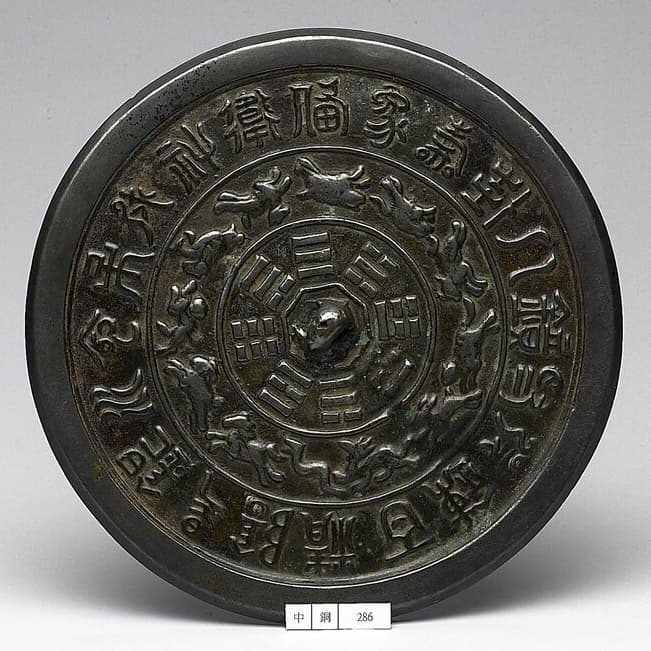
What is the I Ching?
The I Ching, often called the Book of Changes, is one of the oldest and most profound texts of humanity. Unlike purely philosophical works, the I Ching does not present doctrines through lengthy arguments but uses a unique system of symbols: yang lines (solid ,) and yin lines (broken --). From these two basic symbols, the ancients built the Eight Trigrams (bagua), then combined them into 64 hexagrams, covering all rules of change in heaven, earth, and human life.
If we consider the universe as a supreme ultimate (taiji) , the primordial state , then the supreme ultimate gives rise to two opposing energies: yin and yang (liangyi). These two energies constantly interact, push, and rub against each other, creating all movement. This interaction is encoded into the hexagrams, and the I Ching serves as a mirror reflecting the laws of the universe, helping humans understand the world and themselves.
Origins of yin and yang lines
Yin and yang lines , the foundation of the I Ching
The first question any student of the I Ching asks: why are there solid and broken lines? Many Chinese scholars have proposed theories, but most remain unconvincing.
Theory of sexual symbolism: According to Guo Moruo, the yang line symbolizes the male phallus, the yin line the female vulva , remnants of ancient fertility worship. This gave rise to concepts of male/female, father/mother, yin/yang, hard/soft. However, this explanation is heavily sexual and does not explain why a trigram needs three lines.
Theory of divination numbers: Some believe the lines originated from yarrow stalk divination , using 50 stalks, after three transformations one obtains numbers 36, 32, 28, 24; dividing by 4 yields 9, 8, 7, 6. Odd numbers (9, 7) are yang, even (8, 6) are yin, thus converted into solid and broken lines. But as many researchers point out, numbers and symbols are only analogous, not identical , divination uses numbers to predict, while the I Ching originates from symbols. Without the symbols of yin and yang lines, the I Ching would not exist.
Theory of oracle bone numerals: Zhang Zhenglang, based on numeral groups on Shang oracle bones, proposed that the number 1 (yi) became a yang line, and number 6 (liu, written as /\ ) became a yin line. But the group of Zhu Bokun refuted this: using numbers like 1, 5, 6, 7, 8 cannot explain why the I Ching has exactly 8 trigrams and 64 hexagrams , mathematically, only 2^3 = 8 combinations of two line types when arranged in threes, and 8^2 = 64 when doubling trigrams. Different numbers cannot produce such a consistent system.
Hints from Dong Son bronze drums
An interesting direction comes from Vietnamese archaeology. On Dong Son bronze drums, researchers have found patterns of lines and dots on boat sides and drum surfaces , possibly images of yin and yang lines. This suggests that ancient Vietnamese used solid and broken line symbols very early, before the I Ching was widely spread in China. However, caution is needed: the link between drum patterns and hexagram lines remains hypothetical, lacking direct evidence.
Philosophy of Yin-Yang and the Eight Trigrams
Yin-Yang , the two fundamental forces
The philosophy of the I Ching revolves around yin-yang , two opposing yet complementary aspects: day and night, hot and cold, male and female, strong and weak. Yin and yang are not static but constantly transform: when yang reaches its peak, yin arises; when yin peaks, yang arises. Their interaction creates the Five Elements and all things.
In the I Ching, yin and yang are represented by broken (--) and solid (-) lines. Each trigram has three lines, each hexagram six lines. The order from bottom to top symbolizes development from inner to outer, from root to branch.
The Eight Trigrams , eight fundamental states
From the two lines, the ancients stacked three lines to form 2^3 = 8 combinations, called the Eight Trigrams. Each trigram has a name, a natural symbol, and a philosophical meaning:
| Trigram | Name | Symbol | Meaning |
|---|---|---|---|
| Qian (☰) | Heaven | Creative, strong | |
| Kun (☷) | Earth | Receptive, nurturing | |
| Zhen (☳) | Thunder | Arousing, awakening | |
| Xun (☴) | Wind | Penetrating, spreading | |
| Kan (☵) | Water | Dangerous, wisdom | |
| Li (☲) | Fire | Clarity, illumination | |
| Gen (☶) | Mountain | Stillness, obstruction | |
| Dui (☱) | Lake | Joy, exchange |
The eight trigrams move in two great circles: the Former Heaven Sequence (Xiantian) and the Later Heaven Sequence (Houtian). The Former Heaven sequence describes the universe before human intervention, while the Later Heaven sequence reflects the flow of life in the phenomenal world. (Some sources mention a Middle Heaven sequence, but it is not widely circulated.)
The 64 Hexagrams , a comprehensive picture of the universe
By stacking two trigrams, one obtains 8 × 8 = 64 hexagrams, each with six lines. Each hexagram represents a specific life situation, from governing a country to daily interactions. The I Ching does not give absolute right or wrong answers but indicates developmental tendencies based on the interaction of lines.
For example, hexagram Qian (Heaven) consists of six yang lines, symbolizing powerful creativity, but the advice is to remain humble, not to be overly strong. Hexagram Kun (Earth) has six yin lines, emphasizing compliance and nurturing, but also requires perseverance. The combination of yin and yang in each hexagram creates subtle advice, reflecting the dialectical worldview of the ancients.
Symbolic language of the I Ching
What makes the I Ching a classic is its symbolic language , with only two signs, yet possessing multi-functional power like a magic wand. Yin and yang lines are not just drawings but contain a whole philosophical system of movement and transformation. Through symbols, students of the I Ching can contemplate matters from multiple angles, seeing opposites within a whole.
The I Ching also teaches flexible behavior: nothing is permanent; everything transforms. When facing difficulties (a bad hexagram), remember that hardship will pass; when prospering (a good hexagram), beware of decline. This is a philosophy of balanced, harmonious living between yin and yang.
The I Ching in Vietnamese cultural context
Some hypotheses suggest that the I Ching originated in Vietnam, based on patterns on Dong Son bronze drums. However, this remains controversial and requires more archaeological and linguistic research. Regardless of origin, the I Ching has deeply influenced Vietnamese culture through traditional medicine, feng shui, martial arts, and life philosophy. Vietnamese people have long used the I Ching for choosing auspicious days, orienting houses, or interpreting life events.
Conclusion
The I Ching is not merely a divination book but a philosophical system about the dynamics of the universe. Understanding the origins of yin and yang lines helps us appreciate the subtlety of ancient thought. Although theories about its origins remain unsettled, the value of the I Ching lies in its dialectical method, adaptability, and viewing everything in the relationship of yin and yang , a lesson still relevant today.