
What is Đào Hoa in Bát Tự and why is it also called Hàm Trì?
Đào Hoa in Bát Tự (Tứ Trụ) is a thần sát indicating personal magnetism, the destiny of encounters, and the ability to attract others, especially in romantic relationships. Its other name is Hàm Trì, and when it is seen as unfavorable it is called Đào Hoa Sát. The book Uyên Hải Tử Bình Toàn Tập states clearly: "Đào Hoa is Hàm Trì Sát, governing lust, seen at Tý Ngọ Mão Dậu," meaning the old text locates Đào Hoa only within the four branches Tý, Ngọ, Mão, Dậu.
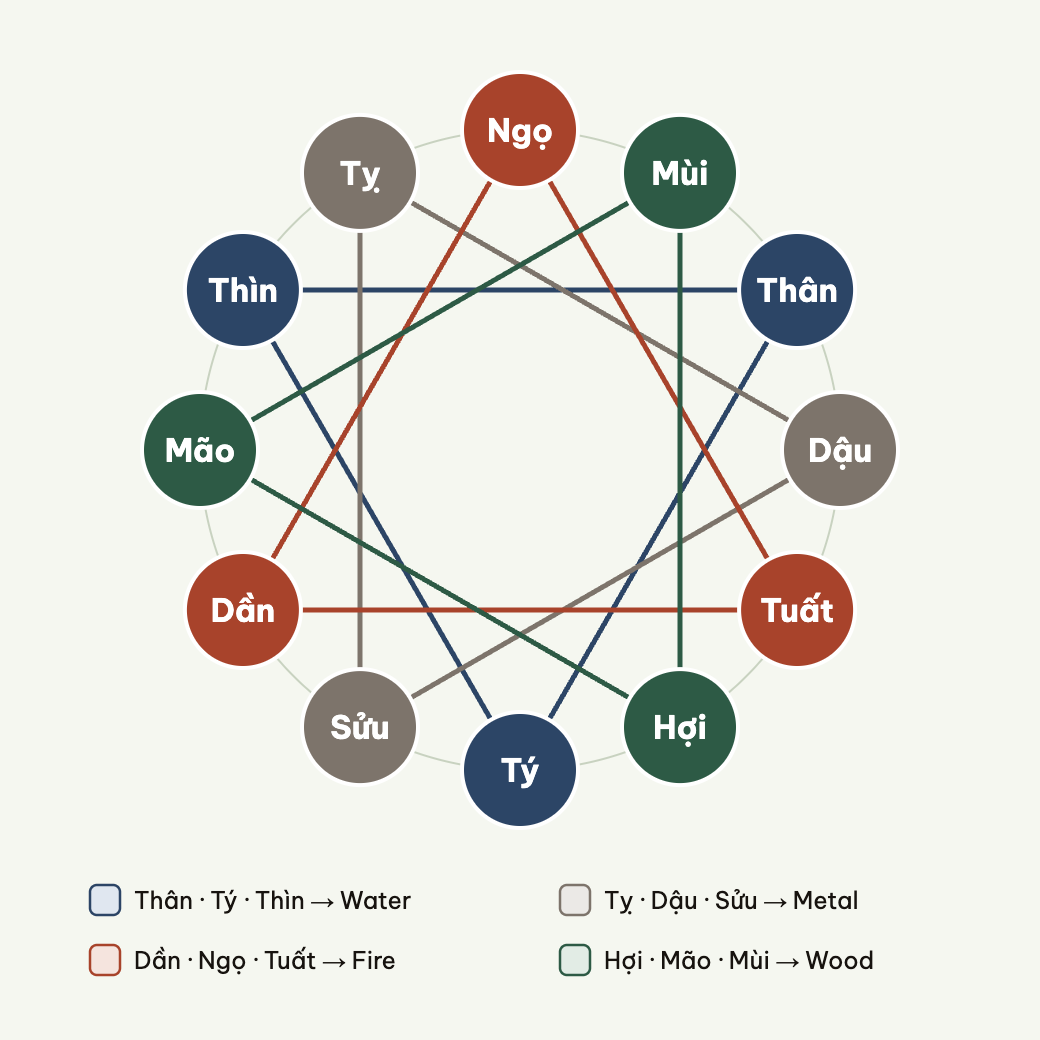
One thing must be separated at once: Đào Hoa is a thần sát in Bát Tự, different from Đào Hoa in Tử Vi Đẩu Số. In Tử Vi, Đào Hoa is only one of four star groups carrying đào hoa energy, alongside Tham Lang, Thiên Riêu, and Hồng Loan, and is read by palace. In Bát Tự, Đào Hoa is found by the branch of the year pillar or day pillar, then compared with the remaining branches.
Mechanism: why does Đào Hoa always fall on Tý Ngọ Mão Dậu?
Đào Hoa is not an arbitrary convention, but stems from the Mộc Dục rule of the Five Elements. Each tam hợp cục has one Mộc Dục character, and that character is the Đào Hoa position of that cục. Because the four tam hợp cục in turn yield the four Mộc Dục characters Dậu, Ngọ, Mão, Tý, Đào Hoa always sits within Tý Ngọ Mão Dậu.
Mộc Dục means bathing, the young stage where all things begin to sprout. By this interpretation, Đào Hoa carries the flavor of new vitality, abundant essence, sharpness, and the capacity to absorb. One way of arguing stresses this point: Hàm Trì is the Mộc Dục position of each cục, carrying the meaning of beginning and potential, so a person with Đào Hoa often has special ability in fields requiring creativity and sensitivity. This is the positive reading, unlike the purely "lustful" label of some old editions.
Đào Hoa lookup table by the 12 root branches
How to look it up: take the year branch or day branch as the root, see which tam hợp it belongs to, then derive the Đào Hoa branch. The table below is built directly from the core of tam hợp calculation, and the hàm daoHoaViTri of the Tử Vi core yields the same result, so both systems can share one table.
| Root branch (year or day) | Tam hợp | Đào Hoa branch (Hàm Trì) |
|---|---|---|
| Thân | Thân Tý Thìn | Dậu |
| Tý | Thân Tý Thìn | Dậu |
| Thìn | Thân Tý Thìn | Dậu |
| Dần | Dần Ngọ Tuất | Mão |
| Ngọ | Dần Ngọ Tuất | Mão |
| Tuất | Dần Ngọ Tuất | Mão |
| Tỵ | Tỵ Dậu Sửu | Ngọ |
| Dậu | Tỵ Dậu Sửu | Ngọ |
| Sửu | Tỵ Dậu Sửu | Ngọ |
| Hợi | Hợi Mão Mùi | Tý |
| Mão | Hợi Mão Mùi | Tý |
| Mùi | Hợi Mão Mùi | Tý |
Compared with the Tướng Tinh cycle in Tử Vi: the method of placing Tướng Tinh is also calculated by the tam hợp position of the year branch, and Đào Hoa (Hàm Trì) is one stage in that cycle. According to discussion sources on Lý số Việt Nam, the Tướng Tinh cycle starts at Ngọ with Dần Ngọ Tuất, at Tỵ with Thân Tý Thìn, at Dậu with Tỵ Dậu Sửu, at Mão with Hợi Mão Mùi, then moves forward. Three stars of this cycle appear in Vietnamese Tử Vi charts: Đào Hoa (Hàm Trì), Hoa Cái, and Kiếp Sát, with Đào Hoa always at Tý Ngọ Mão Dậu. Thus the Bát Tự lookup table and the Tử Vi star placement match, differing only in the name given to the stage.
How do Đào Hoa inside the wall and outside the wall differ?
Đào Hoa inside the wall is Đào Hoa in the year pillar or month pillar, while Đào Hoa outside the wall is Đào Hoa in the day pillar or hour pillar. This division is based on pillar position, and each side is assigned a different tendency.
According to common interpretation experience in Tứ Trụ circles, Đào Hoa inside the wall governs deep marital affection and a harmonious family. Đào Hoa outside the wall, especially in the hour pillar, is seen as easily drawn to outside relationships, romantic and flirtatious, and the female chart is usually considered more adversely affected than the male chart. The folk saying "a flower outside the wall is there for anyone to pick" sums up this idea.
However, this boundary is not absolute. One way of arguing notes: a person with Đào Hoa in the day pillar but meeting a strong Quan tinh, with Ấn tinh to dissolve it, can still have a happy family. The difficulty is that one must look at the whole: whether Đào Hoa is clashed or broken, whether it meets hình or Không Vong. If it meets Không Vong, the effect of Đào Hoa is greatly reduced, even becoming harmless. If it meets Kình Dương in the same pillar, the old text says the body is easily weakened.
Which schools find Đào Hoa by the year branch and which by the day branch?
This is where schools disagree, and this article does not choose for the reader. There are two main methods:
- By year branch: take the branch of the year pillar as the root to derive the Đào Hoa branch. This method is tied to placing stars by year branch in Tử Vi and to many old editions that use the birth year as the marker.
- By day branch: take the branch of the day pillar as the root. This method emphasizes the position of the self, holding that the day branch directly reflects the person and marriage.
The book Uyên Hải Tử Bình Toàn Tập, when discussing mother and wife or concubine, mentions "Ấn arriving at the Đào Hoa mộc dục land" and "Tài arriving at the mộc dục Đào Hoa land," meaning the book uses the Mộc Dục character as the marker rather than fixing one pillar. So in practice, many people look up both roots and compare: where they coincide, confidence increases; where they differ, other factors of the four pillars must be examined.
Is Đào Hoa a bad star? The old view and the modern view
Old texts label Hàm Trì with the word "lust" and make separate judgments for female charts, for instance holding that Đào Hoa in certain positions is a sign of impropriety. It must be said clearly: that is the view of books in the context of old ritual ethics, not a judgment about the reader today. The ancients valued ritual ethics, so anything related to wine and sex was placed in the bad group, and that labeling reflects the standards of the era more than the nature of the star.
From another angle, one way of arguing describes Đào Hoa as a star carrying romance, charm, and personal magnetism, able to create grace and good communication skills. The same book also warns that when Đào Hoa is too strong or combines with bad stars such as Kiếp Sát, it easily becomes Đào Hoa Sát, leading to dissipation and romantic trouble. Thus the documents themselves do not say Đào Hoa is fixedly good or bad, but depend on the combination.
In essence, Đào Hoa mainly means magnetism and the destiny of encounters. It can be a good destiny in marriage, and it can be trouble if accompanied by unfavorable factors. One should not read a single Đào Hoa character and then conclude about a person's morality or happiness.
How does Đào Hoa combine with other stars?
Some ways of arguing point to these notable combinations:
- Hàm Trì meeting Kình Dương in the same pillar: the old text says the body is easily weakened by unrestrained lust.
- Hàm Trì meeting Thất Sát: often tied to artistic professions, women as singers, men as actors.
- Hàm Trì with Chính Tài in one pillar: the book says it governs lustfulness and extravagant spending.
- Hàm Trì meeting Mộc Dục and Tiến thần: beauty is said to be lovely but lustful.
- Đào Hoa dislikes hình and phá, but meeting Không Vong partly dissolves it.
These are combinations recorded in books, not immutable rules. When interpreting, they must be placed in the whole four pillars and đại vận, avoiding cutting one combination out to judge a fate.
Đào Hoa in Tử Vi and other kinds of đào hoa
Many popular books say there are over 20 different kinds of Đào Hoa. Among them, Hồng Diễm is found by stem, while Hồng Loan is a different star, not in the group found by tam hợp branch like Hàm Trì. Here they are only named so the reader can distinguish them, without going deep, because each kind has its own lookup method.
As for Đào Hoa of Tử Vi Đẩu Số, it is one of four đào hoa star groups, comprising Tham Lang, Thiên Riêu, Hồng Loan, and Đào Hoa, and is read by palace. According to the book Đẩu số tinh thành Tập 1, whichever palace the Đào Hoa star gathers in carries the meaning of that palace: Mệnh palace means both thought and action, Tử Tức palace leans toward lust, Phu Thê palace leans toward love and affairs, Tật Ách palace leans toward physical contact, Phúc Đức palace leans toward thought with little action, Nô Bộc palace leans toward attraction from outside, Thân palace means outward beauty and magnetism. This book also divides Đào Hoa into inner and outer: inner Đào Hoa governs romance between husband and wife, outer Đào Hoa governs love outside marriage.
Thus the same word Đào Hoa has different lookup and reading methods in Bát Tự and Tử Vi. Learners should separate the two systems, avoiding applying one system's lookup table directly to the other.
Practical conclusion
Đào Hoa (Hàm Trì) in Bát Tự is found by the tam hợp of the year branch or day branch, always yielding one of the four branches Tý Ngọ Mão Dậu, because that is the Mộc Dục character of the cục. Pillar position determines whether it is called inside or outside the wall, but the final judgment must rest on the whole four pillars, accompanying stars, clash and break, hình, Không Vong, and đại vận. Schools still differ on whether to use the year branch or day branch as the root, so learners should look up both and state clearly which convention they follow. In essence, Đào Hoa speaks of magnetism and the destiny of encounters, not a verdict on a person's morality or happiness.


