
What is the Earth over Heaven Tai hexagram and where does it sit among the 64?
Earth over Heaven Tai is the eleventh hexagram in the 64 hexagram I Ching system according to the King Wen sequence. Its Chinese name is 地天泰, its Unicode symbol is ䷊. The hexagram has six lines, three yang lines below and three yin lines above, arranged in balance. The inner trigram (lower) is Qian ☰, the image of heaven; the outer trigram (upper) is Kun ☷, the image of earth. In familiar usage, this is the hexagram of success, of a favorable time.
A clear distinction is needed: the hexagram name is read Tai (泰), not the Tai of excess. The original meaning of 泰 is opening, peace, vastness. Old texts explain Tai as opening, as favorable, as great peace.
As for its place in the sequence, Tai sits between two hexagrams in the Treatise on the Sequence. Before it is Li (Heaven over Lake Li, hexagram 10), after it is Pi (Heaven over Earth Pi, hexagram 12). The Treatise on the Sequence explains that once rites and propriety exist and high and low are clearly defined, great peace follows, so Li is followed by Tai; and once there is opening, there must come a time of blockage, so Tai is followed by Pi. This is why Tai and Pi are placed side by side: they are two faces of one cycle of movement.
| Attribute | Value |
|---|---|
| Order number | 11 / 64 |
| Sino-Vietnamese name | Địa Thiên Thái (地天泰) |
| Symbol | ䷊ |
| Inner trigram (lower) | Qian ☰, image of heaven |
| Outer trigram (upper) | Kun ☷, image of earth |
| Number of yang lines | 3 / 6 |
| Number of yin lines | 3 / 6 |
| Opposite and inverted hexagram | Heaven over Earth Pi (hexagram 12) |
| Nuclear hexagram | Thunder over Lake Gui Mei (hexagram 54) |
Why is earth above and heaven below called opening and peace?
This is the question beginners of the I Ching ask most often, since by ordinary intuition heaven should be above for things to be right. The common explanation in I Ching texts is this: the yang qi of heaven is light and tends to rise; the yin qi of earth is heavy and tends to sink. When Qian is below and Kun above, the two currents move in opposite directions and so meet in the middle, in harmony, and thus the ten thousand things flourish, which is Tai. Conversely, when Qian is above and Kun below (hexagram Pi), the yang qi already above rises further and the yin qi already below sinks further, the two currents draw apart, do not meet, and so there is blockage.
It should be said clearly that this is a reading by principle and qi, that is, reading the hexagram as a model of the movement of qi, not as pure geometric position. It should also be said clearly that not every school explains it the same way. On Vietnamese I Ching forums there have been objections to this familiar explanation, arguing that the reading of heaven below and earth above as opening has become a formula in books, and raising the question of finding another understanding. Even so, to this day the explanation by way of qi in harmony remains the most common in Vietnamese language I Ching books and in introductory lectures, so this article follows that convention and notes that other views exist.
One further point to note: reading by principle and qi does not contradict reading by image. The image of the hexagram is heaven below and earth above, but what the hexagram wants to say is not the fixed position of heaven and earth, but the communication between the two regions. As long as the two regions can still communicate, there is opening; as soon as the two regions cut off communication, there is blockage.
The judgment and the image of the Earth over Heaven Tai hexagram
The judgment (Tuan text) of the hexagram reads:
泰:小往大來,吉,亨。
Thái: Tiểu vãng đại lai, cát, hanh.
Translation: Tai is opening; the small goes, the great comes; auspicious, successful.
In this sentence, small and great are not only about quantity. In the common explanation, small refers to yin qi, great to yang qi. Yin here is the three yin lines that have gone outward (vãng), yang is the three yang lines that have come inward (lai). Some books also explain small as petty matters, as the petty person; great as great matters, as the noble person. The two explanations do not exclude each other, they complement each other: when qi is in harmony, great matters are done, good people are employed.
The image text (Great Image treatise) reads:
天地交,泰;后以財成天地之道,輔相天地之宜,以左右民。
Thiên địa giao, Thái; hậu dĩ tài thành thiên địa chi đạo, phụ tướng thiên địa chi nghi, dĩ tả hữu dân.
Translation: heaven and earth in harmony is the hexagram Tai; the sovereign accordingly skillfully helps the way of heaven and earth to be accomplished, assists the fitness of heaven and earth, to guide the people.
What is notable about the image text is that it does not stop at describing a favorable time, but speaks at once of the responsibility of the one at the head. A favorable time does not last by itself. The one at the helm must know how to regulate that current, to support it in going the right way, not to let it overflow and then run dry. This is a consistent idea in the I Ching: a good time is a time to act rightly, not a time to lie still and enjoy.
What do the six line texts of the Earth over Heaven Tai hexagram say?
The six line texts describe six stages of a favorable time, read from the bottom up. Below are the original Chinese and Sino-Vietnamese readings, with explanation and lesson.
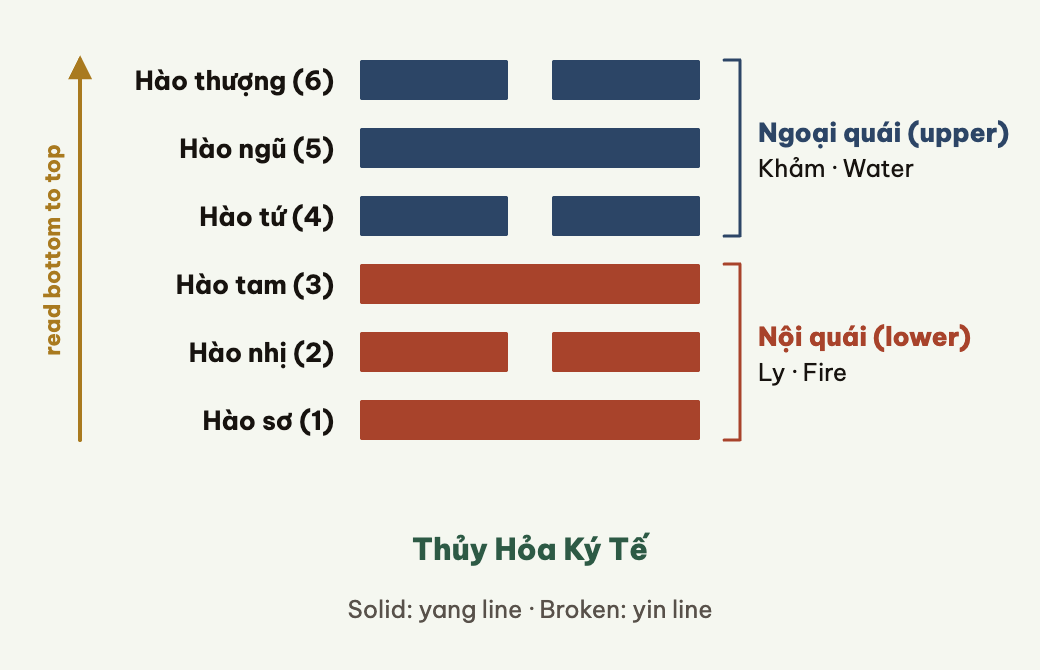
First Nine: Bạt mao nhự, dĩ kỳ vị, chinh cát
拔茅茹,以其彙,征吉。
Bạt mao nhự, dĩ kỳ vị, chinh cát.
Translation: pulling up cogongrass, the roots are joined, drawing along their kind, advancing is auspicious. The first yang line of the hexagram, in the correct position, is the moment when one person starts something and draws along the whole group of like mind. The lesson is that when a time first opens, one should go with those of one heart, not go alone.
Second Nine: Bao hoang, dụng bằng hà, bất hà di, bằng vong, đắc thượng vu trung hành
包荒,用馮河,不遐遺,朋亡,得尚于中行。
Bao hoang, dụng bằng hà, bất hà di, bằng vong, đắc thượng vu trung hành.
Translation: tolerating the wild and uncultivated, daring to ford the river, not neglecting those far away, losing private friends, one is joined to the way of the middle. This is the line of one of broad measure, daring to take on hard tasks, not abandoning those far off, not favoring those near. The phrase bằng vong (losing private friends) is the emphasis: to hold to the middle way one must give up faction.
Third Nine: Vô bình bất pha, vô vãng bất phục, gian trinh vô cữu, vật tuất kỳ phu, vu thực hữu phúc
无平不陂,无往不復,艱貞无咎,勿恤其孚,于食有福。
Vô bình bất pha, vô vãng bất phục, gian trinh vô cữu, vật tuất kỳ phu, vu thực hữu phúc.
Translation: there is no level place without a slope, no journey without a return; in hardship holding firm there is no fault; do not worry about trust; in eating and drinking there is blessing. The third line has passed the lower half, about to touch the yin region, so the line text changes tone to warn. This is the line that states most clearly the law of impermanence of the Tai time.
Fourth Six: Phiên phiên bất phú, dĩ kỳ lân, bất giới dĩ phu
翩翩不富,以其鄰,不戒以孚。
Phiên phiên bất phú, dĩ kỳ lân, bất giới dĩ phu.
Translation: fluttering down lightly, not relying on wealth, with one's neighbors, without warning yet with trust. The first yin line of the upper half, in the correct position, corresponding to the First Nine below. The image is of the three yin lines lightly descending together to meet the three yang lines rising, meeting by trust and not by bond.
Fifth Six: Đế Ất quy muội, dĩ chỉ nguyên cát
帝乙歸妹,以祉元吉。
Đế Ất quy muội, dĩ chỉ nguyên cát.
Translation: Emperor Yi marries off his younger sister, and thereby obtains blessing, greatly auspicious. This is the line of one of noble rank who lowers himself to join with those below, using marriage as the symbol of harmony between two levels.
Top Six: Thành phục vu hoàng, vật dụng sư, tự ấp cáo mệnh, trinh lận
城復于隍,勿用師,自邑告命,貞吝。
Thành phục vu hoàng, vật dụng sư, tự ấp cáo mệnh, trinh lận.
Translation: the wall falls back into the moat, do not use troops, proclaim orders from within the town, holding this course brings regret. The top line is the moment when the Tai time has reached its peak and begins to turn. The wall is earth piled up, the moat is the ditch around the wall; the wall falling back to where the earth was taken from is the image of a completed cycle.
Table of the six lines: correct position, centrality, correspondence
| Line | Yin/Yang | Position | Correct position | Central | Correspondence | Note |
|---|---|---|---|---|---|---|
| First Nine | Yang | 1 (odd) | Yes | No | Corresponds to Fourth Six | Opening line, draws along its kind |
| Second Nine | Yang | 2 (even) | No | Yes | No correspondence | Central line of the inner trigram, broad measure |
| Third Nine | Yang | 3 (odd) | Yes | No | Corresponds to Top Six | Line bordering the yin region, text turns to warn |
| Fourth Six | Yin | 4 (even) | Yes | No | Corresponds to First Nine | First yin line of upper half, descends with its group |
| Fifth Six | Yin | 5 (odd) | No | Yes | No correspondence | Noble line, lowers itself in harmony |
| Top Six | Yin | 6 (even) | Yes | No | Corresponds to Third Nine | Final line, Tai time turns to Pi |
The usual way to read this table: a yang line in an odd position and a yin line in an even position are called correct position; a line in position 2 or 5 is called central. Line 1 corresponds to line 4, line 2 to line 5, line 3 to line 6, but correspondence only holds when the two lines differ in yin and yang. In the Tai hexagram, the Second Nine and Fifth Six, though they are the central pair of the two trigrams, do not correspond to each other, because both are good lines in central positions, each standing firm on its own. This too is a notable feature of the hexagram.
The nuclear, opposite, and inverted hexagrams of Earth over Heaven Tai
Taking lines 2, 3, 4 as the inner trigram and lines 3, 4, 5 as the outer trigram, the nuclear hexagram of Earth over Heaven Tai is Thunder over Lake Gui Mei (hexagram 54). The nuclear hexagram is usually used to read the hidden part within a time: outwardly Tai is successful, but within there is an element of Gui Mei, that is, something off-kilter, some union not properly named. This is a hint not to read the Tai hexagram as an absolute guarantee.
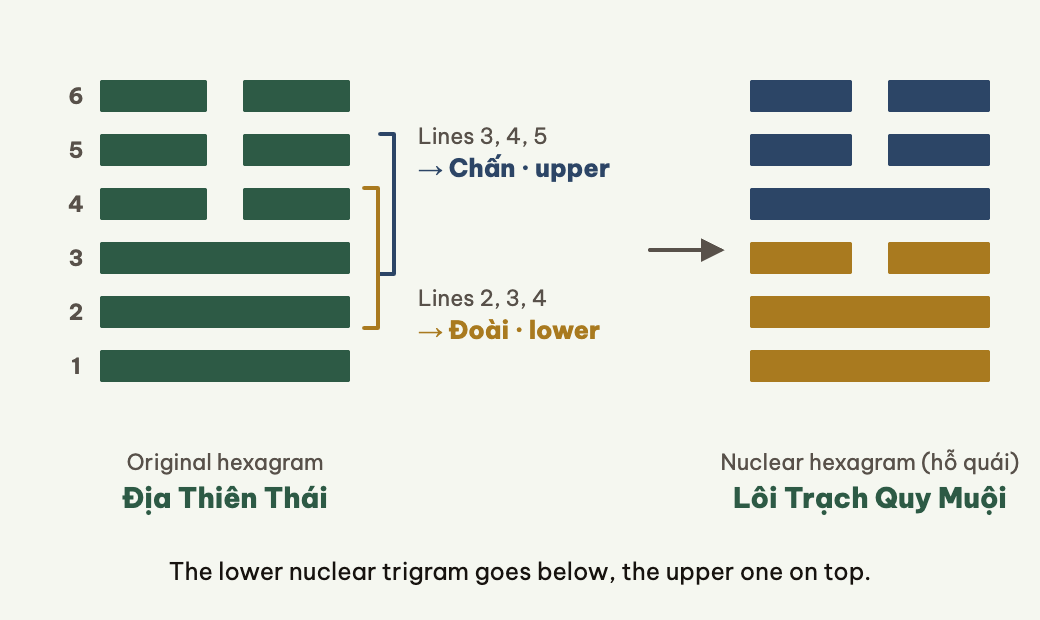
As for opposite and inverted relations: the opposite hexagram (all six lines reversed, yang to yin and vice versa) of Earth over Heaven Tai is Heaven over Earth Pi. The inverted hexagram (order reversed from top to bottom) is also Heaven over Earth Pi. That is, for the Tai and Pi pair specifically, these two transformations give the same result, because each hexagram is the mirror image of the other across the horizontal axis. This is a special case, not every pair of hexagrams is like this.
Where commentaries differ on the Tai hexagram
Which king is Emperor Yi in the Fifth Six line?
This is where books do not agree. One theory holds that Emperor Yi is King Cheng Tang, the founding king of the Shang dynasty, and the younger sister married off was to bind ties with a great clan. Another theory holds that Emperor Yi is the second king of Shang, father of King Zhou, and the marriage of the younger sister was to Ji Chang of Zhou, opening the way for an alliance between Shang and Zhou. Yet another theory holds that Emperor Yi is simply a general way of referring to a Shang era king, and the important point of the line is not in identifying the historical figure, but in the image of one above lowering himself to join with those below. Some books also stress that marrying off the younger sister was a political act, and as such carries both the meaning of building and the meaning of binding. This article does not choose any theory as standard, only noting that books record differently and the reader should know that point and look further.
How is thành phục vu hoàng in the Top Six read?
The character 復 in this sentence has two readings. The first reads it as phục meaning to return, the wall falling back to where the earth was taken to build it, that is, the image of a cycle closed. The second reads it as phục meaning again, the wall again falls into the moat, emphasizing the event of collapse. Some books combine both meanings, holding that the wall falling into the moat is a sign of the decline of the Tai time, and the wording both describes the event and the law. This is where commentaries are not uniform, and the reader may see both readings in different books.
Tai sits between Li and Pi according to the Sequence
The Treatise on the Sequence places Tai right after Li and right before Pi. The common explanation is: once rites and propriety are set and high and low are distinguished, great peace follows; and once there is opening, there must come a time of blockage. This order shows that Tai is not a stopping point, but a segment in a cycle of movement. This also explains why the top line of the hexagram already speaks of the wall falling. The book Kinh Dịch chọn lọc số 6, when discussing the relation between Earth over Heaven Tai and Earth over Thunder Fu, also stresses that Tai is the peak of a cycle, and once at the peak there is inevitably a tendency to decline, giving way to a new phase.
Reading the Tai hexagram in practice: a few notes
Some I Ching books note that the Tai hexagram in practice should not be read as an absolute guarantee of good fortune. The book Kinh Dịch chọn lọc số 6 records a case of an Earth over Mountain Qian hexagram changing into Earth over Heaven Tai in a long illness, and remarks that the peace the Tai hexagram suggests is not always an absolutely positive outcome, but also depends on whether the changing hexagram generates or controls the original hexagram, and on the effect of the moving lines on the Useful God. This is an example showing that with the same hexagram name, the meaning in practice can differ by context.
One point about sources should also be noted. The book Khổng Minh Thần Toán has verse cards for each line, but those are the cards of a separate system, not the line texts of the Zhou I Ching. When consulting, one must clearly distinguish these two kinds of text, not mix them.
In everyday application, the Tai hexagram is usually read as a time of harmony, of great matters advancing, of good people meeting. But reading the six lines closely, one sees the hexagram also teaches how to keep it: the third line warns about slopes and about the time of return, the top line warns about the time the wall falls. In other words, the Tai hexagram does not only say the time is good, it says how a good time needs to be kept.
Frequently asked questions
What number is the Earth over Heaven Tai hexagram, and what does it mean?
Earth over Heaven Tai is the eleventh hexagram of the 64 hexagrams of the I Ching, symbol ䷊, Chinese name 地天泰. It has inner trigram Qian, the image of heaven, below, and outer trigram Kun, the image of earth, above, symbolizing heaven and earth in harmony, hence called Tai, meaning opening, meaning peace. The judgment reads Tai, the small goes and the great comes, auspicious, successful, meaning the small goes, the great comes, auspicious and successful.
Why is the Earth over Heaven Tai hexagram better than the Heaven over Earth Pi hexagram?
The common explanation is that in the Tai hexagram, the yang qi of Qian below rises and the yin qi of Kun above sinks, the two currents meet and so are in harmony, and the ten thousand things flourish. In the Pi hexagram, Qian is above and Kun below, the yang qi already above rises further and the yin qi already below sinks further, the two currents draw apart and so there is blockage. Note that this is a reading by principle and qi, and there are still objections to this familiar explanation on I Ching forums, so the reader should know both sides.
What does the Top Six line of the Tai hexagram say?
The Top Six line reads: 城復于隍,勿用師,自邑告命,貞吝 (Thành phục vu hoàng, vật dụng sư, tự ấp cáo mệnh, trinh lận). The translation is: the wall falls back into the moat, do not use troops, proclaim orders from within the town, holding this course brings regret. This is the last line of the hexagram, marking the moment when the Tai time has reached its peak and begins to turn. The character 復 in the sentence may be read as return or as again, and commentaries are not entirely uniform on this reading.
Structure of the Earth over Heaven Tai hexagram in one table
| Item | Value |
|---|---|
| Order number in the Zhou I Ching | 11 |
| Chinese name | 泰 |
| Upper trigram | Kun (Earth) |
| Lower trigram | Qian (Heaven) |
| Six lines, from top down | yin, yin, yin, yang, yang, yang |
| Nuclear hexagram | Thunder over Lake Gui Mei (hexagram 54) |
| Opposite hexagram | Heaven over Earth Pi (hexagram 12) |
| Inverted hexagram | Heaven over Earth Pi (hexagram 12) |


