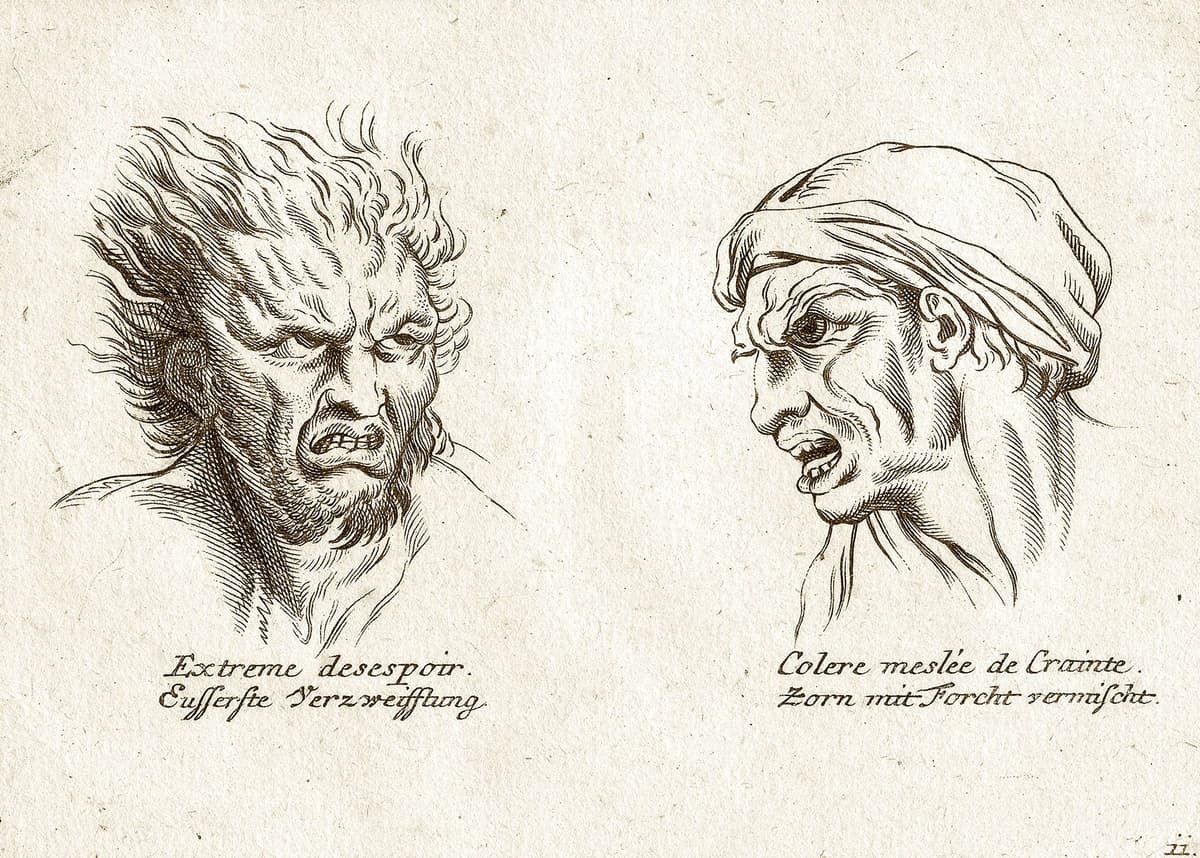
What face reading is and why it has lasted so long
Face reading (nhân tướng học in the East, physiognomy in the West) is a set of methods for observing the lines, proportions, colors, moles, and wrinkles on a face to infer a person's personality, fate, health, or fortunes.
In the East, physiognomy is tied to the philosophy of yin-yang and the five elements, viewing a person as a microcosm reflecting the laws of heaven and earth. In the West, since ancient Greece, scholars believed that outer appearance reflects inner nature. By the 18th and 19th centuries, this trend was dressed in scientific clothing, most notably Cesare Lombroso's theory of criminal physiognomy.
What all face-reading traditions share is the assumption that inside and outside correlate. This is a very strong intuitive assumption, because in daily life we often guess others' emotions from their facial expressions. The problem is that moving from momentary emotional correlation to conclusions about destiny is a very large leap.
19th-century criminal physiognomy: a scientific dead end
Cesare Lombroso and the idea of the "born criminal"
In the second half of the 19th century, Italian physician Cesare Lombroso proposed that criminals were a biologically degenerate type of human, identifiable by physical features such as a low and narrow forehead, high cheekbones, a large jaw, malformed ears, and asymmetrical eyes. He argued these signs reflected an innate tendency to commit crimes.
This theory once had great influence in criminal justice and psychiatry of the time. But later it was strongly rejected for many reasons: subjective observation methods, biased study samples, no control group, and most importantly, conclusions shaped by social prejudice.
Why this theory collapsed
Modern researchers point out three basic errors:
- Sampling error: Lombroso mainly observed prisoners, a group already marked by the justice system, not representative of the whole population.
- Reverse inference error: Seeing many prisoners with feature X, then concluding feature X causes crime, when X may be common among non-offenders too.
- Bias error: Features deemed "criminal" were often tied to the poor, immigrants, or socially stigmatized groups.
This is an important lesson: face reading, even dressed in science, can easily slide into labeling people based on appearance.
A view from anthropology: anthropology is not for fortune-telling
Many people mistakenly think studying anthropology is for reading faces and predicting fortunes. In reality, anthropology is a field that integrates natural, social, humanistic, and artistic knowledge to study humans comprehensively.
Anthropology has five fields: physical anthropology, archaeology, cultural-social anthropology, linguistic anthropology, and applied anthropology. Physical anthropology does study variation and evolution of the human body, but its goal is to understand biological processes and human history, not to judge individual destiny.
In other words, anthropology can help us understand why different cultures developed different face-reading systems, but it does not itself confirm that face-reading pronouncements are true.
Modern psychology looks at face reading
We read faces very quickly, but not as accurately as we think
Psychological research shows people tend to infer personality from faces in just a few hundredths of a second. However, the accuracy of these judgments is usually very low when tested by objective criteria. We are influenced by:
- Halo effect: people with pleasant appearance are often assigned more good qualities.
- Cultural prejudice: which facial features are considered "gentle," "fierce," or "intelligent" depends on cultural norms, not biological laws.
- Correlation illusion: we remember the times we guessed right, forget the times we guessed wrong, so we think face reading is "accurate."
Common "reading" techniques in divination generally
Whether face reading, palm reading, or card reading, practitioners often use the same set of psychological techniques:
- Cold reading: saying general things likely to be true for many people, while observing body reactions to adjust.
- Hot reading: gathering information about the client beforehand and then "predicting" as if guessing.
- Warm reading: using reasoning from context, for example describing feelings of suffocation and cold for someone who drowned.
Physicist Geoffrey Dean systematized the principles and prediction techniques used by fortune-tellers, based on effects such as the Barnum effect (accepting general descriptions), the Dr. Fox effect (believing someone who seems learned), and unfalsifiability (speaking vaguely to avoid being caught in error).
The phenomenon of self-suggestion
An important mechanism making face reading seem true is self-suggestion. When told negative or positive things, the listener is easily fixated, adjusts behavior, and unconsciously creates results matching the pronouncement. The brain also remembers frightening information longer, so predictions of disaster leave deeper traces than ordinary ones.
This explains why many people believe a face reader "told it right." It is not necessarily that the reader is skilled, but that the listener has turned the pronouncement into their own life script.
Face reading and divination from a cultural and social angle
Divination generally is defined as an effort to gain understanding about a question or situation through standardized mystical processes or rituals. Through long social and religious history, divination has kept a certain place in human life, though many scientists consider it superstition or fraud.
The factors making divination, including face reading, appealing:
- The need of the seeker: according to psychology, people who frequently consult fortune-tellers tend to be credulous, anxious, lacking self-confidence and life direction.
- The need for answers about the future: people always want to know in advance their fate, family, career, so they easily seek places with answers.
- Mystery stimulates curiosity: ritual atmosphere, clothing, and tools create a supernatural feeling, making seekers easily fascinated.
From this angle, face reading is not only a matter of right or wrong, but also a cultural phenomenon reflecting human psychological needs in the face of uncertainty.
Common misconceptions about face reading
- Misconception 1: Facial features determine destiny. In reality, destiny is affected by countless factors: circumstances, education, effort, health, luck, personal decisions.
- Misconception 2: Criminals can be identified by face. This is a legacy of the rejected Lombroso theory, and today is considered dangerous prejudice.
- Misconception 3: A good face reader always guesses right. Cold reading, hot reading, warm reading, and self-suggestion explain most "accurate" cases.
- Misconception 4: Science has proven face reading. There is not enough strong scientific evidence to confirm a causal link between facial features and destiny.
So how should we view face reading
In the spirit of much scientific and psychological literature, divination generally is not for knowing the future, but for each person to understand themselves and their personality better, from which to choose and decide their future. Character makes destiny.
With face reading, a reasonable attitude could be:
- View it as a cultural tradition worth learning about, not scientific truth.
- Do not use face-reading pronouncements to decide big matters like marriage, investment, health.
- Do not let negative pronouncements influence psychology in the direction of self-suggestion.
- Verify all important information with reliable sources and appropriate experts.
In other words, face reading can be a hobby, a way of self-reflection, but should not replace critical thinking and personal responsibility for one's life.