Why the Enneagram Is Not Nine Separate Labels
Many people approach the Enneagram as a classification table: take a test, get a number, then assign themselves a fixed label. That approach misses the most subtle part of this system. What gives the Enneagram its depth is not which type you belong to, but that each type is always moving between different psychological states. That movement is expressed through the integration arrow and the disintegration arrow.
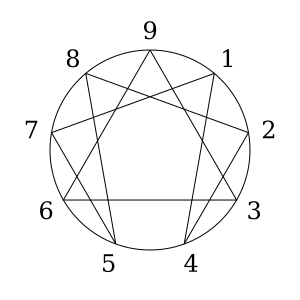
In the Enneagram diagram, each number does not stand alone. It is connected to two other numbers by two straight lines, creating two directions of movement. One direction points to the healthy, developing state, when a person feels safe and balanced. The other direction points to the stressed state, when pressure is prolonged or defense mechanisms are overloaded. The key point: this is not becoming a different type of person. A person keeps the core motivation and basic fear of their type, but the way those traits are expressed is influenced by the energy of the type the arrow points to.
An easy example: imagine a musician playing their main instrument, but occasionally switching to a secondary instrument to create a new timbre. The musician is still themselves, but the music carries a different color. Enneagram arrows operate on a similar principle.
How the Two Arrows Work
Integration: the direction of healthy development
When a person is in a healthy, open psychological state with self-observation, they naturally move along the integration arrow. In this direction, they take in the positive qualities of the personality type the arrow points to. This is a process of expanding inner resources, not losing identity. The person learns an additional psychological language to respond to life more flexibly.
Disintegration: the direction of decline under stress
Conversely, when falling into stress, prolonged anxiety, or imbalance, the person moves along the disintegration arrow and expresses the negative sides of the personality type at the other end. Note: integration and disintegration should not be simply understood as two states of "good" and "bad." They are two directions of one axis of psychological energy, describing how people react when safe or under pressure. Naming them is a self-awareness tool, not for labeling "I am getting better" or "I am getting worse."
The Arrow Map of the Nine Types
To read all nine types as one system, you need to know all the connecting lines. Below are the arrow pairs for each type.
- Type 1 (Reformer): integrates to Type 7, disintegrates to Type 4.
- Type 2 (Helper): integrates to Type 4, disintegrates to Type 8.
- Type 3 (Achiever): integrates to Type 6, disintegrates to Type 9.
- Type 4 (Individualist): integrates to Type 1, disintegrates to Type 2.
- Type 5 (Investigator): integrates to Type 8, disintegrates to Type 7.
- Type 6 (Loyalist): integrates to Type 9, disintegrates to Type 3.
- Type 7 (Enthusiast): integrates to Type 5, disintegrates to Type 1.
- Type 8 (Challenger): integrates to Type 2, disintegrates to Type 5.
- Type 9 (Peacemaker): integrates to Type 3, disintegrates to Type 6.
Looking at this map, a pattern appears: the arrows of the types form a closed loop. If you follow the integration direction, you pass through 1, 7, 5, 8, 2, 4, 1. If you follow the disintegration direction, the loop goes the opposite way. This circular structure is what makes the Enneagram a system, not nine separate pieces.
Deeper Analysis of a Few Representative Pairs
Type 1: from strictness to enjoyment, and back
Type 1 is driven by the need to live rightly, improve the world, and uphold ethical principles. They have a strong inner voice, always judging themselves and others by strict standards. Anger is often suppressed to maintain the image of a proper, rational person.
When integrating to Type 7, Type 1 learns to let go of excessive control and allow themselves to experience joy, freedom, and exploration. They realize the world cannot be perfect and not everything needs a rigid order. Suppressed anger energy is transformed into enthusiasm and the ability to enjoy life. They understand that "good enough" is sometimes a wiser standard than "perfect."
When disintegrating to Type 4, Type 1 is no longer calm but becomes melancholic, easily emotional, comparing themselves to others and feeling inadequate. They may sink into negative emotions, envy others, self-pity, and withdraw from relationships because they feel no one understands them. An example: a Type 1 manager builds a perfect workflow; when an important project fails due to an objective incident, he is not only angry at the situation but also blames himself, thinking he is not capable enough, that colleagues do better, then falls into prolonged discouragement.
Type 2: from dominance to authenticity
Type 2's core motivation is the need to be loved and needed. They express affection by caring for and supporting others enthusiastically, sometimes forgetting their own needs.
Under stress, Type 2 disintegrates to Type 8. They become demanding, imposing, stubborn, easily angered, and use help as a tool of control. They may say: "I did everything for you, now it's your turn to do as I say." They ignore their own needs to the point of exhaustion, then resent that no one cares about them.
When integrating to Type 4, Type 2 learns to connect with real emotions, accept vulnerability, and express authenticity. They can say "I need help" without feeling ashamed, develop creativity and inner depth, and set healthy boundaries. They understand that saying "no" does not mean being selfish, but protecting energy and respecting themselves.
Type 5: from observation to action, and the slip into distraction
Type 5, the Investigator, tends to withdraw from the world to observe, analyze, and understand. They are driven by fear of depletion, fear of intrusion, and fear of being seen as incompetent, so they tend to hoard knowledge, time, and private space.
When integrating to Type 8, Type 5 shifts from storing to sharing, from observing to participating, from isolation to connection. They become decisive, confident, willing to act, and ready to stand up for what they believe is right. A Type 5 researcher after years of diligent work in the lab can become a decisive project leader, inspiring colleagues with a clear vision.
When disintegrating to Type 7, Type 5 does not withdraw deeper into isolation as many think, but explodes with chaotic energy. They talk a lot, ramble, make grand plans but rarely execute, seeking external stimulation to forget inner insecurity. This is a vicious cycle: the more stressed, the more they escape through distraction; the more distracted, the more exhausted and anxious.
Type 9: from harmony to dynamism, and lingering worry
Type 9 seeks peace, harmony, and avoids conflict. They are easily empathetic but often struggle to recognize and assert their own needs.
When integrating to Type 3, Type 9 learns decisiveness, the ability to set clear goals, and persistence. They become dynamic, organized, and effective, while keeping calm and the ability to listen. They realize that pursuing personal goals does not necessarily break harmony, but can bring deep satisfaction.
When disintegrating to Type 6, Type 9 becomes anxious, restless, doubting their own abilities. They hesitate, struggle to make choices, have lingering anxiety, and may resist passively by procrastinating, ignoring, or doing work carelessly. They may become overly alert to others' intentions, suspecting they are being used, the complete opposite of their usual trusting nature.
Comparing the Two States: Summary Table by Energy Axis
The difference between the two directions can be summarized by these opposing axes.
| Aspect | Integrated State | Disintegrated State |
|---|---|---|
| Motivation | Growth, connection, contribution | Fear, insecurity, defense |
| Energy | Focused, abundant, light | Scattered, stagnant, heavy |
| Dominant emotion | Calm, confident, purposeful | Anxious, resentful, melancholic |
| Relationship with others | Open, respecting boundaries | Demanding, avoidant, controlling |
| Self-awareness | Self-observing, recognizing needs | Blaming, self-deceiving, disconnected |
The interesting point is that although the two states seem opposite, both reflect the same inner struggle of that personality type. In the integrated state, people assert themselves healthily and constructively. In the disintegrated state, people react to fear by defending, instead of facing the problem directly.
Practical Application: Turning Arrows into a Self-Awareness Tool
Understanding the two arrows is not just theory. It is a useful tool to recognize your current state and adjust behavior.
- Recognize early signs of disintegration: When you notice unusual procrastination, loss of interest, irritability, or wanting to control others, pause and ask: "What state am I in? What is my real need right now?"
- Practice mindfulness about emotions: Instead of suppressing negative emotions, allow yourself to feel them through journaling, meditation, or sharing with a trusted person.
- Actively seek nourishing activities: Each type has its own integration direction, and consciously practicing that type's qualities helps reinforce balance.
- Reconnect with the body: Many disintegrated states come with "living in the head" and ignoring body signals. Movement, deep breathing, and physical activities help bring you back to the present.
- Seek feedback from trusted people: Sometimes it is hard to see our own behavior, so listening to feedback from loved ones or experts gives a more objective view.
Reading All Nine Types as One System
Once you know the arrow map, you can read the Enneagram in three layers at once. The first layer is the core motivation and basic fear of the main type. The second layer is the integration direction, showing growth potential and qualities to practice. The third layer is the disintegration direction, acting as an early warning system when stress is prolonged.
This way of reading explains why two people of the same type can look very different. A Type 1 integrating can be cheerful, flexible, and creative, while a Type 1 disintegrating can be melancholic, self-tormenting, and withdrawn. Both are still Type 1, but in two different phases of movement of the same system.
An important point to emphasize: the Enneagram is not a prophecy, but a mirror. Its greatest value is not in the label, but in the ongoing journey of self-discovery and growth. Understanding the integration and disintegration arrows helps us see that personality is not a fixed sentence, but a flow that can be directed by awareness and conscious choice.