What Are Tam Thai and Bat Toa in Tu Vi Dau So?
Tam Thai and Bat Toa are two tap tinh (secondary stars) in Tu Vi Dau So, meaning they are auxiliary stars, not among the 14 chinh tinh, and not in the luc cat or luc sat groups. Tam Thai leans toward position, rank, and being respected; Bat Toa leans toward fame, seat, and recognition. Because the two are almost always mentioned together, researchers commonly call them the Thai Toa set, or the Tam Thai Bat Toa pair.
One point to remember at once: their positions are not fixed. These two stars change according to each person's birth data, specifically the birth month and lunar birth day. There is no such thing as Tam Thai or Bat Toa always sitting in one particular palace.
According to tracuutuvi.com, Tam Thai is classified as a cat tinh, element Water, governing fortune, longevity, wisdom, support, and luck. Bat Toa is also a cat tinh, of Yin nature, element Wood, governing study, examinations, academic honors, nobility, and is described as generous and dignified. This element classification is the convention of some popular documents, not a point on which all books agree, so when reading different sources you will see slight variations.
Why Do Books Always Read Tam Thai and Bat Toa as a Pair?
The first reason lies in the placement method: the two stars are placed as a symmetrical pair, one counted forward, one counted backward, both taking the birth day as the target. Tam Thai starts from the palace holding Ta Phu, Bat Toa starts from the palace holding Huu Bat. Ta Phu and Huu Bat are already a paired set of supporting stars, so their offspring also carry a paired nature.
The second reason lies in meaning: both revolve around the word "status." Tam Thai is the sense that a person has a standing, is ranked correctly; Bat Toa is the sense that the person sits in the right seat and is recognized by others. These two sides complement each other; missing one side makes the picture of rank lopsided. The book Dau So Tinh Thanh (Volume 1, Part 1) lists Tam Thai and Bat Toa right next to each other in the group of stars placed by day, together with An Quang and Thien Quy, showing that tradition still treats them as one cluster.
The third reason is practical interpretation. The book Tu Vi Kinh Nghiem, lower volume, has a passage about the pattern "Thai Toa giap Menh," meaning the two stars stand flanking the Menh palace, and considers it a sign of prominence. When speaking of "giap," both stars must be present for the pattern to form; a single star standing alone cannot create the flanking configuration.
How Are Tam Thai and Bat Toa Placed by Birth Date from Ta Phu and Huu Bat?
The most common method, recorded in Dau So Tinh Thanh and many other documents, has two parallel steps:
- Placing Tam Thai: take the palace holding Ta Phu as day one, count forward clockwise through the 12 palaces, stop at the lunar birth day. The palace where you stop is the position of Tam Thai.
- Placing Bat Toa: take the palace holding Huu Bat as day one, count backward counterclockwise through the 12 palaces, stop at the lunar birth day. The palace where you stop is the position of Bat Toa.
Since Ta Phu and Huu Bat are placed by birth month, the positions of Tam Thai and Bat Toa depend on both month and day of birth. This is what makes this set different from stars placed by a single factor alone.
Another phrasing also circulates, recorded in some documents: start from the Thin palace as month 1, count forward to the birth month to find the Ta Phu palace, then from there treat it as day one and count forward to the birth day to place Tam Thai; similarly, start from the Tuat palace as month 1, count backward to the birth month to find the Huu Bat palace, then count backward further to the birth day to place Bat Toa. This method and the one above actually give the same result, differing only in whether the month-counting cycle is described separately or folded into one sentence.
An illustrative example from tracuutuvi.com: a person born on lunar day 3, month 6, counting from the Thin palace forward 6 palaces gives the Dau palace, treat Dau as day one, count forward 3 more palaces and Tam Thai sits in the Hoi palace. This example uses exactly the principle of starting from the month then the day, so it can be cross-checked against the method starting from Ta Phu.
Quick Reference Table by Birth Month and Birth Day
The table below is machine-generated from the Ta Phu and Huu Bat positions that the calculation core has already placed, not typed by hand. The core does not yet place these two stars, so they need to be added to the core before building the table. How to read: each cell gives the Tam Thai palace and Bat Toa palace corresponding to a (birth month, birth day) pair in the lunar calendar.
| Birth month | Birth day | Tam Thai palace | Bat Toa palace |
|---|---|---|---|
| 1 | 1 | Ty | Ty |
| 1 | 15 | Dan | Tuat |
| 2 | 1 | Suu | Hoi |
| 2 | 15 | Mao | Dau |
| 3 | 1 | Dan | Tuat |
| 3 | 15 | Thin | Than |
| 4 | 1 | Mao | Dau |
| 4 | 15 | Ti | Mui |
| 5 | 1 | Thin | Than |
| 5 | 15 | Ngo | Ngo |
| 6 | 1 | Ti | Mui |
| 6 | 15 | Mui | Ti |
| 7 | 1 | Ngo | Ngo |
| 7 | 15 | Than | Thin |
| 8 | 1 | Mui | Ti |
| 8 | 15 | Dau | Mao |
| 9 | 1 | Than | Thin |
| 9 | 15 | Tuat | Dan |
| 10 | 1 | Dau | Mao |
| 10 | 15 | Hoi | Suu |
| 11 | 1 | Tuat | Dan |
| 11 | 15 | Ty | Ty |
| 12 | 1 | Hoi | Suu |
| 12 | 15 | Suu | Hoi |
This table only illustrates the symmetrical principle: Tam Thai counts forward, Bat Toa counts backward, so when birth month and birth day change, the two palaces separate or meet again. To look up accurately for a specific chart, you must use that chart's actual Ta Phu and Huu Bat positions, because these two stars depend on birth month.
Why Do Books Advise "Should Meet the Paired Stars"?
The book Tu Vi Kinh Nghiem, lower volume, mentions the pattern "Thai Toa giap Menh," meaning the two stars stand on either side of the Menh palace, and considers this the foundation for prominence. The book Dau So Tinh Thanh also records the two stars in the same group, right next to each other. From this comes the traditional advice: you should meet the full pair, not just one star.
The reason is fairly easy to understand. Tam Thai and Bat Toa are tap tinh, their meaning shifts with the context of the palace they occupy. When the full pair stands together, they form a symmetrical configuration, like two pillars supporting the word "status." When standing alone, with no counterpart pillar, the meaning of rank becomes faint and is easily overshadowed by stronger stars in the palace.
Moreover, these two stars only show their clearest effect when there are cat tinh supporting them in the tam phuong tu chinh. If around them are Ta Phu, Huu Bat, Van Xuong, Van Khuc, Thien Khoi, Thien Viet, or Loc Ton, Hoa Loc, Hoa Quyen, Hoa Khoa, then rank has a real foundation and the seat is firm. If around them are sat tinh, hinh tinh, or hoa ky, then the same star expresses as disputes over rank, a shaky seat. This is a general principle when interpreting auxiliary stars: do not assign a fixed meaning and apply it to every case.
Where Do Books Differ?
This is where we need to be clear, because many variant versions circulate. On the Ly So Viet Nam forum, a member summarized three different streams of knowledge about placing the Thai Toa set:
- Method 1: Ta Phu counted forward by birth day to place Tam Thai, Huu Bat counted backward by birth day to place Bat Toa. This is the method used by many documents and astrology software, and it also matches the description in Dau So Tinh Thanh.
- Method 2: Ta Phu counted forward by birth month to place Tam Thai, Huu Bat counted backward by birth day to place Bat Toa. This method differs by half from Method 1.
- Method 3: Placing Thai Toa by birth hour together with Ta Huu. This method is noted as unclear and hard to visualize, so it is rarely followed.
Another member on the same forum argued back: Thai Toa is a paired set where one star is placed by month and one by day, which is hard to fit, because in Tu Vi it is rare for a pair to be placed asymmetrically like that. This person believed Method 2 was most likely a typo, mistyping "day" as "month," or a misunderstanding of the phrase "placed by month and birth day." Under that explanation, the phrase only means that to place this set you must rely on both month and birth day, not that each star takes a different factor. Because the set is placed from Ta Phu and Huu Bat, and Ta Phu and Huu Bat are already placed by month, then from there the birth day is used to count further.
Another point also causes debate: Method 3 uses birth hour. The rebutting member said this method is unclear so it is not understood how to place it, and up to now no document has been seen recording any disagreement about how to place Thai Toa. However, since this is a forum note and not a quote from an original book, it should only be taken as a cross-reference opinion, not a general conclusion.
In principle, most current documents follow Method 1. The remaining variants are most likely copying errors or misunderstandings. But since this is a field with many different transmission lines, researchers should still know the variants exist, rather than assuming there is only one way.
The Chart Uses Lunar Day and Month Without Considering Tiet Khi
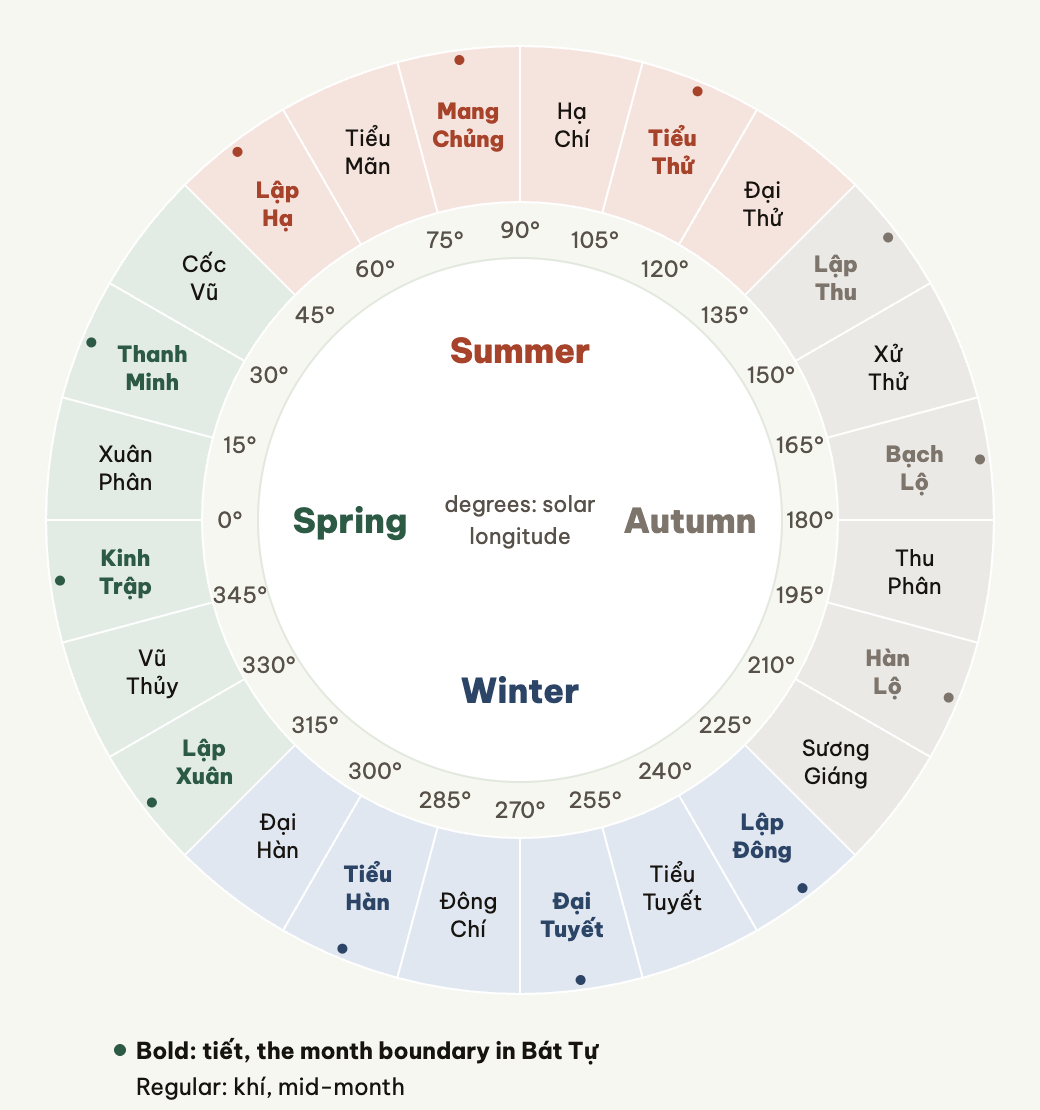
An important technical feature: the method for placing Tam Thai and Bat Toa uses the lunar birth day and birth month, without considering tiet khi (solar terms). This differs from systems like Bat Tu, where the month is determined by tiet khi rather than the lunar month. So when comparing a Tu Vi chart with the Tu Tru chart of the same person, the month used to place stars may not match.
Also note the matter of birth days near the Ty hour boundary. Many chart-building sites, including tracuutuvi.com, advise that people born from 23:00 to 00:00 should choose the Ty hour of the next day if looking up by lunar birth day. This convention directly affects the lunar birth day used to place Tam Thai and Bat Toa, so it must be clearly determined before calculating.
How Do Tam Thai and Bat Toa Affect the Chart?
According to tracuutuvi.com, Tam Thai at the Menh palace is described as a person with strong will, an aspiring spirit, leadership talent, and easily trusted by superiors with important duties. Regarding wealth, the native is said to have stable finances through personal effort and knowing how to manage money. Regarding fortune and longevity, the site records that a person with Tam Thai at Menh usually has good health and enjoys long life if they take care. Regarding marriage, the site describes the romantic path as less favorable than the career, with few close friends and a tendency to marry late.
With Bat Toa at the Menh palace, tracuutuvi.com describes a person with a square-long face, medium build, gentle and kind temperament, fond of charity, but sometimes blunt and hasty. Regarding career, the site records that this person has organizational and leadership ability, easily attains high social position, and has advantages in cultural, educational, media, and artistic fields. Regarding marriage, the site describes harmonious married life. Regarding wealth, the site notes that if Bat Toa meets cat tinh it is noble, but if it meets sat bai tinh the person tends to be lazy and struggles to rise.
These descriptions should be read at the right level. This is popular reference material, not a scientific conclusion, and the sites themselves clearly state that Tam Thai and Bat Toa are auxiliary stars. Their role is to add nuance to a person's bearing and character, especially when accompanied by supporting cat tinh, not to decide a life on their own. A chart with beautiful Tam Thai Bat Toa but weak chinh tinh, or surrounded by sat tinh, can still face many obstacles. Conversely, a chart without these two stars can still succeed through other configurations.
What Should Be Considered When Interpreting?
Once the positions of Tam Thai and Bat Toa are determined, the next step is to place them in context. Do not read these two stars in isolation, but consider the whole tam phuong tu chinh, meaning the palace in question plus the two tam hop palaces and the opposing palace. This method helps see the full picture of a person's rank and recognition.
Two cases must be distinguished. First, when the two stars go with cat tinh and good support, rank has a real foundation, the seat is firm, and many people recognize it. Second, when the two stars meet sat tinh, hinh tinh, or hoa ky, rank is unstable and disputes over hierarchy easily arise. The same star expresses completely differently depending on the surrounding environment, so one cannot say this pair is "always good" or "always bad."
A final note: these two stars show their clearest effect when standing together and when there are supporting cat tinh. If only one star stands alone, with no pair and no supporting star, the quality is quite faint, do not exaggerate it. This is also why old books advise "should meet the paired stars": not because the two stars are strong enough on their own, but because they need to stand side by side to form a configuration.