
What are Thien Quan and Thien Phuc?
In the naming used in Dau So Tinh Thanh (Volume 1, part 1), a star's name often hints at its general meaning: "Thien Quan means heaven grants office," "Thien Phuc means heaven has fortune." These are two auxiliary stars classed among the fortune stars and benevolent stars, both belonging to the Earth element, Yang nature. The site tracuutuvi.com describes Thien Quan, also called Thien Quan Quy Nhan, as governing fortune and longevity, kindness, rescuing the distressed and aiding the endangered, dispelling illness and disaster, and curbing the harm of malefic stars; Thien Phuc, also called Thien Phuc Quy Nhan, governs gentleness, practice, goodness, saving the suffering and relieving calamity.
One point must be stressed from the start: both are auxiliary stars. In the Tu Vi system, auxiliary stars do not by themselves determine the fortune or misfortune of a palace; they colour, strengthen, or soften the main stars and the existing star combination. The same Thien Phuc in a palace with a good main star and in a palace struck by malefic stars are two different stories.
Why are these two stars placed by the year's heavenly stem?
Thien Quan and Thien Phuc are not placed by the birth year's earthly branch, not by the birth hour, and not by the day or month. They are placed by the heavenly stem of the birth year. This is a shared trait of a group of Tu Vi stars often called the stem-based star group: Loc Ton, Kinh Duong, Da La, Thien Khoi, Thien Viet, Thien Quan, Thien Phuc, and several others.
This mechanism has a practical consequence. A person born in a Giap year, whatever the month, hour, or day, always has Thien Quan at Mui and Thien Phuc at Dau. That position changes only when the birth year's heavenly stem changes. Since there are only ten stems, these two stars have only ten possible positions, and those ten repeat on the sixty-year cycle of Luc Thap Hoa Giap.
It should also be said clearly: many people confuse Thien Quan with Thien Quan Quy Nhan as a single star, while Thien Khoi and Thien Viet are the pair usually called "Khoi Viet" or, in some naming conventions, "An Quang Thien Quy." The names overlap somewhat, so when looking them up, read carefully which star is being discussed.
Table of Thien Quan and Thien Phuc by the ten heavenly stems
The table below follows Dau So Tinh Thanh (p. 39) for both stars, cross-checked against tracuutuvi.com's table. Where the two sources diverge, the note is given in the table.
| Birth year stem | Thien Quan (per Dau So Tinh Thanh) | Thien Phuc (per Dau So Tinh Thanh) | Cross-check note vs tracuutuvi.com |
|---|---|---|---|
| Giap | Mui | Dau | Both stars match |
| At | Thin | Than | Website puts Thien Quan at Mui, differs from the book |
| Binh | Ty | Ty | Website puts Thien Quan at Thin, differs from the book |
| Dinh | Dan | Hoi | Both stars match |
| Mau | Mao | Mao | Both stars match |
| Ky | Dau | Dan | Both stars match |
| Canh | Hoi | Ngo | Both stars match |
| Tan | Dau | Ty | Both stars match |
| Nham | Tuat | Ngo | Both stars match |
| Quy | Ngo | Ty | Both stars match |
Reading the table, a few structural points stand out. First, some stems put Thien Quan and Thien Phuc in the same palace: with Mau, both stars sit at Mao. Second, some stems place the two stars in palaces opposite each other across the axis: with Giap, Quan at Mui and Phuc at Dau; with Ky, Quan at Dau and Phuc at Dan. Third, some palaces recur: Dau is Thien Quan's palace for both Ky and Tan, Ngo is Thien Phuc's palace for both Canh and Nham, Ty is Thien Phuc's palace for both Tan and Quy.
Why do texts group Thien Quan and Thien Phuc with Khoi Viet?
In many stem-based star listings, Thien Quan and Thien Phuc are placed near Thien Khoi and Thien Viet, because all four are stars placed by the birth year's heavenly stem. This grouping has a technical reason in chart construction: when programming or looking up tables, one handles a group of stem-based stars together, so placing them side by side is convenient.
But being adjacent in a table does not mean sharing a function. Thien Khoi and Thien Viet lean toward support from above, from people of standing, often tied to career, education, and helpful figures at work. Thien Quan and Thien Phuc lean toward fortune and rescue, that is, easing disaster and adding a measure of security. Tuyen Tap Bai Viet Tu Vi Chon Loc no. 17 (p. 101) draws a fairly clear distinction: Thien Quan is not a star that creates direct power, but a star of "noble prominence," meaning respect, reputation, and social standing; a person with a good Thien Quan is often favoured by superiors and elders, entrusted with representative duties, and respected for intelligence and refinement rather than for strength or decisiveness. According to this text, Thien Phuc is said to govern "rank and emolument," meaning income and wealth obtained through reputation; even so, the more noteworthy layer of meaning lies in its "rescue" function, likened to a cushion keeping a person from risks that should not have come.
This distinction matters, because it shows Thien Quan and Thien Phuc are not copies of Khoi Viet. They operate in the same stem-based group, but differ in interpretive function.
What does "quy nhan" actually mean here?
The full names of the two stars are "Thien Quan Quy Nhan" and "Thien Phuc Quy Nhan" in tracuutuvi.com's naming. The word "quy nhan" in these names easily causes misunderstanding. Many read it as: a person of rank will appear at the right moment to help. That reading is not entirely wrong, but it is not the focus.
In the sense of these two stars, "quy nhan" is closer to rescue than to a specific person. The Luc Nham source (volume 1, Introduction, p. 35), discussing the Quy Nhan star in the Luc Nham system, describes it: Quy Nhan in full is Thien At Quy Nhan, whose heavenly post is the deity Thien De, seated to the right outside the gate of the Tu Vi Dai De palace, reviewing to grant blessings to the human world; in Luc Nham this star is also called "Thien Tu." This is a different system from Tu Vi, but the use of "quy nhan" shows that in the Eastern divination tradition, a quy nhan is often a star carrying the function of granting fortune and rescue, not necessarily a flesh-and-blood person.
When interpreting Tu Vi, saying "the Menh palace has a quy nhan" usually means: that palace is guarded by a star of rescuing nature. The concrete effect depends on which star, in which palace, and how it interacts with the rest.
How does the rescue mechanism of Quan Phuc work?
Tuyen Tap Bai Viet Tu Vi Chon Loc no. 13 (p. 168) discusses this mechanism fairly clearly. According to it, unlike Tuan Triet, which are obstructing stars, Thien Quan and Thien Phuc belong to the purely rescuing group. Thien Phuc leans toward doing good and urging people to do good, with rescue at a gentle level; Thien Quan also carries the meaning of doing good, but its rescuing capacity is rated stronger. Also per this source, when a period runs into difficulty, both stars must be present at once for the best rescue effect, and in some situations other stars are needed in support for a complete resolution.
This leads to an important principle: the power of a fortune star is not absolute. It depends on the interaction of the whole star system on the chart. In other words, Thien Quan and Thien Phuc are not a "free pass" against every risk.
tracuutuvi.com also states Thien Quan's property as "governing the rescue of the distressed and aid of the endangered, dispelling illness and disaster, increasing fortune and longevity, curbing and reducing the harm of malefic stars." The word "reduce" is noteworthy: soften, not eliminate.
How do the "spiritual practice" reading and the traditional rescue reading differ?
This point needs stating clearly because sources do not agree.
The traditional reading, evident in tracuutuvi.com's description and in Tuyen Tap Bai Viet Tu Vi Chon Loc no. 17, stresses the rescue function: whichever palace the star occupies, it reduces disaster, illness, and harm in that palace, adds fortune and longevity, adds luck, and to some degree can be seen as outside support.
The second reading, leaning toward "spiritual practice," also appears in the sources. tracuutuvi.com, discussing Thien Quan at the Menh palace, describes the person with this star as kind-hearted, highly virtuous, fond of a secluded life away from the bustling world, often doing good deeds to help others, holding reverence for Buddhism, deeply connected to the path of practice, and able to quickly attain results on the learning path. This site also describes Thien Quan as "also meaning to guide people toward practice, doing good, continuing to build merit." For Thien Phuc, the same source says a person with Thien Phuc at Menh is often kind, gentle, virtuous, inclined to charity, with deep faith in Buddha and Heaven and an affinity for practice.
There is a third reading, appearing in a member's discussion on the lyso.vn forum (thread "Thien Quan Thien Phuc, Nguon Thay Hoang Quy Son"). This person recounts personal experience with Quan Phuc at Menh and Tai, describing himself as having, since childhood, a tendency to share, to give, to pity the poor, and sometimes to sense things before they happen. This reading ties Quan Phuc to a kind of instinct toward goodness and intuition rather than to rescue from outside. Note this is a personal forum share, not a scholarly argument, so it should be taken only as a reference viewpoint.
The difference between these readings is not absolute contradiction, but a difference of focus. The traditional rescue reading stresses the star's effect on one's course. The practice reading stresses the personality tendency and life path the star suggests. Both can coexist on one chart, but the interpreter should state which reading they follow.
How to interpret Thien Quan and Thien Phuc in different palaces?
tracuutuvi.com has separate descriptions for each palace. At the Phu Mau palace, Thien Quan governs parents who are courteous, fond of helping others, possibly interested in Buddhist teaching and spirituality, believing in cause and effect; the native is born into a family with decent upbringing and easily enjoys the fortune left by parents. Thien Phuc at Phu Mau governs the native enjoying fortune and luck, benefits left by parents through hidden or open virtue.
At the Phuc Duc palace, Thien Quan governs grandparents, ancestors, and many in the clan being good people who do good deeds, bringing merit to the native in this life; this source also notes the native should not therefore indulge in dissipation, but should continue to cultivate merit later. Thien Phuc at Phuc Duc governs the native enjoying fortune and avoiding many calamities; even if ancestral graves are poor or the clan has negative matters, a true teacher will come to rescue and dispel them.
At the Menh palace, tracuutuvi.com describes Thien Quan as bringing luck in career, easy support from quy nhan, easy promotion, harmonious marriage, smooth finances, reduced harm and risk of illness. For Thien Phuc at Menh, the same source says the person receives help from quy nhan in career, stable work but possibly lacking breakthroughs if they do not develop themselves, harmonious marriage, little worry about finances but easily content with the present and lacking strong drive to advance.
A noteworthy point: even within the same site's description, Thien Phuc is recorded as "possibly lacking breakthroughs" and "possibly lacking the drive for strong financial development if one does not know how to seize opportunities." This is the flip side of a fortune star: too much ease can become stagnation.
Why is it said a rescuing star cannot replace taking care of oneself?
This point should be stated plainly, because it is often skipped when people look up good stars.
First, as noted above, Tuyen Tap Bai Viet Tu Vi Chon Loc no. 13 (p. 168) asserts that the power of a fortune star is not absolute but depends on the interaction of the whole star system. If a palace is heavily struck by malefic stars and has no supporting stars, Thien Quan or Thien Phuc alone is not enough to resolve it thoroughly.
Second, tracuutuvi.com itself, in the section on Thien Quan at the Phuc Duc palace, writes: "Remember that the native must not therefore indulge in dissipation, but should continue to cultivate merit later." This is a reminder that merit is not fixed property, but something needing continued building.
Third, the sources all describe Thien Quan and Thien Phuc as tied to acts of doing good, practice, and inclining toward goodness. If the person with the star does nothing, that very description shows the contrast: the star suggests a direction, but the person must walk it. A Thien Phuc at Menh where the native does not develop themselves, per tracuutuvi.com, can lead to work lacking breakthroughs and finances lacking drive.
In short: Thien Quan and Thien Phuc lighten and soften; they do not do the work for you. This reading fits the general spirit of Tu Vi, where auxiliary stars colour rather than rewrite the whole story.
Why should the placement table be machine-generated and added to the calculation core first?
When looking things up on websites, users often find two sites giving two different results. As noted in the cross-check table above, for the At stem, Dau So Tinh Thanh puts Thien Quan at Thin while tracuutuvi.com puts it at Mui; for the Binh stem, the book says Ty while the website says Thin. That is two stems diverging, enough for a chart born in an At or Binh year to have the two stars placed in different palaces depending on the source.
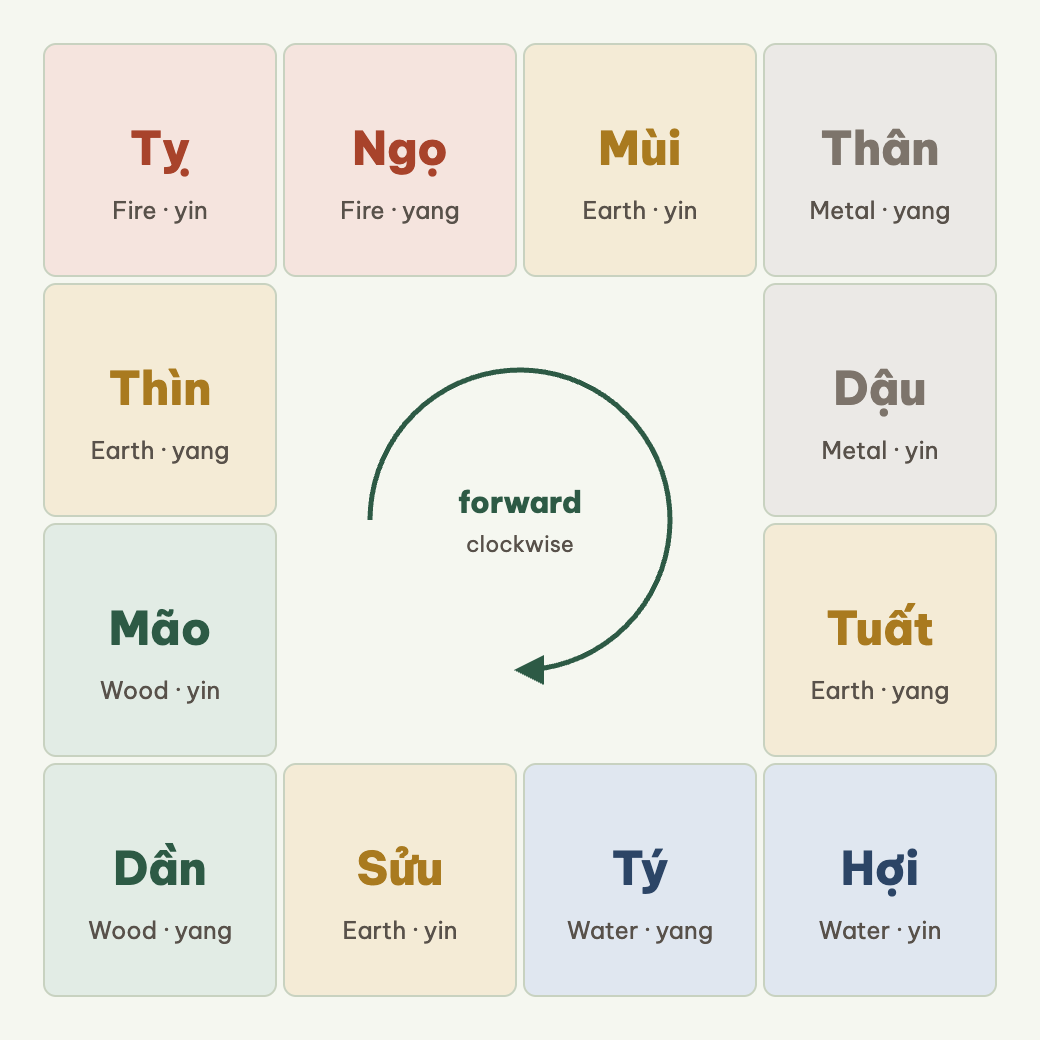
The practical handling is: choose one standard source, state clearly which source is being followed, and when programming the placement core, put these two stars into the calculation core before generating the table, rather than looking them up by hand case by case. The reason is that their position depends on a single variable, the birth year's heavenly stem, so putting them into the core is simple and removes manual lookup errors. The ten-stem table above, if machine-generated from a source-locked base table, will give consistent results for every chart.
The question "according to which book" has no single correct answer for every school. What matters is transparency: state clearly whether the table follows Dau So Tinh Thanh or another source, and if there are variant versions, place them side by side for readers to compare.
Points to remember when interpreting Quan Phuc
- These are auxiliary stars of the Earth element, Yang nature, in the fortune-star and benevolent-star group.
- Placed by the birth year's heavenly stem, not by branch, not by hour, not by day.
- Thien Quan leans toward strong rescue and noble prominence, Thien Phuc toward gentle rescue and easy fortune.
- Whichever palace either occupies is considered beneficial to that palace, but the degree depends on the surrounding star combination.
- "Quy nhan" in the name describes the rescue function, not a promise of a person who will come to help.
- Sources disagree on the At and Binh stems, so state the source when looking up.
- The "spiritual practice" reading and the traditional "rescue the suffering and aid the endangered" reading differ in focus, can coexist, but the reading followed should be stated.
- Rescuing stars lighten and soften, they do not replace taking care of oneself.


