
What is Tam Hinh in Bat Tu?
Tam Hinh is a set of relationships among the earthly branches, formed into four groups: Dan Ty Than, Suu Tuat Mui, Ty Mao, and the four self-punishing branches Thin, Ngo, Dau, Hoi. Unlike luc xung (direct opposition) or luc hop (binding), hinh describes an off-axis collision where the relationships of generation and control are reversed or disordered. The text Uyen Hai Tu Binh has a section titled "The Twelve Branches in Mutual Punishment" listing all these groups, while Tu Binh Chan Thuyen devotes a chapter, "On Punishment, Clash, and Combination," to discussing how to interpret them.
One thing must be said at once to avoid misunderstanding: hinh is not a verdict. It is a type of relationship, and its value depends on the entire chart. The same Ty Mao pair may bring family troubles for one person, while another only experiences inner conflict and adjusts on their own.
Why do texts group Dan Ty Than, Suu Tuat Mui, and Ty Mao into three punishment groups?
These three groups are not arranged by a shared element, but by three different kinds of reversed relationship. This is a point that classical texts emphasize and that many students memorize without noticing.
Dan Ty Than: tri the chi hinh (punishment of reliant power)
Dan is wood, Ty is fire, Than is metal. In the generative cycle, Dan wood generates Ty fire, Ty fire controls Than metal. It should be an orderly sequence of generation then control, but when all three appear together they punish one another. Classical texts call this tri the chi hinh, meaning the powerful rely on one another and then turn to oppress one another. Old texts also call this group vo an hinh (punishment of ingratitude), arguing that Dan generates Ty, Ty generates Than, yet what is generated harms what generated it.
Suu Tuat Mui: vo an chi hinh (punishment of ingratitude)
Suu, Tuat, and Mui all belong to earth, but are three different states of earth: Suu is damp earth, Tuat is dry earth, Mui is mixed earth. Three things of the same element yet punishing one another, so texts call it vo an chi hinh: same household, same element, yet still in conflict. This group is often linked to internal matters, siblings, colleagues, and superior-subordinate relations.
Ty Mao: vo le chi hinh (punishment of disrespect)
Ty is water, Mao is wood. Water generates wood, so Ty is seen as the parent of Mao, like mother and child. But these two branches punish each other, so texts call it vo le chi hinh: the child does not keep propriety toward the one who gave it life. Some documents also call this pair ho hinh (tiger punishment), and in classical Liu Ren texts it is named tu bai tuong hinh (death-defeat mutual punishment), because according to the twelve-stage life cycle Ty is the death stage and Mao is the defeat stage.
Self-punishment: Thin, Ngo, Dau, Hoi
The four branches Thin, Ngo, Dau, Hoi are considered self-punishing, meaning they punish themselves. Classical texts describe it as a person holding a knife and wounding themselves, with no one else to blame. This is the most special type, because it does not need a second branch of a different kind to form a punishment.
Table of punishment groups and the elements of each branch
| Punishment group | Name | Component branches | Element of each branch |
|---|---|---|---|
| Dan Ty Than | Tri the chi hinh, also called vo an hinh | Dan, Ty, Than | Dan wood, Ty fire, Than metal |
| Suu Tuat Mui | Vo an chi hinh | Suu, Tuat, Mui | Suu damp earth, Tuat dry earth, Mui mixed earth |
| Ty Mao | Vo le chi hinh, also called ho hinh | Ty, Mao | Ty water, Mao wood |
| Self-punishment | Tu hinh | Thin, Ngo, Dau, Hoi | Thin earth, Ngo fire, Dau metal, Hoi water |
Note: the names of these groups are not consistent across texts. The same Dan Ty Than group is called tri the in some books and vo an in others. The same Ty Mao pair is called vo le in some and ho hinh in others. Readers should grasp the component branches first, names second.
When does punishment actually take effect in a chart?
This is the most practical question, and also where many popular texts answer too quickly.
Full set of three branches
For Dan Ty Than, most documents hold that all three branches must be present for the punishment meaning to be clear. If only two of the three appear, their relationship is judged by other rules: Dan with Ty takes mutual harm as primary, Dan with Than takes luc xung as primary, Ty with Than takes luc hop as primary. Punishment then becomes only a secondary effect. This is a very important point, because it explains why many charts have Dan and Than without anything serious happening: that pair is in clash, not in punishment.
Missing one character
When one character is missing, the punishment pattern does not form. Then one should read by the strongest relationship present. For example, a chart with Ty and Than but no Dan: Ty Than luc hop is the main theme, not punishment.
Resolved by combination
Tu Binh Chan Thuyen, in the chapter "On Punishment, Clash, and Combination," discusses that punishment and clash can be resolved by combination. If a punished branch joins a strong three-combination or six-combination, the punishment effect may diminish or disappear. Some texts even say plainly: punishment meeting combination is no longer as concerning as when it stands alone.
Does self-punishment require two identical characters to appear?
This is where schools disagree. Some hold that self-punishment only forms when that branch appears two or more times in the four pillars, for example two Thin characters, two Ngo characters. Others hold that a single self-punishing branch in an important position, combined with a coming luck period, is already activated. Uyen Hai Tu Binh lists self-punishment as a separate entry without specifying a quantity condition. Students should know both readings and weigh them according to the chart.
How do different schools read punishment?
This part needs to be stated clearly to avoid presenting it as if there were only one interpretation.
Tu Binh Chan Thuyen, in the chapter "On Punishment, Clash, and Combination," tends to downplay punishment. It holds that some forms of punishment are harmless to the destiny, and that combination can resolve punishment and clash. In other words, Chan Thuyen places punishment in a secondary position relative to the useful god and the structure.
Conversely, many popular texts and some empirical documents read punishment quite heavily: punishment is tied to litigation, accidents, gossip, family conflict. This reading has support in old lines such as "punishment governs injury and ruin," but stopping there easily misses layers of meaning. Some documents also record the line "tam hinh dac dung, uy tran tam bien," meaning that punishment, if used correctly, can become authority; used wrongly, it becomes disaster.
So when interpreting a chart with punishment, one must consider: is the punishment complete, is it resolved by combination, what is the useful god of the chart, and is the punishment serving or destroying that useful god. One should not conclude merely from seeing the character for punishment.
The case of Dan Ty Than where punishment and the Ty Than combination coexist
This is the most subtle point of the Dan Ty Than group. Within the same group, Ty and Than are also a luc hop pair. That means when all three branches appear, the chart has both a punishment pattern and a combination pair within it.
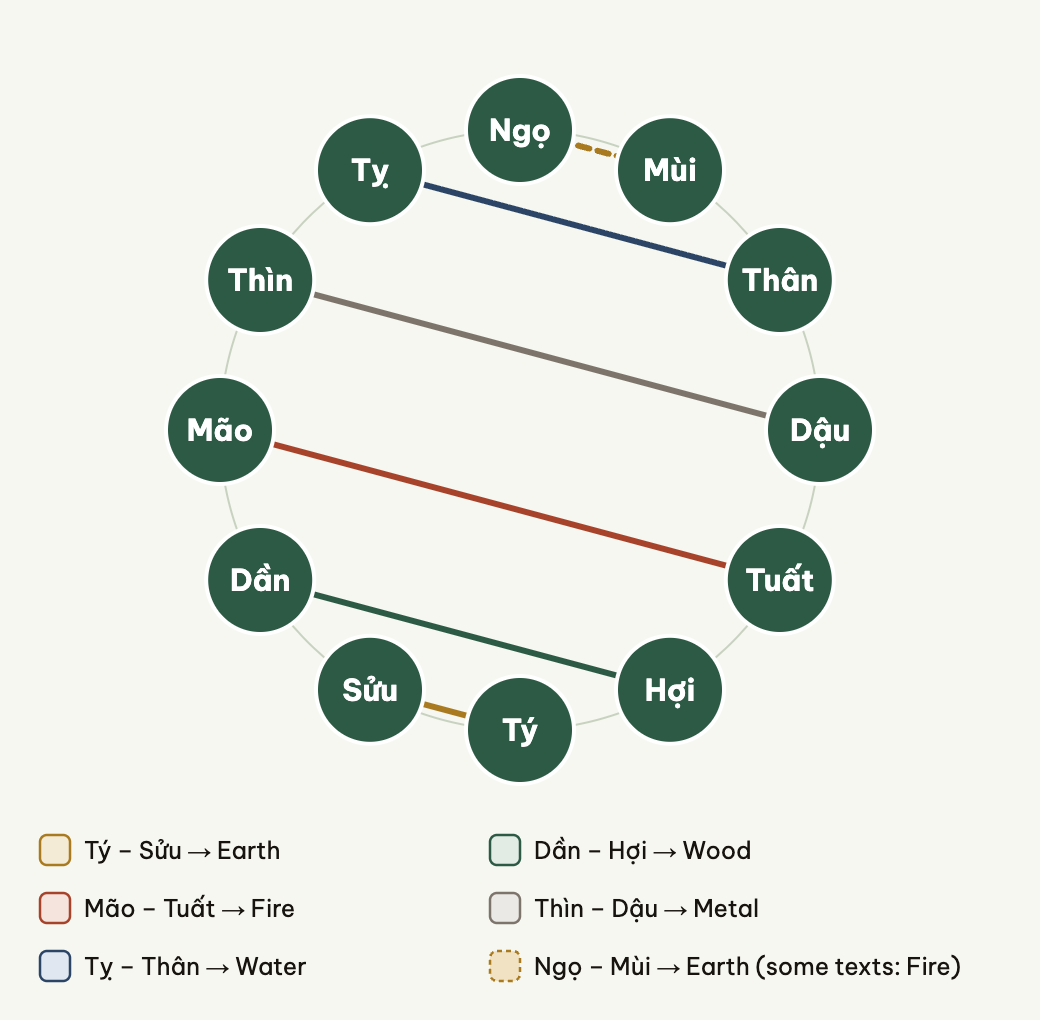
The common reading is: Ty Than combine first, then Dan punishes into them. Or conversely, Dan's punishment breaks the Ty Than combination. Classical texts are not fully consistent on this order. Some documents hold that combination can soften punishment, while others hold that punishment breaks combination so the punishment still applies. Students should note both readings and test them on specific charts rather than choosing one side in advance.
Reading punishment within the whole chart
One point to emphasize: this article does not read punishment as specific illness or accident. Punishment is a relationship, and its manifestation depends on the six relations, palace positions, ten gods, and luck periods. The same Ty Mao in the year pillar tells a different story than in the hour pillar. The same Suu Tuat Mui as a favorable god tells a different story than as an unfavorable god.
Therefore, when seeing punishment in a chart, what should be done is to determine: where the punishment sits, which six relation it involves, whether it serves or destroys the useful god, and which luck period will activate it. That is a far more useful reading than assigning a predetermined outcome.
A few notes for research and study
First, the names of punishment groups are not consistent between Vietnamese and Chinese texts. Learn by component branches first, names second.
Second, do not confuse punishment with clash or harm. These three relationships differ in mechanism and in manifestation. This article is a deep branch of the topic of punishment, clash, combination, and harm, so it does not repeat the tables of luc hop, luc xung, and luc hai.
Third, sources on forums may copy classical texts with errors. Compare at least two sources before using an old line as a basis.
Fourth, punishment is not for scaring people. It is a tool of interpretation, and any tool needs to be placed correctly to be useful.


