
What Is the Thủy Hỏa Ký Tế Hexagram?
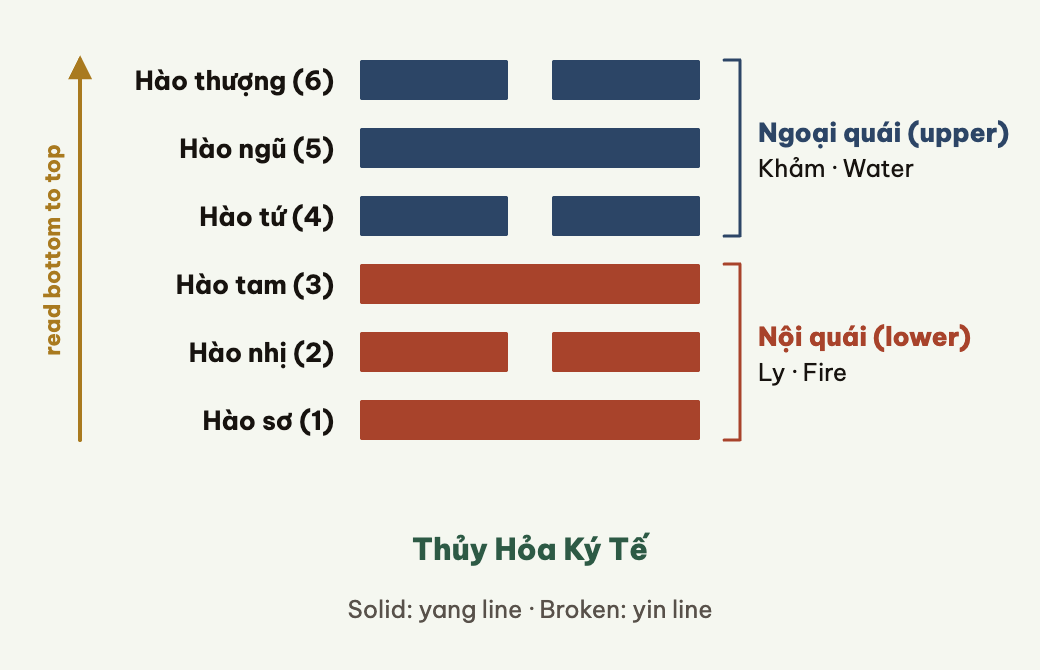
Thủy Hỏa Ký Tế (水火既濟, ䷾) is hexagram 63 of the 64 Kinh Dịch hexagrams in the King Wen sequence. Another name is Ký Tế (既濟). Ký means already, tế means to cross a river; Ký Tế means the river has been crossed, the work is done. The hexagram consists of the inner (lower) trigram Ly ☲ representing fire and the outer (upper) trigram Khảm ☵ representing water, hence it is also called Thủy Hỏa Ký Tế, water above fire. Its Five Elements phase belongs to Water. The hexagram has three yang and three yin lines perfectly alternating in their correct positions. It is the only hexagram among the 64 where all six lines are in correct position (yang in odd places, yin in even places) and all are paired (line 1 with line 4, line 2 with line 5, line 3 with line 6). In Dịch studies, this absolute perfection is a sign that there is nothing left to advance toward, everything has reached its peak and is beginning to risk turning into its opposite.
The Judgment and the Image of the Thủy Hỏa Ký Tế Hexagram
The Judgment (Thoán từ)
Original Sino-Vietnamese text: 既濟:亨小,利貞,初吉終亂。
Ký Tế: Hanh tiểu, lợi trinh, sơ cát chung loạn.
Meaning: Ký Tế means already done, already crossed the river. Small success, holding firm brings benefit, good at first, chaos at the end. The last three words 'sơ cát chung loạn' are the focus: good at the beginning, chaotic later. When everything is completed, people easily lose their goal, become lax, arrogant, and that is the seed of later collapse. The judgment warns that the period after completion is more dangerous than the period of doing.
The Image (Tượng từ)
Original Sino-Vietnamese text: 水在火上,既濟。君子以思患而預防之。
Thủy tại hỏa thượng, Ký Tế. Quân tử dĩ tư hoạn nhi dự phòng chi.
Meaning: Water above fire, that is the image of Ký Tế. The noble person accordingly thinks of adversity and prepares in advance. Water above fire means the pot is boiling, everything is running correctly. But if the fire goes out, the water cools; if the water runs dry, the pot burns. A perfect state always needs to be actively maintained. The Image advises: do not wait for breakdown to fix it, think ahead about possible bad outcomes and prepare.
The Six Lines of the Thủy Hỏa Ký Tế Hexagram and Their Explanations
The six lines of Ký Tế describe six states after the work is done, from initial caution to gradual laxity. Read from the bottom up: Sơ Cửu is the lowest line, Thượng Lục the highest.
| Line | Original Sino-Vietnamese | Meaning | Commentary |
|---|---|---|---|
| Sơ Cửu (line 1) | 曳其輪,濡其尾,無咎 / Duệ kỳ luân, nhu kỳ vĩ, vô cữu | Pulling back the wheel, wetting the tail. No harm. | Yang line in yang position, talented, at the start of inner trigram Ly (fire) with a hot temper and great ambition. The line advises caution, slowing the wheel, like a fox going slowly so its tail gets wet but the task succeeds. Do not rush into the next task. |
| Lục Nhị (line 2) | 婦喪其茀,勿逐,七日得 / Phụ táng kỳ phất, vật trục, thất nhật đắc | The wife loses her carriage curtain, do not chase, in seven days it will be regained. | Yin line in the middle of inner trigram Ly, with civilized virtue, central and correct. It is paired with line 5 yang and strong, but in the Ký Tế time when work is done, line 5 pays no attention to line 2, so line 2 is like a woman who lost her carriage curtain. Because she is central and correct, do not waste effort chasing, just wait and it will naturally come as desired. The number 7 represents movement; only with movement is there change, and only with change is there flow. |
| Cửu Tam (line 3) | 高宗伐鬼方,三年克之,小人勿用 / Cao Tông phạt Quỷ Phương, tam niên khắc chi, tiểu nhân vật dụng | King Cao Tông attacked Quỷ Phương, took three years to win. Do not employ petty people. | Yang line in yang position, overly strong, prone to recklessness. Must be cautious like Vũ Đinh (King Cao Tông of the Shang dynasty, around 1324-1264 BCE) attacking the small state of Quỷ Phương, taking three years to subdue it. Advice: do not employ petty people. |
| Lục Tứ (line 4) | 繻有衣袽,終日戒 / Nhu hữu y nhự, chung nhật giới | Have patched clothes ready, be vigilant all day. | Has begun to ascend to outer trigram Khảm, a dangerous period, with rumblings of bandits to guard against. Like a person on a boat who, if water leaks in, must have rags to plug the hole. Yin line in yin position, correct, a cautious person who knows fear. |
| Cửu Ngũ (line 5) | 東鄰殺牛,不如西鄰之禴祭,實受其福 / Đông lân sát ngưu, bất như tây lân chi thược tế, thực thụ kỳ phúc | The eastern neighbor slaughters an ox for a great sacrifice, not as good as the western neighbor's simple sacrifice, which truly receives blessing. | The east is line 5, the west is line 2. Both are central and correct, equally sincere. Line 5 in the supreme position makes a great sacrifice, but when it comes to receiving blessing, line 2 is better, because line 2 is at the start of Ký Tế with strong advancing power and much future ahead. |
| Thượng Lục (line 6) | 濡其首,厲 / Nhu kỳ thủ, lệ | Wetting the head. Danger. | Yin line at the end of the hexagram, the Ký Tế time has reached its extreme. Like a person wading across a river getting their head wet, dangerous. The line warns of the consequences of complacency and laxity when everything is done. |
Why Is 'Done' Considered the Most Dangerous Moment?
When everything is completed, people easily fall into a state of lost direction, laxity, arrogance. This is the most dangerous moment because there is no longer motivation to strive, and mistakes are easy. The Ký Tế hexagram warns that absolute perfection is only temporary; if not actively maintained, it will quickly decline. The Image advises 'tư hoạn nhi dự phòng chi', think of adversity and prepare in advance. Historically, many dynasties collapsed not because of weakness at the start but because of complacency at the peak. The book Khổng Minh Thần Toán has poem cards for each line of this hexagram, but those are cards from another book, not the Chu Dịch line texts, so they are not mixed into the line commentary above.
Is the Thủy Hỏa Ký Tế Hexagram Auspicious or Inauspicious?
It cannot be absolutely stated whether this hexagram is auspicious or inauspicious. Ký Tế carries the meaning 'the work is done', like the image of 'having one's name on the golden tablet', a time of prosperity, success, everything going smoothly. However, the judgment also warns 'sơ cát chung loạn', good at first, chaos at the end. When everything is completed, people easily lose their goal, become lazy, and begin to decline. Therefore, one must be cautious, not arrogant, not negligent, and should not undertake new development plans without careful preparation. Different Dịch schools may emphasize different aspects: some focus on the hexagram's success, others on the 'chung loạn' warning. This article presents both sides so the reader has a comprehensive view.
Which Hexagrams Is Thủy Hỏa Ký Tế Related To?
According to the transformation principles of Kinh Dịch, the Ký Tế hexagram has the following relationships:
| Type of relationship | Hexagram name | Number | Note |
|---|---|---|---|
| Nuclear hexagram (Hỗ quái) | Hỏa Thủy Vị Tế | 64 | The nuclear hexagram is formed by lines 2, 3, 4 as the inner trigram and 3, 4, 5 as the outer trigram. For Ký Tế, the nuclear hexagram is Hỏa Thủy Vị Tế. |
| Opposite hexagram (Thác quái) | Hỏa Thủy Vị Tế | 64 | The opposite hexagram is the one with completely opposite yin-yang lines. Ký Tế (Ly above Khảm) becomes Vị Tế (Khảm above Ly). |
| Reversed hexagram (Tổng quái) | Hỏa Thủy Vị Tế | 64 | The reversed hexagram is the original turned upside down. Ký Tế reversed becomes Vị Tế. |
Thus, the nuclear, opposite, and reversed hexagrams of Ký Tế are all Hỏa Thủy Vị Tế (hexagram 64). This shows the close link between the two: Ký Tế is done, Vị Tế is not done. When done, if not maintained, it returns to the not-done state.
Applying the Thủy Hỏa Ký Tế Hexagram in Life
The Ký Tế hexagram reminds that after achieving success, special attention must be paid to preserving the results. At work, when a project is completed, do not rush to rest but prepare for the next phase, and review factors that could cause risk. In finance, when savings are accumulated, be cautious in investment, avoid complacency leading to loss. In relationships, when stability is achieved, continue to nurture, avoid laxity. The hexagram does not assert absolute auspiciousness or inauspiciousness but emphasizes proactive prevention. Some ancient documents record cases of casting Ký Tế but work not going well, yet achievement in a secondary field, showing the hexagram needs interpretation in specific context.
Different Schools of Interpretation of the Thủy Hỏa Ký Tế Hexagram
There are many different understandings of the Ký Tế hexagram. Some commentators emphasize 'small success' and hold that the hexagram is about success but only at a moderate level. Others focus on the 'sơ cát chung loạn' warning and see it as a hexagram of transformation from prosperity to decline. Meanwhile, some documents emphasize the Image text 'tư hoạn nhi dự phòng chi' and consider it advice on risk management. This difference reflects the polysemy of Kinh Dịch; each person can draw a lesson suited to their circumstances. This article does not assert any single understanding as uniquely correct, but presents viewpoints for the reader's reference.
Frequently Asked Questions
Is the Thủy Hỏa Ký Tế Hexagram a Good Hexagram?
The Thủy Hỏa Ký Tế hexagram carries the meaning of work completed, small success, holding firm brings benefit. However, the judgment also warns 'sơ cát chung loạn', good at first but the end tends to chaos. Therefore, it cannot be said to be absolutely good or bad. The important thing is that after achieving success, one must continue to be cautious, prevent risks, and not be complacent or lax.
Why Is the Thủy Hỏa Ký Tế Hexagram Considered the Only One with All Six Lines in Correct Position?
In the 64 Kinh Dịch hexagrams, each line has a position from 1 to 6, where odd positions (1, 3, 5) are yang positions and even positions (2, 4, 6) are yin positions. A line is called correct when a yang line is in a yang position or a yin line in a yin position. The Thủy Hỏa Ký Tế hexagram has the structure Sơ Cửu (yang in position 1), Lục Nhị (yin in position 2), Cửu Tam (yang in position 3), Lục Tứ (yin in position 4), Cửu Ngũ (yang in position 5), Thượng Lục (yin in position 6). All six lines are in correct position. In addition, the lines are paired: line 1 with line 4, line 2 with line 5, line 3 with line 6. This is the only hexagram among the 64 where all six lines are both in correct position and paired.
How Does the Thủy Hỏa Ký Tế Hexagram Differ from the Hỏa Thủy Vị Tế Hexagram?
The Thủy Hỏa Ký Tế hexagram (No. 63) has inner trigram Ly (fire), outer trigram Khảm (water), the image of water above fire, indicating work done. The Hỏa Thủy Vị Tế hexagram (No. 64) has inner trigram Khảm (water), outer trigram Ly (fire), the image of fire above water, indicating work not done. These two hexagrams are an opposing and transforming pair: Ký Tế is the nuclear, opposite, and reversed hexagram of Vị Tế, and vice versa. When done (Ký Tế) but not maintained, it returns to not done (Vị Tế), and when not done (Vị Tế) but with effort, it moves to done (Ký Tế).
Structure of the Thủy Hỏa Ký Tế Hexagram in a Table
| Item | Value |
|---|---|
| Order in Chu Dịch | 63 |
| Chinese characters | 既濟 |
| Upper trigram | Khảm (Water) |
| Lower trigram | Ly (Fire) |
| Six lines, from top down | yin, yang, yin, yang, yin, yang |
| Nuclear hexagram | Hỏa Thủy Vị Tế (hexagram 64) |
| Opposite hexagram | Hỏa Thủy Vị Tế (hexagram 64) |
| Reversed hexagram | Hỏa Thủy Vị Tế (hexagram 64) |


