



Image: The Metropolitan Museum of Art (Public Domain)
TL;DR: The Year Pillar (Heavenly Stem and Earthly Branch of birth year) is one of four pillars in BaZi, representing ages 0-16, relationship with grandparents/ancestors, and the social environment of one's early years. It is determined by the sexagenary cycle of the birth year.
What is the Year Pillar in Bát Tự (Four Pillars)?
The Year Pillar is the first of the four pillars, determined by the pair of Heavenly Stem and Earthly Branch of the birth year according to the Can Chi calendar. It is an input to the whole chart, not the scale used to weigh the chart. To understand what it contributes, it must be placed in the correct chain of reasoning of the discipline: fix the Can Chi of the four pillars, read the month command, measure strength and weakness, determine the structure, and only then choose the useful god. This article follows that exact chain, and pauses at each step to make the basis of that step clear.
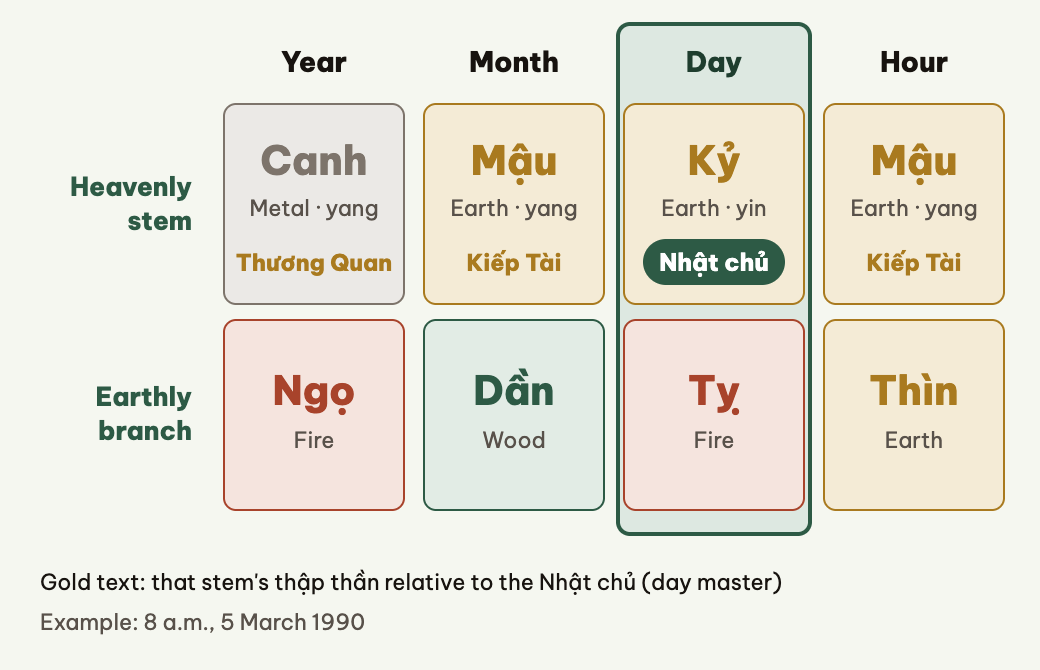
What is its nature and how is the Year Pillar determined?
Unlike counting years by the solar calendar, the Year Pillar is calculated according to the Can Chi calendar, a traditional Eastern calendar system. This system is not only for counting days and months, but is the foundation for astrology and many other scholarly fields.
The rule for determining the Can Chi of a year is described as a simple calculation:
- Determining the Heavenly Stem: Take the remainder `a` of dividing year X by 10, and look it up in the convention table. Years ending in 0 have the Stem Canh (Canh = 0), ending in 1 is Tân, 2 is Nhâm, 3 is Quý, 4 is Giáp, 5 is Ất, 6 is Bính, 7 is Đinh, 8 is Mậu, 9 is Kỷ.
- Determining the Earthly Branch: Take the remainder `b` of dividing year X by 12, and look it up in the convention table. The year 2020 divided by 12 leaves a remainder of 4, and looking it up in the table gives the Branch Tý.
A typical example: The year 2020 has the Stem Canh (because 2020 divided by 10 leaves a remainder of 0) and the Branch Tý (because 2020 divided by 12 leaves a remainder of 4), therefore the year 2020 is the year Canh Tý. A person born in 1990 has the Year Pillar Canh Ngọ (Canh because it ends in 0, Ngọ because 1990 divided by 12 leaves a remainder of 10).
There is one point to settle immediately, because it affects every later step: the Bát Tự year does not begin on January 1 of the solar calendar. It begins at Lập Xuân, the first solar term of spring. People born in January or early February of the solar calendar usually have to check the solar term again to know which Can Chi year they belong to. If this step is skipped, the entire Year Pillar and, following from it, the Month Pillar as well, will be wrong from the root.
Is the Year Pillar a favorable or unfavorable factor when the self is strong or weak?
The Year Pillar becomes a useful god only when its element falls exactly into the element needed for supplementation or restraint after balancing the month command, strength or weakness, and structure. When the self is strong, the Year Stem and Branch carrying an element that controls or drains qi is usually favorable, while carrying an element that generates or supports becomes unfavorable. When the self is weak, the Year Pillar generating or supporting the Day Master is favorable, but if it is controlled by the month command and other pillars, its supporting power weakens. The Year Pillar can also be an intermediate element for support and restraint, mediation, climate adjustment, or disease and remedy, and in follow structures it complies with the dominant element rather than opposing it. To fully grasp this, see What is the 'Useful God' (Yong Shen) in BaZi (Four Pillars)? and Strong Self, Weak Self.
What is the role of the Year Pillar in a Bát Tự chart?
The Year Pillar is not merely a time marker. In the Four Pillars structure, each pillar carries its own layer of symbolic meaning, reflecting different relationships and stages of a life.
Representing ancestors and lineage
The Year Pillar is considered the "root" of the tree of life, symbolising grandparents, ancestors and the paternal line. It reflects part of the heritage, the blessings (or karma) that a person inherits from their family. If the Year Pillar is strong and supported, that person usually has a good background, sheltered by their family. Conversely, if the Year Pillar is damaged, it can indicate distance, or little support received from the clan.
It should be noted that the assessment of "strong" or "damaged" here only has meaning after the useful god has been chosen. A strong Year Pillar is not necessarily good, if its element is the unfavourable god. A weak Year Pillar is not necessarily bad, if its element is the favourable god and it is being over-restrained.
Reflecting the early years (ages 0 to 16)
The Year Pillar represents the fortunes of the first 16 years of life (from birth up to before 16). This is the stage when a person is entirely dependent on their family. Therefore, the Year Pillar describes the living environment of childhood, the relationship with grandparents, and the foundational experiences that shape early character. A Year Pillar with a harmonious combination of Stem and Branch usually indicates a peaceful childhood with few upheavals.
Expressing the social environment and circumstances of birth
The Earthly Branch of the Year Pillar is also used to examine the social environment, homeland, country where a person was born. It can also reveal something about the occupation and status of the parents in the social context of that time. For example, a person whose Year Pillar carries the element Fire may be born in a land with a warm climate, or have parents working in a field related to fire (energy, engineering, media...).
How does the Year Pillar interact with the other pillars?
According to the philosophy of the Five Elements, the pillars in a Bát Tự chart do not exist independently but always interact, generating and controlling one another. The Year Pillar plays the role of the "foundation", with a close relationship to the Month Pillar (representing parents and career) and the Day Pillar (representing the self and marriage).
| Relationship | Meaning |
|---|---|
| Year Pillar generates Month Pillar | The family and clan have blessings, giving good support to career and parents. |
| Month Pillar generates Year Pillar | Parents or ancestors have a good influence, and the person receives education and protection from childhood. |
| Year Pillar controls Month Pillar | There may be a hidden clash between the clan and the immediate family, or the person may have to become independent early. |
| Year Pillar clashes with Day Pillar | The relationship with grandparents and ancestors may not be close, or there may be a departure far from one's homeland. |
This table should be read together with the month command, not on its own. Because the Month Pillar holds the month command, the relationship between the Year Pillar and the Month Pillar is always governed by the season currently holding power. A Year Pillar generating the Month Pillar in a season when that element is weak may not bring the effect the table describes, because the supporting element is itself weak.
What are the applications of the Year Pillar in interpretation?
In the practice of Bát Tự interpretation, the Year Pillar is usually used to:
- Interpret ancestors and inherited blessings: Examine the strength or weakness of the Can Chi of the Year Pillar to assess the spiritual "black box" the family has passed down.
- Interpret the younger years: Combine the Year Pillar with the first major cycle to predict major events in the first 16 years of life, such as schooling, health, and family upheavals.
- Examine relationships with relatives: The Year Pillar represents grandparents, especially paternal grandparents. The harmony or clash between the Year Pillar and the Day Pillar (the self) can reflect the degree of closeness.
- Determine the base destiny (Nạp Âm): The Can-Chi pair of the Year Pillar is also used to look up Nạp Âm (for example: the year 1990 is Canh Ngọ, whose Nạp Âm is Lộ Bàng Thổ). This is an important piece of information in many schools of interpretation.
Limitations and an objective view
It must be emphasised that Bát Tự is a doctrine grounded in experience and philosophy, not an absolutely exact science. The Year Pillar is only one part of the overall picture. Interpreting a chart requires looking comprehensively at all four pillars together with their complex interactions. A single pillar should not be used to draw decisive conclusions about a person's destiny, wealth or health. Treat Bát Tự as a tool for understanding yourself and those around you more deeply, and from there living a more active and meaningful life.
Speaking specifically of the Year Pillar, there are two limitations to remember. First, it is farthest from the Day Master of the four pillars, so its direct impact on the self is usually weaker than that of the Month Pillar and the Hour Pillar. Second, most of the Year Pillar's meaning is symbolic meaning about origins, not technical data used to choose the useful god. Mixing these two kinds of meaning together is a common mistake, leading to taking a symbolic detail as a technical basis.


