What is Tam Long and why must one travel from far to near?
Tam Long is tracing a mountain range backward from its distant source peak to where the vein settles, to determine which vein is true, which is false, and where a huyet is worth placing. The book Phuong phap tam Long Mach opens with the principle: first the highest peak is the to, the next peak is the tong, then the two flanking peaks are the phu mau, and only then does one examine the terrain to find the huyet. The reason for going far is that a long from afar has a long vein and receives much water, while a long from nearby has a short vein and receives little water.
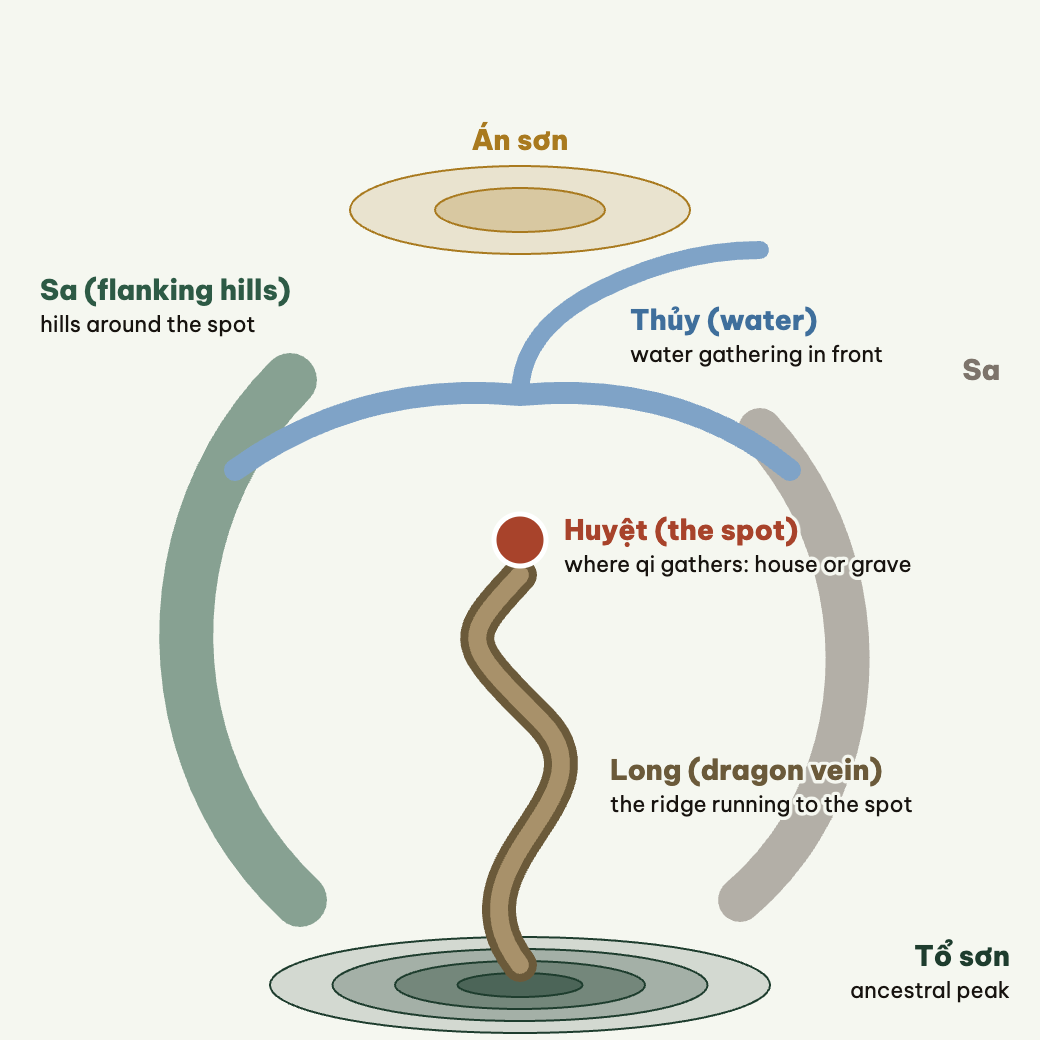
In other words, Tam Long is not standing in one place looking around and pronouncing. It is an upstream journey, requiring the walker to follow mountain forms, watercourses, and branching offshoots to find the root.
Which types of son does the Tam Long sequence pass through?
The book Nhap mon loan dau: tam long diem huyet divides the vein from source to settlement into four main son. The first is to tong son, the headwater of the dragon vein, a majestic peak surpassing all others, surrounded by ten thousand mountains, from which all veins issue. The second is thieu to son, a peak that suddenly rises while the long is moving, taller than all others but still lower than the to son.
The third is phu mau son, the qua hiep of a proper formation, where the vein narrows before opening out to settle. The fourth is huyet tinh son, where the tinh phong settles into a huyet. Between phu mau son and huyet tinh son lie four stages, thai, tuc, dung, duc, describing how the vein accumulates sinh khi before coalescing into a huyet.
How do qua hiep, thuc yet, and long nhap thu differ?
Qua hiep is where the vein narrows, gathering khi into a tight point before opening again. Thuc yet are the smaller constrictions along the way, section by section. Long nhap thu is the stretch of vein pouring into the huyet truong, the final point before settlement. The book Phuong phap tam Long Mach stresses that one must distinguish long nhap thu, because this is what decides whether sinh khi can enter the huyet.
According to the same book, the direction of a long is determined by water: if there is minh thuy, take minh thuy as the standard; if there is no minh thuy, take rainwater as the standard, since water flowing to the low point is an eternal rule. Phuong lai thuy is regarded as the thuy to of the dragon vein, and where water gathers is exactly where the huyet settles.
How are true long and false long distinguished?
True long is a vein carrying abundant, flourishing, complete sinh khi, able to settle a huyet that brings wealth and honour. False long is a vein lacking sufficient sinh khi, or whose form looks fine but in truth does not gather khi. The book Phuong phap tam Long Mach states the principle clearly: if the long arrives from a great distance, wealth and honour will last long; if the long is short, wealth and honour will not last.
One important point: according to Phuong phap tam Long Mach, if the nhap thu contradicts the sinh vuong of the four cuc and offends the bat sat, then however beautiful the form, it becomes a false long. This shows that true long is not only a matter of outward form, but depends on the harmony between the long and the direction of the huyet.
Types of long by form and by khi the
The book Phuong phap tam Long Mach classifies long by shape into nine types: hoi long, xuat duong long, giang long, sinh long, phi long, ngoa long, and others. Each has its own features. For example, hoi long is a winding posture turning back toward the to tong like a dragon coiled and a tiger seated. Xuat duong long is a posture reaching outward like a beast leaving the forest. Giang long is a posture standing majestic like entering court and taking the great seat.
The book also classifies long by khi the into types such as thuan long, nghich long, tien long, thoai long, phuc long, benh long, kiep long, sat long. The table below summarises the main types of long with their features and the book's assessment.
| Type of long | Form features | Book's assessment |
|---|---|---|
| Tien long | Mountains layered one after another, branches even as if embracing downward, hau long rising step by step | Very good |
| Thoai long | Mountains disordered, arms and legs shortening, long retreating backward, starting small and growing larger behind | Very bad |
| Phuc long | Both sides sealed, front and back cared for, limbs not large but with granaries, clear mountains and beautiful water | Brings lasting fortune |
| Benh long | Body incomplete, one side alive one side dead, one side fine one side poor, one side sealed one side lacking | A bad long, half auspicious half inauspicious |
| Kiep long | Many branches but none upright, scattered east and west, true khi dispersed | Not good |
| Sat long | Carrying sat khi, rocky and perilous, jagged | Very bad |
Note that this classification differs between books. While Phuong phap tam Long Mach gives the list above, some other documents divide long into can long, chi long, chan long, gia long, benh long, tu long, lai long, khi long, truc long, hoanh long, phi long, tiem long. Schools do not fully agree on the categories, but the common principle is to judge by form and khi the.
Reading mountains by ngu tinh and cuu tinh hinh the
When tracing a long, the ancients read mountain shapes to infer their ngu hanh attribute. A round mountain with a blunt top is kim tinh. A pointed, soaring mountain is hoa tinh. A square, flat mountain is tho tinh. A long, winding mountain is moc tinh. A rippling, soft mountain is thuy tinh. These are the basic forms, and each has good and bad depending on position and relation to the huyet.
The table below summarises ngu tinh mountain shapes with their hanh and general assessment.
| Mountain shape | Hanh | Identifying features | General assessment |
|---|---|---|---|
| Kim tinh | Kim | Round, blunt top, bulging body | Usually good, brings wealth and honour, but position must be checked |
| Moc tinh | Moc | Long, winding, upright | Good if winding with feeling, bad if dry and stiff |
| Thuy tinh | Thuy | Rippling, soft, meandering | Good, brings sinh khi, but distorted shapes are inauspicious |
| Hoa tinh | Hoa | Pointed, soaring, sharp-edged | Usually bad if standing alone, good if serving as an an son |
| Tho tinh | Tho | Square, flat, broad | Good, brings stability, but low-lying hollows are inauspicious |
However, one must distinguish clearly: names such as Tham Lang, Cu Mon, Loc Ton, Van Khuc, Liem Trinh, Vu Khuc, Pha Quan, Ta Phu, Huu Bat in cuu tinh hinh the refer to mountain FORM, not to Huyen Khong stars. Phuong phap tam Long Mach mentions cuu tinh, but this is a way of naming terrain by cuu tinh, different from the star system in Huyen Khong phi tinh used to calculate period energy over time.
Duong Cong used cuu tinh, other books use ngu tinh
By tradition, Duong Cong (Duong Quan Tung) is credited with systematising cuu tinh hinh the, dividing mountains into nine types corresponding to the nine stars of the Big Dipper. Many other dia ly books use only ngu tinh, the five basic hanh. This difference is not a contradiction but two classifications of differing detail. Ngu tinh is the foundation, cuu tinh the extension. A student needs to know which system they follow to avoid confusion when reading books.
Ta Ao and the dia ly books bearing his name
Ta Ao, or Ta Ao tien sinh, is honoured as the Holy Master of Dia Ly, the first Vietnamese to learn orthodox dia ly in China, according to Bao Ha Tinh. He was from Ta Ao village, formerly of Hoa Vien canton, Duc Quang prefecture, Nghe An garrison, now Xuan Giang commune, Nghi Xuan district, Ha Tinh province. He is regarded as the founding master of Vietnamese dia ly phong thuy, widely learned and highly talented, yet he did not take office but roamed the world helping people choose good land.
However, his biography has points of disagreement. According to Bao Quan doi nhan dan, the books Viet Nam phong tuc and Nam Hai di nhan by Phan Ke Binh record his real name as Nguyen Duc Huyen. Lich trieu hien chuong loai chi by Phan Huy Chu records his name as Hoang Chiem or Hoang Chi. Nghi Xuan dia chi by the tu tai Le Van Dien, written in 1842, records his name as Vu Duc Huyen, courtesy name Dia Tien.
On birth year, researchers estimate around the year Nham Tuat (1442), under the Early Le, but some documents hold that Ta Ao tien sinh lived under King Le Hy Tong (1676-1705). There is thus a discrepancy of as much as two centuries between sources. This is a point to note when studying him.
His works are largely lost, but envoys of the Le and Nguyen periods copied some stories in scattered form. Books attributed to Ta Ao include Ta Ao chan truyen di thu, Ta Ao chan tuyen tap, Ta Ao chan truyen dia ly (5 volumes), Ta Ao tien sinh bi truyen gia bao tran tang, Ta Ao tien sinh dia ly, Ta Ao xa tien su thu truyen bi mat cac luc. There is also Dia dao dien ca (120 rhymed lines), Da Dam Ta Ao or Tam long gia truyen bao dam (prose), Phong thuy Dia ly Ta Ao bao ngoc thu. These works are now held at the Institute of Han-Nom Studies.
However, according to Bao Quan doi nhan dan, the books bearing Ta Ao's name may not all be by one author. Studies old and new alike regard him as the Holy Master of Dia Ly Ta Ao, the founding ancestor of Vietnamese dia ly phong thuy, but identifying the true author of each work remains an open question.
A scientific conference on Ta Ao
In 2020, Nghi Xuan district joined with the Institute for Research and Application of Architectural Phong Thuy to hold the scientific conference "Holy Master of Dia Ly Ta Ao with his homeland Nghi Xuan", according to Bao Ha Tinh. The conference had 30 papers on topics such as form, water methods, and the humanist thought in Ta Ao's Dia ly, and asked whether phong thuy is a science. It was an occasion for researchers to analyse the geomancy factors that shaped Ta Ao's value, and how old villages applied Ta Ao's dia ly to build their settlements.
Points to note when studying Tam Long
First, Tam Long is a process requiring patience and the ability to observe the whole. One cannot judge from one or two details of the nhap thu huyet truong. One must look high, look far, and find the coordinates of the lai long's origin.
Second, schools differ on how they classify long and read mountains. Ngu tinh and cuu tinh are two different systems and should not be mixed. Names such as Tham Lang, Cu Mon in cuu tinh hinh the refer to mountain form, not to Huyen Khong stars.
Third, old books often stress morality. According to one source, the book Ta Ao Dia Ly Toan Thu warns: a person skilled in dia ly may still fail to enjoy a precious plot if lacking high virtue. This is a highlight in the thought of the old dia ly masters.
Finally, remember that phong thuy in general and Tam Long in particular are an ancient body of knowledge with cultural and historical value, but should not be absolutised. Conclusions about cat and hung are for reference only and should not be taken as unchanging truth.