
What is the Bac Si ring and why is it also called the Loc Ton ring?
The Bac Si ring is the name for a group of twelve minor stars whose starting point is the star Loc Ton, which is why many texts simply call it the Loc Ton ring. The name "Bac Si ring" highlights a star sitting in the middle of the ring, while "Loc Ton ring" highlights the opening star, but both refer to the same sequence and the same placement. The online source tracuutuvi.com describes this ring as a set of stars specialising in money, property, and the ability to keep or lose wealth.
One point must be stated at once to avoid misunderstanding: this is a group of minor stars. They do not replace the main stars, they do not replace the four transformations, and they should not be read apart from the context of the palace, the tam hop, or the main star sharing the palace. Thanh Long alone does not create a career, Benh Phu alone does not decide illness. The value of this ring lies in how it highlights or dims what is already present in the chart.
How is the starting palace of the ring placed by the heavenly stem of the birth year?
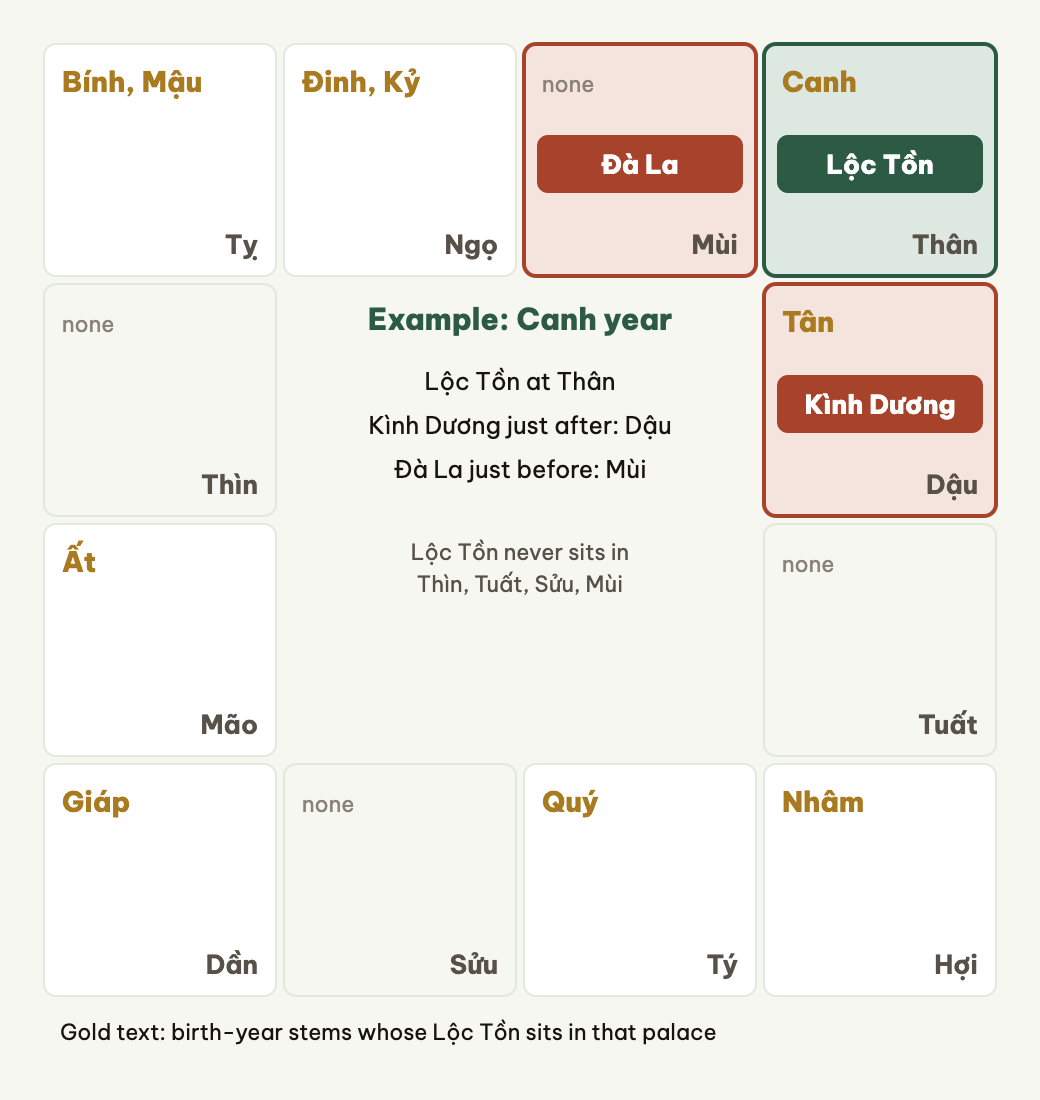
The palace where Loc Ton is placed, that is the opening palace of the whole ring, is determined by the heavenly stem of the birth year and does not depend on the gender or yin yang of the native. According to the placement table recorded by tracuutuvi.com:
| Heavenly stem of birth year | Palace of Loc Ton |
|---|---|
| Giap | Dan |
| At | Mao |
| Binh, Mau | Ty |
| Dinh, Ky | Ngo |
| Canh | Than |
| Tan | Dau |
| Nham | Hoi |
| Quy | Ty |
Two stems share one palace: Binh and Mau both place at Ty, Dinh and Ky both place at Ngo. The four earthly branches Thin, Tuat, Suu and Mui are never the palace of Loc Ton. This is a point many beginners get wrong, because other star rings such as the Trang Sinh ring or the Thai Tue ring have quite different starting rules.
Does the Bac Si ring run forward or backward, and why does it depend on yin yang and gender?
Once the palace of Loc Ton is set, the remaining stars are placed one by one into the next eleven palaces, one star per palace, in a fixed order. The direction follows the yin yang of the birth year stem combined with gender: Duong Nam and Am Nu are placed clockwise, Am Nam and Duong Nu are placed counterclockwise. This rule matches the placement of several other rings in Tu Vi, and it reflects an old idea: male forward, female backward, yin and yang paired to close one ring.
The order, according to tracuutuvi.com, is:
Loc Ton, then Luc Si, then Thanh Long, then Tieu Hao, then Tuong Quan, then Tau Thu, then Phi Liem, then Hy Than, then Benh Phu, then Dai Hao, then Phuc Binh, then Quan Phu.
After Quan Phu, the ring returns to Loc Ton, filling twelve palaces.
One worked example
Take a person born in a Giap year, Duong Nam. The palace of Loc Ton is Dan. Because Duong Nam goes forward, we count on: Luc Si at Mao, Thanh Long at Thin, Tieu Hao at Ty, Tuong Quan at Ngo, Tau Thu at Mui, Phi Liem at Than, Hy Than at Dau, Benh Phu at Tuat, Dai Hao at Hoi, Phuc Binh at Ty, Quan Phu at Suu.
If the same Giap year person is Am Nu, the starting palace is still Dan, but because Am Nu also goes forward, the result is identical. The difference only appears when switching to Am Nam or Duong Nu: then Luc Si moves back to Suu, Thanh Long to Ty, and so on backward.
What do the twelve stars of the Bac Si ring say on a chart?
The section below summarises each star in the common presentation, mainly based on the meaning table compiled by tracuutuvi.com. To repeat: these are suggested meanings, not fixed ones, and the shade changes greatly with the palace.
Loc Ton
Element Earth, in the noble star group, governing rank, wealth and longevity. A person with Loc Ton at Menh is often described as intelligent, upright and capable of organising. Loc Ton meeting Vu Khuc, Thien Phu or Thai Am is seen as prosperous in money; meeting Dia Khong, Dia Kiep, Tuan, Triet or Pha Quan reduces the financial good and tends to loss.
Luc Si
Element Fire, leaning to martial matters, indicating strength, force and authority. At Menh it usually marks a person with a strong build, quick and brave. The book Tuyen tap bai viet Tu Vi chon loc so 5 (Thien Hoa Dong Nhan) records the old line "Menh has Kinh Duong, naturally Luc Si comes along", hinting at the bond between the two stars: Kinh Duong gives drive, Luc Si supports stamina to finish the task. The same book notes the downside: Kinh Duong is impatient, so this pair easily acts before thinking carefully.
Thanh Long
Element Water, in the benevolent star group, governing joy and luck in career and marriage, and able to dissolve illness and small misfortune. At Menh it is often said to mark a bright face, gentle temper, favourable for exams and seeking fame. On the two-sided view, the book Tuyen tap bai viet Tu Vi chon loc so 1 (Thien Hoa Dong Nhan) observes that Thanh Long makes events happen fast, and too fast may leave the native unable to adapt; with bad stars, that acceleration also brings disadvantage sooner.
Tieu Hao
Element Fire, in the loss and ruin star group, governing depletion and loss. At Menh it usually marks a person who often changes aims, generous, fond of travelling, suited to mobile work. Tieu Hao meeting Tham Lang is often said to be lustful but discreet; meeting Hoa Ky means hardship and shortage; meeting Dao Hoa and Hong Loan means spending on love matters.
Tuong Quan
Element Wood, in the martial and authority star group, governing power and command. At Menh it usually marks a person who is upright, brave, sometimes hot-tempered, with leadership talent. For a female chart, texts usually describe a strong person with authority at home. Tuong Quan meeting Thien Tuong makes authority clearer; meeting Tuan or Triet tends to demotion; meeting Phuc Binh, Dia Khong or Dia Kiep warns of danger.
Tau Thu
Element Metal, in the literary star group, governing seals, petitions, writing and speech. At Menh it usually marks a person with talent and a refined appearance. Tau Thu joining Van Xuong and Van Khuc makes speech skilful and persuasive; meeting Thai Tue is said to give eloquence. The book Vuong Dinh Chi dam Dau So (Vuong Dinh Chi) pays special attention to the pair Thanh Long and Tau Thu when with Thien Luong: the author calls it "van thu chi hi", the joy of documents, and distinguishes it clearly from Van Xuong and Van Khuc. In that distinction, Xuong and Khuc lean to papers and certificates, while Thanh Long and Tau Thu lean to official documents, administrative papers or texts of agencies and large organisations.
Phi Liem
Element Fire, in the attendant star group, governing speed, agility, and also carelessness. At Menh it usually marks a lively person who reacts fast but is easily impatient. The book Tuyen tap bai viet Tu Vi chon loc so 2 (Thien Hoa Dong Nhan) describes Phi Liem as a star that "boosts the strong and the weak alike": with auspicious stars it brings luck quickly, with inauspicious stars it magnifies disadvantage. The same book notes Phi Liem is not good for women in childbirth, and when joining Hoa Tinh, Linh Tinh and Thien Hinh it warns of accidents involving knives and hammers, especially around the head. This is an old reading, so take it as a caution, not a prediction.
Hy Than
Element Fire, in the benevolent star group, governing luck, joy, marriage, childbirth, growing wealth and exams. At Menh it usually marks a cheerful and generous person. Hy Than meeting Long Tri and Phuong Cac makes joy in exams, career and marriage clearer; meeting Dao Hoa and Hong Loan brings luck in love.
Benh Phu
In the illness star group, governing disease and declining health. The book Tuyen tap bai viet Tu Vi chon loc so 3 (Thien Hoa Dong Nhan) cites Tu Vi Khao Luan by Ham Chuong with combinations such as "Benh Dao Rieu: venereal disease", "Benh Hao Sat Hinh Ky: cancer", "Benh Pha: few children". The same book cites Menh Ly Thien Co distinguishing the two stars: the star Benh represents illness purely, while Benh Phu in the annual ring carries not only illness but also gossip and dispute. It must be said clearly: these are combinations recorded in old books, not medical diagnoses, and should not be used to self-assess health.
Dai Hao
In the same group as Tieu Hao but stronger, governing major loss and major change in property and work. When with Tieu Hao, Cu Mon and Thien Co, tracuutuvi.com records the opposite direction: it governs wealth and plenty of money. This is a typical example of a star's meaning changing with the combination, so it cannot be read fixed.
Phuc Binh
Governing hiding, ambush and secrecy. In many combinations Phuc Binh is mentioned as the star of waiting, accumulating, or hidden scheming. When with Luc Si and Thien Hinh, texts often warn about using force for improper matters. This is the traditional reading and must be set in the context of the whole chart.
Quan Phu
Governing official matters, papers, legal issues and disputes. In whichever palace it sits, that palace easily meets matters involving documents, lawsuits or administrative procedures. Quan Phu is not bad in itself, but it signals that the palace has an element of "having to deal with agencies and organisations".
Why are these minor stars, not to be read apart from the main stars?
There is a general principle almost every Tu Vi text repeats: minor stars only carry meaning when placed beside the main stars and the four transformations. The Bac Si ring fits that principle even more, because its stars are mostly minor, some merely attendants. For example, Thanh Long in the Quan Loc palace where the main star is already fallen cannot save it; conversely, Thanh Long in the Quan Loc palace with a strong main star highlights the good already there.
The reasonable way to read is: first identify the theme of the palace, look at the main star and the four transformations, then see whether the Bac Si ring highlights or dims that theme. Reading in reverse, that is seeing Thanh Long and immediately concluding good, or seeing Benh Phu and immediately concluding illness, is a fragmented reading.
Where do the schools disagree?
This is where clarity is needed so readers are not misled when consulting many sources.
First is whether to use this ring at all. Some schools, including the direction called the Modern school, use only about 28 stars and drop the Bac Si ring (Loc Ton ring) from the chart entirely. In that school, stars such as Thanh Long, Tau Thu, Phi Liem and Benh Phu do not appear. So the same chart, placed by the old school and by the modern school, shows two different pictures. This article follows the traditional placement, that is, it uses the Bac Si ring.
Second is the element of a few stars. Even within the twelve, the elements of some stars are recorded differently across books. For instance Luc Si, Phi Liem and Hy Than are all listed by tracuutuvi.com as Fire, but when checked against other tables in the field, differences remain. For stars where sources disagree, learners should note both and should not take the element of a minor star as the main axis of interpretation.
Third is the degree of fortune. The same star may be listed as benevolent in one text and merely neutral in another. The safe approach is to see who that star is with, in which palace, and whether it is in tam hop or opposite to what.
Reading the Bac Si ring in practice: a few notes
When facing a chart, the working order should be: identify the palace of Loc Ton by the heavenly stem of the birth year; identify the forward or backward direction by yin yang and gender; place all twelve stars; then go back and read each palace by its theme. For the Tai Bach palace, watch Loc Ton, Tieu Hao and Dai Hao. For the Quan Loc palace, watch Thanh Long, Tau Thu, Tuong Quan and Quan Phu. For the Tat Ach palace, watch Benh Phu. For the Phu The palace, watch Hy Than, Dao Hoa and Hong Loan if present. For the Dien Trach palace, watch Dai Hao and Tieu Hao.
This way of reading keeps the Bac Si ring in its proper role: a supporting layer that fine-tunes the judgement, not a set of stars that decides fate. And like every other star set in Tu Vi, the final conclusion should still be stated as a tendency, with conditions, not as an absolute assertion.


