Introduction to Type 2 - The Helper
Type 2, also known as "The Helper," is one of the nine Enneagram personality types. The core motivation of Type 2 individuals is the need to be loved and needed. They often express affection through enthusiastic care and support for others, sometimes forgetting their own needs. In relationships, Type 2s constantly seek connection, build intimacy, and are willing to sacrifice time and effort to help those around them.
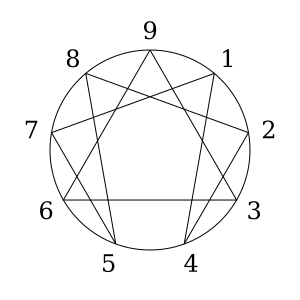
However, like all Enneagram types, Type 2 is not static. They continuously move between different psychological states, and the two arrows on the Enneagram diagram play a key role in describing this shift. The integration arrow indicates the direction of healthy development, while the disintegration arrow describes the state under stress or imbalance.
The Principle of Integration and Disintegration Arrows in the Enneagram
The Enneagram is not merely a static personality classification system but a dynamic model of human psychological functioning. Each type has two arrows connecting to two other types on the nine-point circle, forming two important directions of movement:
- Integration arrow (growth direction): When a person is healthy, open, and self-observant, they move toward the type indicated by the arrow. For Type 2, this arrow points to Type 4 (The Individualist).
- Disintegration arrow (stress direction): When a person falls into stress, anxiety, or lacks self-awareness, they move toward the type at the other arrowhead. For Type 2, this arrow points to Type 8 (The Challenger).
It is important to emphasize that this movement is not about "becoming" another type but borrowing characteristics, both positive and negative, from that type. Understanding this mechanism helps Type 2s identify their current state and develop appropriate adjustment strategies.
The Disintegration Arrow: Type 2 to Type 8 Under Stress
When Type 2 falls into stress, exhaustion, or feels taken advantage of, they tend to move toward Type 8. Type 8, or "The Challenger," is known for strength, assertiveness, a desire for control, and protecting the vulnerable. This borrowing manifests in several characteristic behaviors:
- Becoming demanding and controlling: Type 2 at this point can become stubborn, making blunt demands instead of their usual tactful approach. They might say, "I did everything for you, now it's your turn to do what I say."
- Openly expressing anger: Normally, Type 2 suppresses negative emotions to maintain a pleasant image, but when disintegrating, they may explode, shout, or sharply criticize others.
- Using help as a means of control: Instead of unconditional support, they begin to use help as a tool to pressure others, making them feel indebted or dependent.
- Ignoring their own needs to the point of exhaustion: Stress drives them to dive even more into helping others as a way to prove their worth, while simultaneously resenting that no one cares for them.
A typical example: A Type 2 office worker often takes on colleagues' tasks without complaint. When workload becomes overwhelming, instead of asking for rest, they start criticizing colleagues as irresponsible, demand managerial intervention, and even threaten to quit if not acknowledged. This is a clear manifestation of disintegration toward Type 8.
The Integration Arrow: Type 2 to Type 4 When Growing
Conversely, when Type 2 achieves self-awareness and inner balance, they move toward Type 4 (The Individualist). Type 4 is distinguished by a deep connection to emotions, the ability to accept darker aspects of oneself, and artistic creativity. Integrating these qualities brings Type 2 many benefits:
- Connecting with their true feelings: Type 2 learns to listen to their own needs and desires rather than focusing only on others. They no longer deny negative emotions like sadness, hurt, or loneliness.
- Accepting vulnerability and showing authenticity: Type 4 teaches Type 2 that revealing weakness does not diminish their worth. They can naturally say "I need help" without feeling ashamed.
- Developing creativity and inner depth: Instead of acting only for recognition, Type 2 begins to explore artistic hobbies, writing, or self-expressive activities, finding joy from within.
- Setting healthy boundaries: Type 2 learns that saying "no" is not selfish but a way to protect their energy and self-respect.
Example: A Type 2 who always sacrificed for family, after a period of self-reflection, begins attending a painting class they love, sets aside evening time for themselves, and communicates to loved ones that they need personal space. They no longer feel guilty about prioritizing themselves, and miraculously, this makes relationships more genuine.
Comparing the Two States of Integration and Disintegration
For clarity, the two states can be compared in the following table:
| Aspect | Disintegration state (toward Type 8) | Integration state (toward Type 4) |
|---|---|---|
| Dominant emotion | Anger, resentment, control | Acceptance, peace, deep emotion |
| Treatment of others | Demanding, imposing, manipulative | Empathetic, respectful of boundaries |
| Self-awareness | Blaming circumstances, lacking reflection | Self-observant, identifying own needs |
| Outer expression | Rigid, prone to anger | Soft, creative, authentic |
| Relationships | Conflict, tension | Bonded, deeper |
This comparison shows that the two states are opposite extremes, but both are inseparable parts of Type 2's developmental journey.
Practical Significance and Application
Understanding the two arrows is not just theoretical knowledge but a useful tool for Type 2 to self-regulate life. Here are some practical suggestions:
- Early recognition of disintegration signs: When feeling irritated, wanting to control others, or having thoughts like "I've given too much and received nothing," Type 2 should pause and ask: "What state am I in? What is my true need right now?"
- Practicing emotional mindfulness: Instead of suppressing negative emotions, allow yourself to feel them. Journaling, meditation, or sharing with a trusted friend are effective methods.
- Learning to say "no" kindly: Type 2 can start with small situations, such as declining an outing when tired, gradually building confidence.
- Seeking activities that bring personal joy: Not necessarily art; it could be reading, walking alone, or learning a new skill. The key is that these activities are not aimed at pleasing others.
- Seeking feedback from loved ones or professionals: Sometimes Type 2 finds it hard to see their own behavior, so listening to feedback from trusted people helps them gain a more objective view.
Conclusion
The integration and disintegration arrows of Type 2 in the Enneagram are two important dimensions of movement, reflecting human flexibility and adaptability. While disintegration toward Type 8 is a warning bell for unresolved stress, integration toward Type 4 opens the door to wholeness and authenticity. By recognizing and working with these two states, Type 2 can transform their altruism into sustainable inner strength, helping not only others but also nurturing themselves.
Like any psychological tool, the Enneagram is not a prophecy but a mirror. What matters most is not the Type 2 label, but the ongoing journey of self-discovery and growth that each person creates.

