Introduction to Type 1 - The Reformer
In the Enneagram system, Type 1, often called the Reformer or Perfectionist, represents individuals driven by the need to do what is right, improve the world, and uphold personal ethical principles. They possess a powerful 'Inner Critic' that constantly judges and evaluates their own and others' behavior against strict standards. Type 1 craves order, fairness, and perfection. They have strong self-control, discipline, and a high sense of responsibility. However, this very strictness is also the source of the anger they often suppress to maintain an image of propriety and rationality.
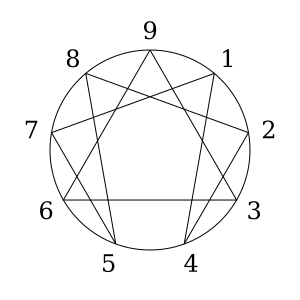
Understanding the arrows in the Enneagram is key to seeing the full picture of a type's psychological movement. Each type is not limited to their own traits; they can move around the Enneagram diagram. This movement is shown through two arrows: the integration arrow and the disintegration arrow. For Type 1, the integration path points to Type 7 (The Enthusiast) and the disintegration path points to Type 4 (The Individualist).
How the Arrows Work: Integration and Disintegration
The concepts of 'integration' and 'disintegration' should not be misunderstood as simply 'good' and 'bad' states. They are two directions of a psychological energy axis, describing how a person responds when in a healthy state (safe, balanced) or when facing stress and pressure.
Integration Arrow (toward Type 7)
When Type 1 is in a healthy, developed state, they begin to let go of excessive control and allow themselves to experience joy, freedom, and exploration. This is when they 'integrate' positive Type 7 qualities. They learn to accept that the world cannot be perfect and that everything does not always need to follow a rigid order. Their long-suppressed anger transforms into positive energy, enthusiasm, and the ability to enjoy life.
Disintegration Arrow (toward Type 4)
Conversely, when Type 1 falls into prolonged stress, anxiety, or feels they have failed to meet their standards, they may 'disintegrate' toward Type 4. At this point, they are no longer rational and calm but become melancholic, easily emotional, overly self-comparing, and feel terrible and lacking. They may sink into brooding, pessimism, and feel uniquely special in their suffering.
Deep Dive into the Disintegration Arrow: Type 1 to Type 4
When Type 1 feels overwhelmed by responsibility, when their efforts at perfection go unrecognized, or when they make a mistake they deem unforgivable, they begin to slide toward Type 4. This shift is not always dramatic but often subtle.
Signs That Type 1 Is Disintegrating to Type 4
- Immersed in negative emotions: Instead of suppressing anger as usual, they let sadness and disappointment take over. They may feel envious of others who they think find happiness more easily.
- Negative self-comparison: This is not aimed at self-improvement as Type 1 typically does, but is a torment, a self-flagellation for believing they are inferior to others in every way.
- Feelings of inadequacy and failure: They feel not good enough, unworthy, and have a deep inner emptiness that external achievements or recognition cannot fill.
- Moodiness and melancholy: The usually calm Type 1 may become easily irritable, inexplicably sad, or plagued by obsessive negative thoughts. They may withdraw from social relationships, feeling no one understands them.
- Self-pity: They may nurture a sense of being a victim of circumstances, that the world is unfair to them despite their best efforts to live righteously.
Concrete Example
Imagine a Type 1 manager who has painstakingly built a perfect workflow for the company. When a major project fails due to an objective, uncontrollable event, he is not just angry at the situation but turns to self-blame. He starts thinking: 'I should have foreseen this,' 'I am not competent enough to be a manager,' 'Other colleagues do much better than me.' He no longer wants to meet anyone, feels all his efforts are meaningless, and falls into a prolonged state of dejection and gloom. This is when he is disintegrating toward Type 4.
Deep Dive into the Integration Arrow: Type 1 to Type 7
Integration toward Type 7 is a journey of healing and growth for Type 1. It is not about becoming irresponsible or pleasure-seeking like the negative aspects of Type 7, but about learning valuable lessons Type 7 represents: knowing how to enjoy life, embracing novelty, and letting go of the fear of imperfection.
Signs That Type 1 Is Integrating to Type 7
- Optimistic and cheerful spirit: They start seeing the positive in life instead of focusing only on flaws to fix. They laugh more, are more relaxed, and are less harsh on themselves and others.
- Flexible and open-minded: They are no longer rigid in thinking and action. They are willing to try new approaches, accept different ideas, and no longer feel threatened by change.
- Ability to enjoy the present: Instead of always worrying about the future or regretting the past, they learn to appreciate simple joys of the moment. They can spend time on hobbies or have fun with friends without feeling guilty.
- Creative and visionary: Letting go of control gives them space for new, creative ideas. They are not limited by frameworks and can see new possibilities and opportunities.
- Acceptance of imperfection: They understand that 'good enough' is sometimes wiser than 'perfect.' They learn to release trivial details and focus on the bigger picture.
Concrete Example
The same Type 1 manager, after a period of personal development, realizes that taking on everything and self-flagellation does not yield good results. In a new project, he knows how to delegate tasks sensibly, trusts colleagues, and does not micromanage every detail. He also takes weekends to go hiking, a hobby he had set aside for years as 'a waste of time.' As a result, he feels more relaxed, relationships with colleagues improve, and the project succeeds thanks to creative input from many people. He has successfully integrated Type 7 qualities.
Quick Comparison Table of the Two States
| Characteristic | Disintegration (toward Type 4) | Integration (toward Type 7) |
|---|---|---|
| Dominant emotion | Sadness, melancholy, envy, self-pity | Joy, optimism, enthusiasm |
| Self-perception | Lacking, inferior, failure | Good enough, capable, deserving happiness |
| Typical behavior | Withdrawal, negative comparison, brooding | Openness, engaging in activities, exploring hobbies |
| Relationship with others | Feeling isolated, difficulty connecting | Connected, sharing joy, cooperative |
| Energy | Stagnant, introverted, heavy | Abundant, extroverted, light |
The Significance of Understanding the Two Arrows
Understanding the integration and disintegration arrows is not about labeling yourself as 'getting worse' or 'getting better,' but is a powerful tool for self-awareness. For Type 1, recognizing early signs of disintegration toward Type 4 (e.g., unusual melancholy, self-comparison) is an early warning. Then they can proactively take steps to return to balance, such as:
- Practicing self-compassion: Instead of self-blame, remind yourself that everyone makes mistakes and it is normal.
- Allowing yourself to rest: Recognize that nonstop work is not an effective way to achieve perfection.
- Consciously seeking joy: Proactively plan fun, enjoyable activities without feeling guilty.
- Sharing with others: Talk about difficult feelings with a trusted friend instead of holding them in.
Conversely, when noticing positive signs of integration (like feeling happy, flexible), they can nurture this state by continuing to practice letting go and enjoying.
Conclusion
The integration arrow (toward Type 7) and disintegration arrow (toward Type 4) are two important psychological paths that every Type 1 will experience in life. They are not fixed destinations but fluctuating states depending on stress levels and personal maturity. Understanding this mechanism gives the Reformer a map for self-observation and direction. The goal is not to avoid disintegration forever, but to learn to recognize it quickly and use the integration path as a compass to return to balance, happiness, and a more meaningful life, where they can be both useful to society and able to enjoy their own life.
