



TL;DR: The East direction corresponds to the Chấn trigram and belongs to the Đông tứ trạch (East Four Houses) in Bát Trạch, so it is favorable for people whose cung phi falls in the Đông tứ mệnh (East Four Fates) group and unfavorable for those with Tây tứ mệnh (West Four Fates). The specific good or bad depends on the individual cung phi. The method based on nạp âm ngũ hành (sound element five phases) may give different conclusions for certain ages because it does not distinguish between male and female and measures by the element of the birth year. To find your eight directions, look up your cung phi using the site's house direction tool, and remember to enter your lunar year of birth.
Who does the East direction suit according to Bát Trạch?
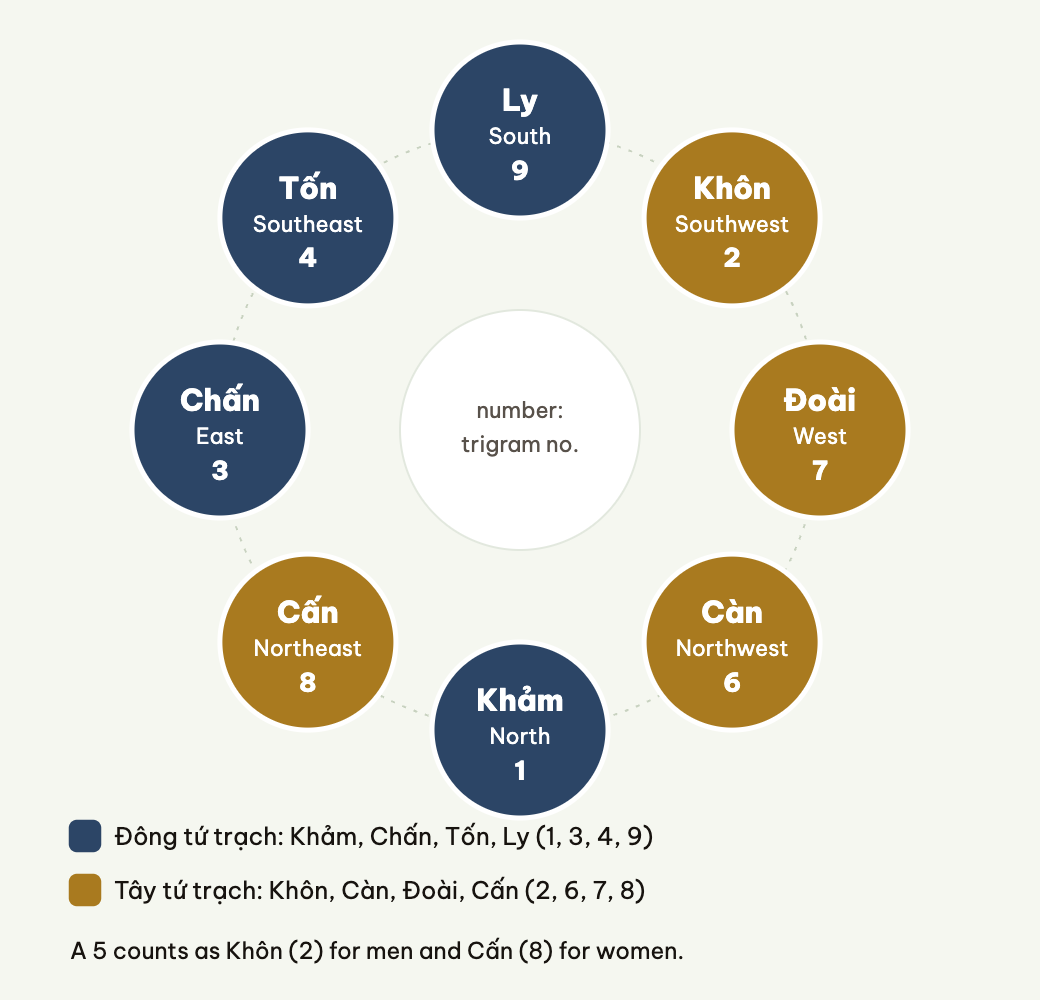
The East corresponds to the Chấn palace in the Hậu Thiên Bát Quái (Later Heaven Eight Trigrams) and belongs to the East group of houses (Đông tứ trạch). For people in the same East group of destinies (Đông tứ mệnh), the East is one of the four favourable directions; for people in the West group (Tây tứ mệnh), it is an unfavourable direction. Exactly how favourable or unfavourable it is, and which du niên (one of the eight directional influences) it carries, depends on each person's cung phi (life palace number), as shown in the table below.
Table of the eight cung phi with the East direction (applies to birth years from 1950 to 2009, according to the site tool's calculation method):
| Cung phi | Group | East direction is | Favourable or unfavourable | Men born in | Women born in |
|---|---|---|---|---|---|
| Khảm (1) | Đông tứ mệnh | Thiên Y | favourable | 1954, 1963, 1972, 1981, 1990, 1999, 2008 | 1950, 1959, 1968, 1977, 1986, 1995, 2004 |
| Khôn (2) | Tây tứ mệnh | Họa Hại | unfavourable | 1950, 1953, 1959, 1962, 1968, 1971, 1977, 1980, 1986, 1989, 1995, 1998, 2004, 2007 | 1951, 1960, 1969, 1978, 1987, 1996, 2005 |
| Chấn (3) | Đông tứ mệnh | Phục Vị | favourable | 1952, 1961, 1970, 1979, 1988, 1997, 2006 | 1952, 1961, 1970, 1979, 1988, 1997, 2006 |
| Tốn (4) | Đông tứ mệnh | Diên Niên | favourable | 1951, 1960, 1969, 1978, 1987, 1996, 2005 | 1953, 1962, 1971, 1980, 1989, 1998, 2007 |
| Càn (6) | Tây tứ mệnh | Ngũ Quỷ | unfavourable | 1958, 1967, 1976, 1985, 1994, 2003 | 1955, 1964, 1973, 1982, 1991, 2000, 2009 |
| Đoài (7) | Tây tứ mệnh | Lục Sát | unfavourable | 1957, 1966, 1975, 1984, 1993, 2002 | 1956, 1965, 1974, 1983, 1992, 2001 |
| Cấn (8) | Tây tứ mệnh | Tuyệt Mệnh | unfavourable | 1956, 1965, 1974, 1983, 1992, 2001 | 1954, 1957, 1963, 1966, 1972, 1975, 1981, 1984, 1990, 1993, 1999, 2002, 2008 |
| Ly (9) | Đông tứ mệnh | Sinh Khí | favourable | 1955, 1964, 1973, 1982, 1991, 2000, 2009 | 1958, 1967, 1976, 1985, 1994, 2003 |
If you want to know your own eight directions, go to the site's house and land viewing tool and enter your lunar birth year. Note two points when calculating cung phi: the year used is the lunar year, so people born in January or February of the solar calendar before Tết must use the previous year; and cung phi 5 has no trigram of its own, men are assigned to Khôn (2) and women to Cấn (8).
How is cung phi calculated?
The tool's method is as follows: add the last two digits of the birth year and reduce to a single digit. For men born before 2000, subtract that number from 10; from 2000 onward, subtract from 9. For women born before 2000, add 5 to that number; from 2000 onward, add 6. Reduce the result to a single digit again, and that gives the cung phi.
Đông tứ mệnh comprises Khảm (1), Chấn (3), Tốn (4) and Ly (9). Tây tứ mệnh comprises Khôn (2), Càn (6), Đoài (7) and Cấn (8). Each cung phi has four favourable directions, Sinh Khí, Thiên Y, Diên Niên and Phục Vị, and four unfavourable directions, Họa Hại, Lục Sát, Ngũ Quỷ and Tuyệt Mệnh, collectively called the eight du niên.
Why do the five elements method and the Bát Trạch method give two different conclusions?
Because the two methods measure two different things. Bát Trạch is based on cung phi, calculated from birth year and gender; the five elements method is based on the nạp âm (sound element) of the birth year's stem and branch and does not distinguish between men and women. So a husband and wife of the same age can have different cung phi, and the same direction can be praised by one method and criticised by the other.
A few examples show where they diverge. A woman born in 1972 (Nhâm Tý, Tang Đố Mộc, Wood element) has cung phi Cấn (8), Tây tứ mệnh, so for her the East is Tuyệt Mệnh, the most unfavourable direction; whereas by the five elements, Wood meeting Wood is the same element. A man born in 1974 (Giáp Dần, Đại Khê Thủy, Water element) has cung phi Cấn (8), Tây tứ mệnh, and the East is Tuyệt Mệnh; whereas by the five elements, Water and Wood are mutually generating. In the opposite direction, a man born in 1970 (Canh Tuất, Thoa Xuyến Kim, Metal element) has cung phi Chấn (3), Đông tứ mệnh, and the East is Phục Vị, favourable; whereas by the five elements, Metal and Wood are mutually overcoming. A woman born in 1976 (Bính Thìn, Sa Trung Thổ, Earth element) has cung phi Ly (9), Đông tứ mệnh, and the East is Sinh Khí, favourable; whereas by the five elements, Earth and Wood are mutually overcoming.
The clearest case of a husband and wife of the same age getting two opposite conclusions from Bát Trạch is the pair born in 1990. A man born in 1990 has cung phi Khảm (1), Đông tứ mệnh, and for him the East is Thiên Y. A woman born in 1990 has cung phi Cấn (8), Tây tứ mệnh, and for her the East is Tuyệt Mệnh. When the two methods diverge, the site's tool follows Bát Trạch; this article does not judge which method is correct.
An East-facing house faces which way, and is it assessed by the sitting direction or the facing direction?
An East-facing house sits on the opposite side, that is, it sits to the West, corresponding to the Đoài palace. The book Bát Trạch Minh Kính names the house according to the sitting side, so this house is a Đoài house, belonging to Tây tứ trạch. So with the East direction, the sitting and facing directions belong to two different groups: judged by the facing direction, the East suits the group of Chấn, while judged by the house's sitting direction, this house suits the group of Đoài.
The method common today, and also the one the site's tool uses, is to assess the house's facing direction (the direction of the main door) against the eight du niên of the cung phi. Anyone who assesses the house by its sitting direction will get the opposite group. With the four directions East, West, Southeast and Northwest, the two methods give two opposite groups; with the four directions North, South, Northeast and Southwest, the two methods coincide.
What should be kept in mind when arranging an East-facing house?
The East receives morning sunlight, which is beneficial for daily life and health. But if the main door or bedroom is too glaring early in the day, a thin curtain should be used to adjust it and make it easier on the eyes.
As for colours and materials, the East corresponds to the Chấn palace, Wood element, so green tones and wooden furniture are usually harmonious. Fire elements such as lamps and red or orange colours can be used as accents. Metal elements such as shiny metal should be restrained. These are suggestions following the five elements method for the direction, not a pronouncement about destiny.
As for rooms, the living room should have firm support at the back of the chairs and a view of the door. For people who are not suited to the East according to Bát Trạch, the remedy mentioned in Bát Trạch books is to place the main door, bedroom and kitchen according to the four favourable directions of one's own cung phi, because the books consider the door, the master room and the kitchen to be the three main factors of a dwelling (dương trạch tam yếu).
A few things to avoid for tidiness and comfort: do not place a mirror facing the main door, do not leave the walkway cluttered, and avoid thorny plants in the living room. These are notes on arrangement, not assertions about wealth or health.


