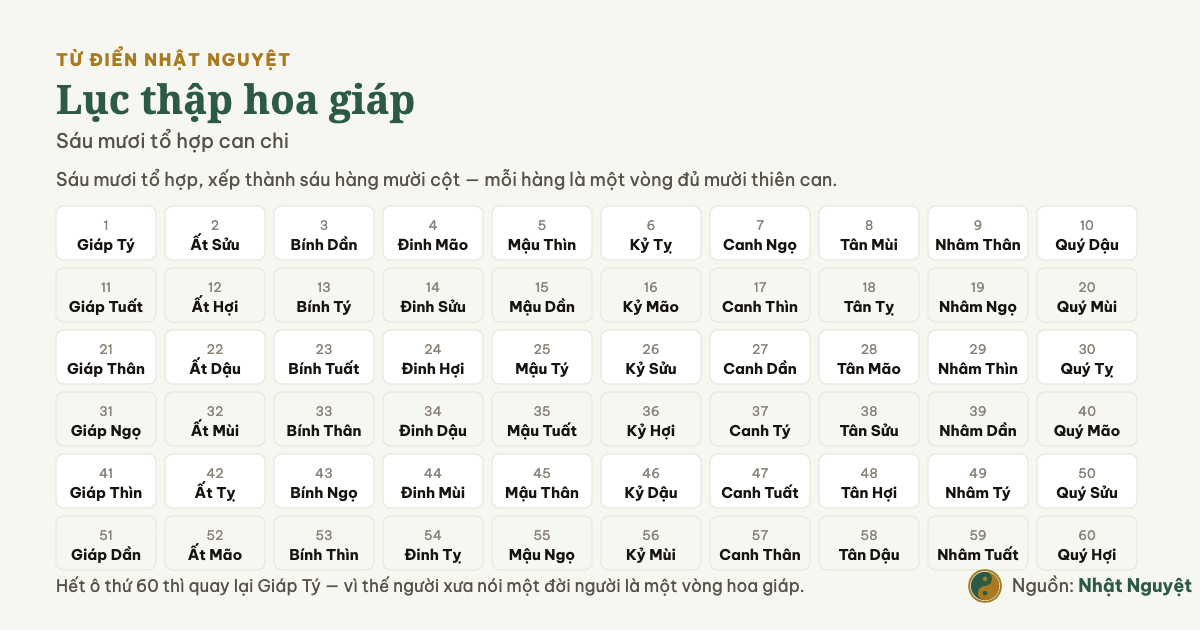
What is the Sixty Jiazi?
The Sixty Jiazi (六十花甲) is a cycle of 60 units formed by pairing the ten Heavenly Stems (Jia, Yi, Bing, Ding, Wu, Ji, Geng, Xin, Ren, Gui) with the twelve Earthly Branches (Zi, Chou, Yin, Mao, Chen, Si, Wu, Wei, Shen, You, Xu, Hai). Because a Stem and a Branch combine only when they share the same polarity (both yang or both yin), the number of possible combinations is the least common multiple of 10 and 12, namely 60. After 60 years the cycle returns to its starting point, which is why it is also called "one huajia" or "one full zodiac round".
Why is it called "huajia"?
The character "hua" (花, flower) conveys variety and interweaving, like flowers and leaves, alluding to the intricate interlacing of the 60 Stem-Branch combinations. The character "jia" (甲) is both the name of the first Stem and a word for "first" or "beginning". The phrase "huajia" is also used to refer to the age of 60, the age at which one completes a full Stem-Branch cycle. In traditional culture, celebrating a 60th birthday is an important milestone marking a complete cycle of life according to the Stem-Branch calendar.
Na Yin and its role in calendrics
Each successive Stem-Branch pair is assigned a "Na Yin" (納音), a name with a Five-Element quality, such as Sea Gold, Furnace Fire or Great Sea Water. Na Yin is not derived directly from a single Stem or Branch but follows an ancient rule. In calendrics, the Sixty Jiazi is used to record years, months, days and hours; in astrology, feng shui and date selection, the Na Yin of the birth year is often used to interpret a person's Na Yin Five Element.
Distinguishing it from easily confused concepts
The Sixty Jiazi should be distinguished from the Twelve Earthly Branches (the twelve zodiac animals) and the Ten Heavenly Stems. The Sixty Jiazi is the combination of both, not a separate set of symbols. It should also be distinguished from a "natal element" based on a single Stem or Branch: two people born in the same zodiac year may still have different Na Yin if their Stems differ. Furthermore, "one huajia" refers to a 60-year cycle, not to a century in the 100-year sense.
Note: this is traditional knowledge for reference only and has not been verified by science. Its applications in astrology, feng shui and date selection should be regarded as cultural heritage, not as a substitute for decisions based on scientific grounds.