


TL;DR: Direct Wealth is the Ten God representing genuine wealth earned through labor, as well as diligence, practicality, and responsibility. In destiny analysis, Direct Wealth not only concerns money but also reflects relationships with one's wife (for male charts), mother, and how a person manages finances and life.
Is Direct Wealth a favorable or unfavorable factor when the self is strong, when the self is weak, and when does it become the useful god?
With Direct Wealth, the answer depends on the month command and the strength or weakness of the Day Master. When the self is strong, Direct Wealth is a favorable god, used to drain the strength of the self, and if the structure permits, it becomes the useful god. When the self is weak, Direct Wealth is an unfavorable god, to be avoided, replaced by Seal and Peer. When Wealth and Seal clash with equal strength, mediate through Officer as a bridge. In cases of extreme climate, climate adjustment can override support and restraint. If Peer and Rob Wealth are too many and press down on weak Wealth, for disease and remedy choose Officer and Seven Killings as the medicine. When the Day Master has no root and Wealth is abundant, the following structure must follow Wealth. To understand fully, see Useful God in Bazi and Strong Self, Weak Self.
What is Zheng Cai in the Ten Gods?
In the BaZi (Four Pillars) system, the Ten Gods are ten terms used to describe the relationship between the Heavenly Stems and Earthly Branches of the birth day (Day Stem, Day Branch) and the other stems and branches in the chart. These Ten Gods are divided into two main groups: the group that generates and supports (Yin) and the group that drains, reduces and controls (Cai, Guan, Shi Shang). Within this, Zheng Cai and Pian Cai both belong to the "Cai" group, but carry two completely different shades of meaning.
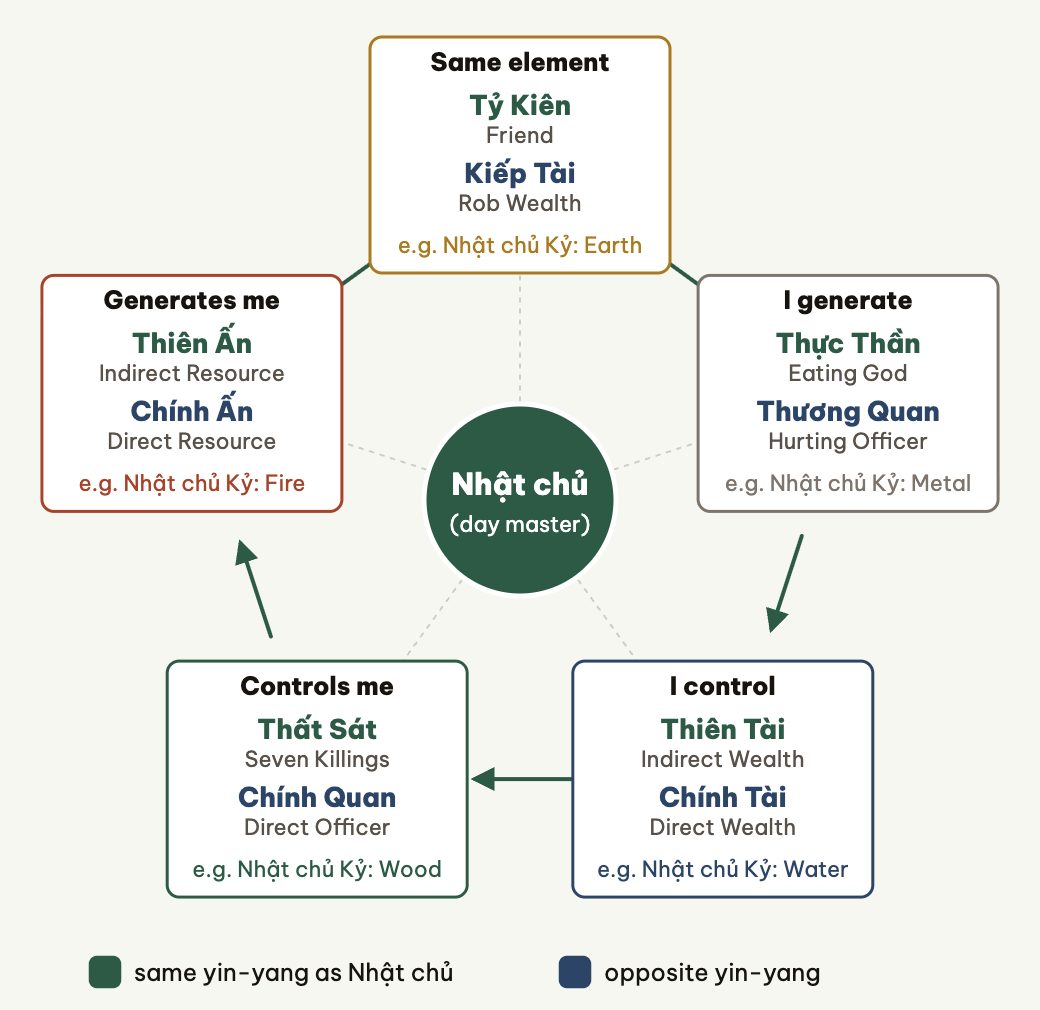
Zheng Cai, written in Chinese as "Zheng Cai" (正財), is determined based on the principle of mutual control in the Five Elements. Specifically, Zheng Cai is the element that the Day Stem (the self) controls, and the two sides stand in an opposite yin-yang relationship. For example: if the Day Stem is Jia Wood (yang wood), then Zheng Cai will be Ji Earth (yin earth), because Wood controls Earth and Jia (yang) controls Ji (yin). Conversely, if the Day Stem is Yi Wood (yin wood), Zheng Cai will be Wu Earth (yang earth). In other words, Zheng Cai is what we control in a legitimate, reasonable way.
The origin of this concept comes from the philosophy of Yin-Yang and the Five Elements in the I Ching, where the interaction between the elements gives rise to all things. The Ten Gods were systematized over many centuries by Chinese fate-analysis scholars, in order to turn the abstract principles of the Five Elements into a concrete descriptive language for human life. Within this, "Cai" is not simply money, but also what a person must expend effort to "control" and conquer.
What is the mechanism and operating principle of Zheng Cai?
To understand Zheng Cai deeply, one needs to grasp clearly how it is formed and its role in the chart as a whole.
How is Zheng Cai determined?
Zheng Cai is determined based on the Day Stem. The basic reference table is as follows:
| Day Stem | Zheng Cai |
|---|---|
| Jia, Yi (Wood element) | Wu, Ji (Earth element) |
| Bing, Ding (Fire element) | Geng, Xin (Metal element) |
| Wu, Ji (Earth element) | Ren, Gui (Water element) |
| Geng, Xin (Metal element) | Jia, Yi (Wood element) |
| Ren, Gui (Water element) | Bing, Ding (Fire element) |
However, to distinguish Zheng Cai from Pian Cai, the yin-yang factor must be considered. Zheng Cai is the element controlled by the Day Stem and standing in an opposite yin-yang relationship to the Day Stem. For example:
- Jia Wood (yang) controls Wu Earth (yang): this is Pian Cai, because both are yang.
- Jia Wood (yang) controls Ji Earth (yin): this is Zheng Cai, because yin and yang are opposite.
This principle reflects a philosophy: what is opposite attracts and creates harmony. Zheng Cai is wealth that comes to a person in a "legitimate" way, through a transparent and clear path.
The role of Zheng Cai in the structure of the chart
Zheng Cai sits in the position of "being controlled by me", so it symbolizes what we can hold, control and manage. Within this:
- Financially: Zheng Cai represents stable income from work, salary, legitimate business. It is money earned diligently, without fraud, without illegality.
- In terms of character: Zheng Cai brings practicality, care, thrift and responsibility. People with strong Zheng Cai tend to live by principles, know how to calculate spending and have a high sense of discipline.
- In relationships: For a male chart, Zheng Cai also symbolizes the wife, the official partner. For a female chart, Zheng Cai symbolizes the father or the stepmother (depending on the specific structure of the chart, usually the father in relation to Yin).
How does Zheng Cai interact with the other Ten Gods?
Zheng Cai does not operate independently; it always interacts with the other Ten Gods, creating rich layers of meaning:
- Zheng Cai meeting Zheng Guan: This is a good configuration, because Cai generates Guan. People who have both are usually reputable, work responsibly, and can succeed in management or in organizations and state agencies. They earn money through legitimate means and know how to use money to build a career and reputation.
- Zheng Cai meeting Yin (Zheng Yin or Pian Yin): Cai controls Yin, this is a relationship of mutual conflict. People with strong Zheng Cai and a Yin star that is controlled may lack protection, have limited education, or easily cut ties with family and homeland. However, if the Yin star is strong, that person can use wealth to buy reputation, to buy degrees.
- Zheng Cai meeting Shi Shen: Shi Shen generates Cai, this is a very good configuration for business. People whose Shi Shen produces wealth are usually intelligent, have practical talents, and know how to turn ideas into money. Shi Shen is an inexhaustible source of wealth, while Zheng Cai is where assets are stored.
- Zheng Cai meeting Xiao Shen (Pian Yin): Xiao Shen snatches Shi; if Shi Shen is the source that generates Cai and is snatched, then wealth is easily damaged. However, Xiao Shen also controls Zheng Cai (because Yin controls Cai), so people with this configuration may encounter many obstacles in finance, or hold a mindset that looks down on money.
- Zheng Cai meeting Bi Jian, Jie Cai: Bi Jian and Jie Cai are both the same element as the Day Stem, and their role is to "rob" Cai. People with weak Zheng Cai who meet many Bi Jian and Jie Cai easily have money fought over by friends and siblings, or have to share assets, and find it hard to keep the fruits of their business dealings.
To analyze Zheng Cai correctly, where must it first be placed?
Before saying whether Zheng Cai is good or bad, four questions must be answered in the correct order: which season the chart was born in, whether the Day Stem is strong or weak, what the framework of the chart is, and which element is needed to rebalance it. Zheng Cai only has meaning after these four steps are clear, because the same prosperous Zheng Cai can be wealth for one person and a burden for another.
What do the month command and prosperity-decline determine?
The month command is the branch of the month pillar, meaning the season in which the chart was born. This is the first measure of prosperity and decline, because it tells which element holds power in that season: in spring Wood is prosperous, in summer Fire is prosperous, in autumn Metal is prosperous, in winter Water is prosperous, and in the last month of each season Earth is prosperous. A Zheng Cai stem sitting in a season that generates and supports it becomes much stronger; sitting in a season that controls it, it becomes weaker, regardless of which pillar it occupies.
Prosperity and decline is the strength level of the Day Stem, measured by three criteria: obtaining the command (the Day Stem is supported by the season), obtaining the position (the Day Stem has a root in a branch, meaning a stem of the same element is hidden in the Earthly Branch), and obtaining the momentum (there are many stems and branches on the same side generating and supporting it). Having all three is called a strong self; lacking all three is called a weak self. This is the second step, and it is the step that decides how Zheng Cai is used, because the general principle is that only when the self is strong enough can it control Cai.
When is a configuration named after Zheng Cai?
A configuration is the framework of the chart, named after whichever god holds the month command and reveals itself in the Heavenly Stems. If the branch of the month pillar is a Cai element, and within that branch there is a hidden Cai stem, and that stem is revealed in the Heavenly Stems (usually the month pillar or the hour pillar), then the chart is called a Cai configuration. This is the third step, and it matters because the configuration tells what category the chart belongs to, not merely whether a single god is strong or weak.
One point needs to be stated clearly: a Cai configuration does not mean being rich, and not every chart that has Zheng Cai becomes a Cai configuration. Zheng Cai is only one of ten gods; it is only elevated into a configuration when it holds the month command and is revealed in the stems. If Zheng Cai is scattered across the pillars while the month command is held by another god, then it is one factor in the chart, not the framework of the chart.
What are the useful god, the favorable god and the unfavorable god?
The useful god is the element chosen to rebalance the chart, meaning the element the chart is lacking or is skewed toward. The favorable god is the element that generates and supports the useful god, making the useful god stronger. The unfavorable god is the element that destroys the useful god, making the original imbalance worse. This is the fourth step, and it is the step that every conclusion about Zheng Cai must pass through.
With Zheng Cai, the question is not "is Zheng Cai good or bad" but "is Zheng Cai the useful god". The same prosperous Zheng Cai, if the self is strong, is a favorable god, is wealth; if the self is weak, it is an unfavorable god, is a burden. Without this step, every judgment about Zheng Cai is just recitation.
What is the meaning of Zheng Cai in fate analysis?
Zheng Cai and the path of wealth
In BaZi fate analysis, Zheng Cai is regarded as the symbol of "genuine finance". People with prosperous Zheng Cai usually have the ability to earn money steadily and sustainably. They do not like fast, risky paths to wealth, but lean toward gradual accumulation from legitimate work. They are often good salaried employees, or run small but solid businesses.
If Zheng Cai appears in the month pillar (month command) or is well generated and supported, that person may have a firm financial career. Conversely, if Zheng Cai is damaged by Bi Jian and Jie Cai or is clashed or combined unfavorably, wealth may be lost, with much work done and little enjoyed.
Zheng Cai and human character
Zheng Cai controls Zheng Yin, so people with strong Zheng Cai tend to lean toward the practical rather than mere theory. They have a calculating mind, know the value of money, live thriftily but are not stingy. They are reliable, keep their promises, and have a high sense of responsibility toward work and family.
However, if Zheng Cai is too prosperous without Yin or Guan stars to regulate and transform it, that person can become too pragmatic, thinking only of money, living closed off, lacking flexibility and creativity. They can be seen as boring, conservative, resistant to change, and easily drawn into the whirlpool of materialism.
Zheng Cai and the husband-wife relationship
For a male chart, Zheng Cai is the wife, while Pian Cai is the lover or concubine. Therefore, a man with prosperous Zheng Cai is usually someone who values the husband-wife bond greatly, loving and respecting his wife. He tends to marry a virtuous wife who knows how to manage the household.
If Zheng Cai is damaged, for example meeting many Bi Jian (Jie Cai robbing Cai), then the husband may encounter setbacks in marriage, the couple may easily fall into discord, or the wife may fall ill, or a third person may easily intrude. In some cases, a male chart with Zheng Cai close to the Day Stem (the day pillar) usually loves his wife deeply and is closely attached to family.
For a female chart, Zheng Cai does not directly represent the husband (the husband is Guan Sha), but it does affect the relationship with the husband through generating Guan. A female chart with prosperous Zheng Cai and a smoothly flowing Guan star is usually a capable woman, knowing how to preserve family happiness and supporting husband and children very well.
Zheng Cai and other relationships
In social relationships, Zheng Cai also symbolizes the father (for a female chart), subordinates, or people who work for oneself. People with good Zheng Cai are usually loved by their father, respected and loyally served by subordinates. Conversely, if Zheng Cai is damaged, they may encounter many problems in managing employees or their relationship with their father may not be harmonious.
What are specific cases and examples in fate analysis?
What does prosperous Zheng Cai with a strong self mean?
This is the most ideal configuration. A person with a powerful Day Stem, strong enough to control Zheng Cai, will master money, earn easily and keep their wealth. They are people who do business honestly, have reputation, and live in warmth and prosperity. For example, a person whose Day Stem is Bing Fire (yang fire) born in summer, strongly supported by Wood, meeting Zheng Cai as Xin Metal (yin metal) in the month pillar. With a strong self, Xin Metal is a favorable god, and they will have a wealthy life, succeeding in whatever they do, with ample money.
What does prosperous Zheng Cai with a weak self mean?
This is the hardest case to handle. When the self (Day Stem) is too weak while Zheng Cai is too abundant, that person is like a frail person who must carry a huge fortune, unable to control it. They may encounter many business opportunities but lack the strength to seize them, or earn money but fail to keep it, or work beyond their strength, toiling hard with results that do not match.
In this case, the chart needs a Yin star (Water, Wood) or Bi Jian (the same element as the Day Stem) to help. If there is none, that person toils a lifetime for money, health wears down, and they easily contract digestive illnesses or illnesses related to the controlled element.
One thing must be stated clearly: this case is only correct when the Day Stem can still resist, meaning it still has a root or still has a supporting side. If the Day Stem is already completely rootless, then one must switch to analyzing the following configuration, and then Zheng Cai is no longer a burden but the element that must be followed. This is where beginners most often analyze wrongly: seeing a weak self and by default calling Cai an unfavorable god, when in fact one must first check whether the chart falls into the following configuration.
What is Zheng Cai robbed by Jie Cai?
When a chart has too many Bi Jian and Jie Cai (the same element as the Day Stem) and a weak Zheng Cai, that person will encounter the situation of "Jie Cai robbing Cai". They are often robbed of money and effort by friends, siblings and partners. Doing business together easily fails, or as soon as they have money it is borrowed and not repaid. They need to be extremely careful in business partnership relationships.
What does Zheng Cai meeting Guan Sha mean?
If Zheng Cai generates Guan (Guan Sha), and Guan in turn has Yin to transform it, forming the chain: Cai generates Guan, Guan generates Yin, Yin generates the Self. This is a very beautiful configuration; people with this chart usually have both money and authority, as well as education, are respected by many, and live a fulfilled life.
How do Zheng Cai and Pian Cai differ?
To understand Zheng Cai more clearly, it should be compared with Pian Cai, its twin sibling:
| Criterion | Zheng Cai | Pian Cai |
|---|---|---|
| Nature | Genuine, legitimate finance, with stability | Miscellaneous wealth, small wealth, coming from sudden opportunities, speculation, or innate talent |
| Way of earning | Earning money by the sweat of one's brow, working hard | Earning money by talent, cleverness, quickness, or unexpected opportunities |
| Way of spending | Thrifty, spending with a plan | Generous, free-spending, fond of enjoyment |
| Regarding marriage (for men) | Is the wife, values wife and children | Is the lover, prone to many outside affairs |
| Character | Careful, principled, sometimes conservative | Flexible, creative, fond of risk |
In an ideal chart, one needs both Zheng Cai and Pian Cai in balance: Zheng Cai to keep wealth, Pian Cai to earn extra opportunities. If there is only Zheng Cai, the person is rich but slow; if there is only Pian Cai, the person earns but cannot keep.
Practical application of Zheng Cai in work and life
How to choose a career suited to Zheng Cai?
People whose Zheng Cai is the useful god should choose professions related to finance, accounting, banking, management, or stable office work. They are also suited to professions related to the element that Zheng Cai represents. For example, if the Day Stem is Wood and Zheng Cai is Earth, they can work in real estate, construction, agriculture.
Conversely, if Zheng Cai is the unfavorable god, they should avoid work that is too heavy in financial management or high in money pressure, and may instead choose professions in the element that generates and supports the self.
Personal financial management
Understanding Zheng Cai in one's own chart helps each person have a suitable financial strategy. If Zheng Cai is a favorable god, they should focus on their main work to advance and increase stable income. If Zheng Cai is an unfavorable god, they need to be careful with large investments, avoid borrowing heavily, and should seek help from financial experts.
Improving relationships
For men, understanding Zheng Cai helps them recognize the role of the wife in their life. If Zheng Cai is damaged, they need to nurture the husband-wife bond more, and stay away from outside temptations. For both men and women, understanding Zheng Cai clearly helps them have a more correct view of the value of money, and know how to balance earning money with other spiritual values.
It should be emphasized that BaZi is only a reference tool for understanding oneself, not an absolute prophecy about fate. Each person has the ability to change their life through effort, learning and training. Understanding Zheng Cai should be used as a guiding principle to develop strengths and overcome weaknesses, heading toward a better life, rather than being depended on blindly.


