



Image: Wellcome Collection (Public Domain)
TL;DR: The Eating God is the 'child' of the Day Master, representing talent, creativity, and blessings. When strong and pure, and meeting Wealth or Officer in a favorable structure, it indicates an intelligent, eloquent person who enjoys good fortune. When weak, damaged, or seized by the Jealous God, it suggests hard work, gossip, and disputes.
Does the Eating God being favorable or unfavorable depend on strength and the useful god?
With the Eating God, the month command determines its root qi, while the strength or weakness of the Day Master determines whether it is used or held in caution. When the self is strong, the Eating God is favorable and often becomes the useful god because it drains qi in the right place; when the self is weak, it is unfavorable, unless the structure forces one to follow it. When choosing the useful god, support and restraint lean toward the Eating God if the self is strong, mediating can place an intermediate element between the Resource and the Eating God, climate adjustment classifies the Eating God if it skews the climate, and the disease-remedy method uses Wealth when the Owl snatches the Eating God. The following structure reverses the conclusion: in a following Eating-Hurting structure, the Eating God becomes the dominant element. To grasp the full foundation, see The useful god in BaZi and Strong self, weak self.
How is the Eating God defined in BaZi?
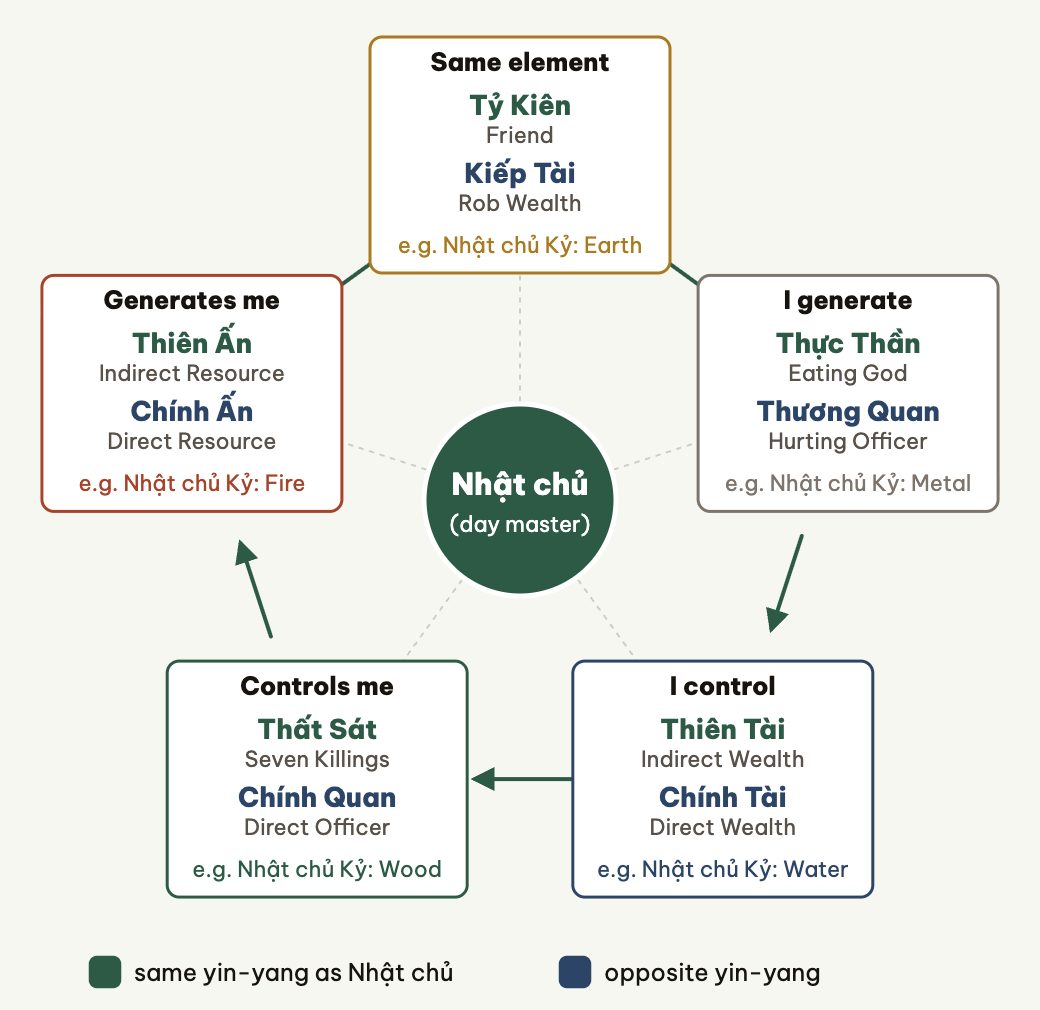
According to Uyên Hải Tử Bình, the Eating God is the element produced by the Day Master and sharing the same yin-yang polarity as the Day Master. In other words, it is what the Day Master produces, but it does not stand in yin-yang opposition to the Day Master as the Hurting Officer does. The name "Eating God" comes from the fact that it produces one's Wealth: for example, Giáp (Yang Wood) produces Bính (Yang Fire), Bính produces Mậu (Yang Earth), and Mậu is the Wealth of Giáp, so Bính is called the Eating God of Giáp. Ancient texts also call it the Heavenly Granary longevity star.
The table below lists the ten stems according to the definition in Uyên Hải Tử Bình:
| Day Master | Eating God |
|---|---|
| Giáp | Bính |
| Ất | Đinh |
| Bính | Mậu |
| Đinh | Kỷ |
| Mậu | Canh |
| Kỷ | Tân |
| Canh | Nhâm |
| Tân | Quý |
| Nhâm | Giáp |
| Quý | Ất |
What does the Eating God govern according to Uyên Hải Tử Bình?
According to Uyên Hải Tử Bình, the Eating God governs abundant wealth and plentiful rice, a tolerant heart, a full and healthy body, ease and contentment, descendants, and the enjoyment of fortune and longevity. However, these things only come when the conditions are complete: the self must be strong and there must be Wealth for the Eating God to produce. The text does not favor the Eating God meeting the Resource, because the Resource controls the Eating God, cutting off the source that produces Wealth. The verse in Uyên Hải Tử Bình states clearly: "When the Eating God has qi and can overcome Wealth and Officer, first its own stem must be strong and prosperous," meaning that for the Eating God to overcome Wealth and Officer, the Day Master itself must first be strong.
So when is the Eating God truly effective?
Putting the above steps together, the Eating God is effective when a whole chain of conditions is complete, and this chain must be checked in order.
Step one: the Day Master must be in a state that needs its qi drained, meaning the self is strong or at least not weak. This is the condition determined by strength or weakness, and strength or weakness in turn is determined by the month command, gaining ground, and gaining support. If the structure is Establishing the Robe or Yang Blade, this step has almost already provided its answer.
Step two: after determining that the Day Master needs draining, one must check whether the Eating God is being broken. The three common forms of breakage are being directly controlled by the Owl God, being lost through combination and transformation, and being broken by clash in the branch.
Step three: check whether the Eating God has an outlet. The Eating God producing Wealth is having an outlet. The Eating God controlling the Seven Killings is having an outlet in a different direction. An Eating God standing alone, neither producing nor controlling, has greatly reduced value.
Step four: re-check using the three remaining methods, and additionally check the possibility of following. If climate adjustment demands an element contrary to the Eating God, or if the disease-remedy method points to a different element, or if the chart is in fact a following structure rather than a weak one that can be rescued, then the conclusions from step one to step three must be adjusted and cannot be kept as they are.
Only when all four steps are free of contradiction can one say the Eating God is effective. The result of step four is precisely the final useful god, and this useful god is what is used to analyze the fortunes of the cycles.
What is the Owl snatching the Eating God (Upsetting the Eating God) and how is it resolved?
The Owl snatching the Eating God, also called Upsetting the Eating God, occurs when the Owl God (Indirect Resource) directly controls the Eating God, cutting off the source that produces the Day Master's Wealth. The specific mechanism: Giáp uses Bính as its Eating God and greatly fears Nhâm, because Nhâm controls Bính, causing Bính to no longer be able to produce Mậu and Kỷ, the Wealth of Giáp. Uyên Hải Tử Bình cites the example Giáp Tuất, Bính Dần, Giáp Tuất, Nhâm Thân: the self and the Eating God are both strong, originally a noble fate, but the hour pillar Nhâm Thân both controls Bính and clashes Dần, so fame and profit do not come to fruition.
Chapter 8 of Tử Bình Chân Thuyên sets out the way to preserve it: the Eating God rejoices in a strong self, and "producing Wealth can protect the Eating God," meaning one uses Wealth to control the Owl and shield the Eating God. In other words, when the Eating God is threatened by the Owl, Wealth is precisely the rescuing element, because Wealth can control the Owl.
How is the Eating God controlling the Killings read through the charts in Tử Bình Chân Thuyên?
The commentary in Tử Bình Chân Thuyên cites two charts showing the method of the Eating God controlling the Killings. Chapter 8 cites Kỷ Mão, Đinh Sửu, Quý Sửu, Ất Mão: the month command Seven Killings Kỷ appears in the stem, and Ất the Eating God is used to control the Killings as the useful god. Chapter 21 cites Kỷ Mùi, Quý Dậu, Đinh Tị, Đinh Mùi (the fate of Viên Thế Khải): Từ Nhạc Ngô wrote that at a glance it is a strong self, the Eating God controlling the Killings, and only then did he read the further layer of noble stars. Chapter 16 adds the case of Bính born in the month of Thìn, with Mậu appearing as the Eating God and Nhâm as the Killings: the two stems control each other and yet form a good structure.
For the Eating God controlling the Killings to form a proper structure, the key factor lies in the Eating God needing enough strength to suppress the Seven Killings, while at the same time the Seven Killings must not play the role of a favorable useful god in the chart. In the case where the Seven Killings already belong to the favorable useful gods, using the Eating God to control them would, it is feared, damage the noble quality of the Killings. The self also needs to be strong or at least balanced; if the self is weak, the Eating God draining qi further exhausts the Day Master, and the Seven Killings seize the opportunity to intrude.
Formation and breakage of the Eating God structure according to Tử Bình Chân Thuyên
According to chapters 18, 19, and 25 of Tử Bình Chân Thuyên, when the Eating God carries the Killings and Wealth appears, this breaks the structure, because Wealth transforms the Eating God to produce the Killings, and a Wealth cycle is also a failing cycle. Conversely, when the Eating God does not carry the Killings, it rejoices in meeting Wealth. The Owl by nature snatches the Eating God, but it can form a structure when the Eating God carries the Killings, because the Owl controls the Eating God and transforms the Killings.
As for cycles: when the Eating God carries the Killings and the self is weak, a Resource cycle is good (one cycle that controls the Hurting Officer, transforms the Killings, and supports the self); when the self is strong and the Killings are prosperous, an Eating-Hurting cycle is good; and when the Killings have the Eating God controlling them and then meet an Owl cycle, that is breakage.
Is there an example of the Eating God producing Wealth in Tử Bình Chân Thuyên?
The commentary in chapter 37 of Tử Bình Chân Thuyên (On the Eating God) cites the fate of Governor Hoàng, Kỷ Mùi, Kỷ Tị, Giáp Dần, Bính Dần. Giáp sits on Dần, and the hour is again Dần; the Day Master is strong and its elegance is drained through Bính, and the beauty lies in the Eating God being light and Wealth heavy; the cycles need the territory of Resource and Robe, and the 35 years of the Ất Sửu, Giáp Tý, Quý Hợi, and Nhâm Tuất cycles are the best.
The Eating God with children and the hour pillar according to Trích Thiên Tủy
Nhâm Thiết Tiều in Trích Thiên Tủy revised the old method, taking the Eating and Hurting as children and citing the line "the Eating God has longevity, a wife, and many children." For example Mậu Tý, Quý Hợi, Nhâm Tuất, Giáp Thìn: Nhâm water at the start of winter, with Giáp the Eating God appearing alone in the hour stem, raised ten children.
The chapter on the Mother image examines the case where the Day Master is strong but the Eating and Hurting are solitary (strong Mother, solitary Child): it fears the Resource because the Resource controls the Eating God, and rejoices in Fire and Earth cycles. For example Mậu Ngọ, Giáp Dần, Ất Mão, Kỷ Mão, when it reaches the Canh Thân cycle its fortune ends.
The children star: Officer and Killings or Eating and Hurting?
The texts are not consistent about the children star. Chapter 23 of Tử Bình Chân Thuyên takes the Officer and Killings as children; Nhâm Thiết Tiều in Trích Thiên Tủy revised it to take the Eating and Hurting as children; Từ Nhạc Ngô recorded both. The division "the Eating God is children in a female chart" in the table of the overview article is a later convention, not the wording of those two texts.
Where the texts differ on the Owl and the Eating God
Uyên Hải Tử Bình regards the Resource and the Upsetting of the Eating God as things the Eating God always fears, while chapter 19 of Tử Bình Chân Thuyên allows the Owl to form a structure when the Eating God carries the Killings. For example, the case of Governor Hoàng was recalculated by someone commenting in the interpretive tradition as a weak self, meaning the same chart measured by two methods of strength gives two conclusions; so one should cite the original words of the texts and not conclude in their place.
Application to analyzing fortunes: from the useful god to the major cycles
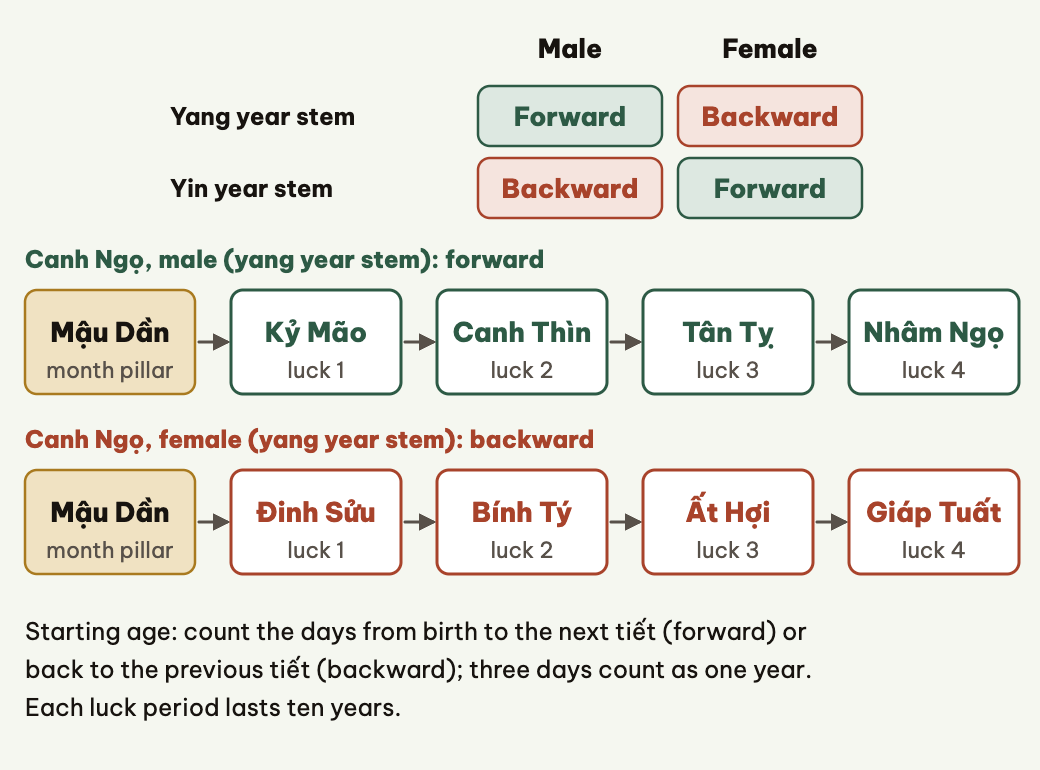
Once the useful god is established, analyzing the major cycles and annual cycles becomes a method of comparison. A cycle that brings in an element matching the useful god or a favorable god is considered favorable. A cycle that brings in an element matching an unfavorable god is considered adverse.
With the Eating God, this method of comparison yields specific situations:
- If the Eating God is precisely the useful god, an Eating God cycle is a favorable cycle, and an Owl God cycle is an adverse cycle.
- If the Eating God is an unfavorable god, an Eating God cycle is an adverse cycle, and a cycle that can control the Eating God is a favorable cycle.
- If the Eating God is the intermediate element in mediation, its role depends on which two elements it is connecting.
- If the chart is a following Eating-Hurting structure, an Eating God cycle continues to follow the following tendency, but a cycle that breaks the following tendency is more worrying than an ordinary unfavorable god cycle.
This is why one cannot say "meeting an Eating God cycle is good" as a general rule. That statement is only correct after knowing what role the Eating God plays in the original chart.


