


TL;DR: Zheng Yin is the Ten God representing protection, knowledge, education, and the mother, generated from the element that produces the Day Master. In destiny analysis, a strong Zheng Yin brings intelligence, gentleness, and benefits learning and reputation, but must be balanced with other gods to avoid laziness or dependency.
Whether the Direct Resource is favourable or unfavourable depends on strength, weakness and the useful god
The Direct Resource only becomes the useful god when the Day Master is weak and needs support, in which case it strengthens the self and can be a favourable god. If the self is already strong, the Resource is a further addition to what is already in excess, and it is usually controlled by the Wealth star or drained by the Output stars. In special structures such as the "establishing the lu" or the "yang ren" (the blade), the month command already leans toward a strong self, so the Direct Resource finds it hard to serve as the useful god. When two elements are evenly matched in conflict, the Resource can act as a mediator if it sits between them. Climate adjustment may set the Resource aside if a warming or cooling element is more needed. In the "disease and medicine" approach, the Resource counts as medicine if it cures the right serious defect. In a "following" structure, the Resource turns into an unfavourable god because it breaks the momentum. For a fuller picture, see The useful god in BaZi and A strong or weak self.
So what exactly is the Direct Resource, and how is it determined?
The Direct Resource, also called the "seal" or "resource", is a stem or branch whose element produces the element of the Day Master while carrying a different yin or yang polarity from the Day Master. If the Day Master is a yang stem, the Direct Resource is a yin stem of the element that produces it; if the Day Master is a yin stem, the Direct Resource is a yang stem of the element that produces it.
| Day Master | Direct Resource |
|---|---|
| Jia Wood (yang) | Gui Water |
| Yi Wood (yin) | Ren Water |
| Bing Fire (yang) | Yi Wood |
| Ding Fire (yin) | Jia Wood |
| Wu Earth (yang) | Ding Fire |
| Ji Earth (yin) | Bing Fire |
| Geng Metal (yang) | Ji Earth |
| Xin Metal (yin) | Wu Earth |
| Ren Water (yang) | Xin Metal |
| Gui Water (yin) | Geng Metal |
The Yuan Hai Zi Ping records judgments on the ten stems exactly in this manner: Jia seeing Gui, Yi seeing Ren, Bing seeing Yi, Ding seeing Jia, Wu seeing Ding, Ji seeing Bing, Geng seeing Ji, Xin seeing Wu, Ren seeing Xin, Gui seeing Geng are all Direct Resource. The same book also calls the Resource "living qi", meaning the qi that gives life to the self.
Both are Resource stars, but the Indirect Resource (the "eccentric" star) shares the same polarity as the Day Master, while the Direct Resource does not. This difference in polarity is the basis for distinguishing the two. The saying that the Direct Resource is measured, moderate support while the Indirect Resource is skewed support is a later formulation, with no direct wording in the old texts, so it should be treated as a mnemonic rather than as the words of the sources.
How does the Direct Resource connect to the other Ten Gods?
Only after knowing whether the Day Master is strong or weak, and after choosing the useful god, can the Direct Resource be read in relation to the remaining gods:
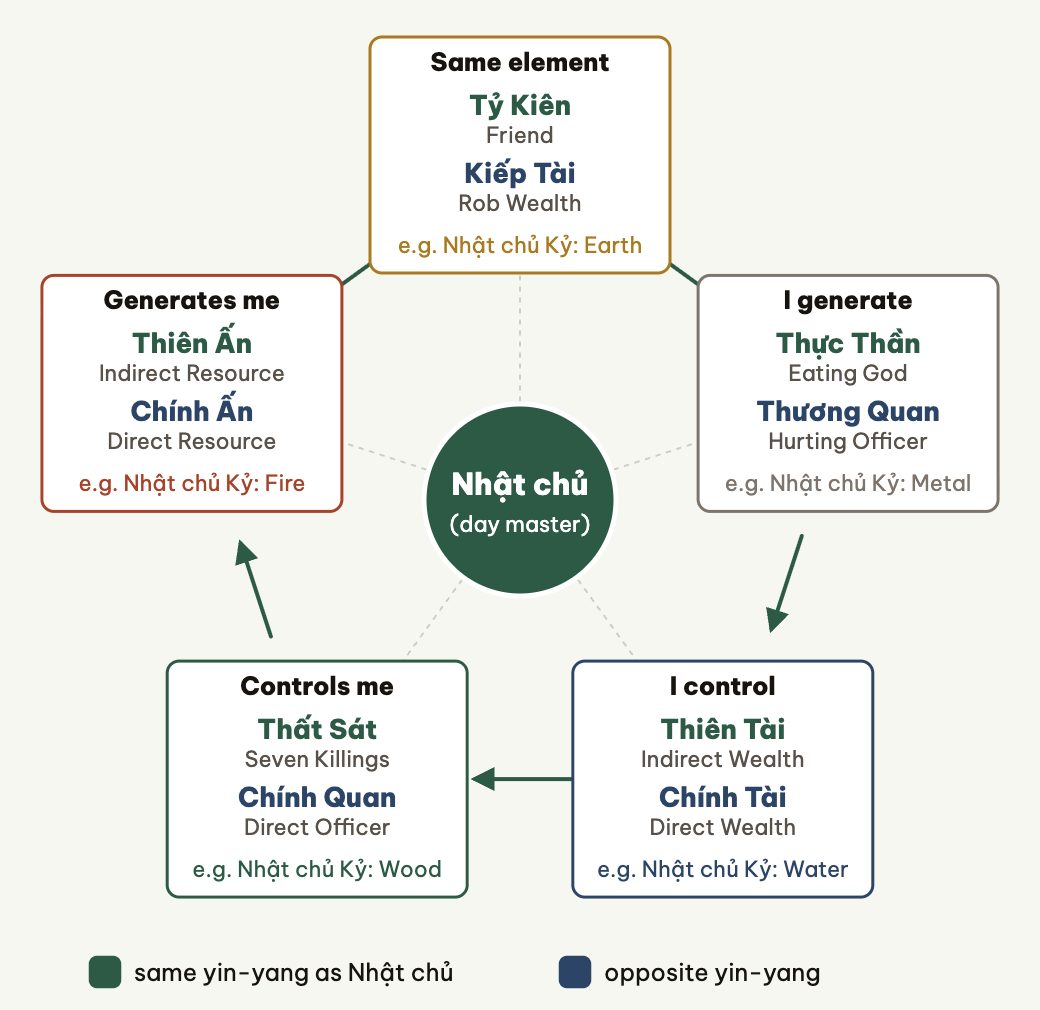
- With the Officer and Seven Killings: The Officer and Seven Killings control the Day Master. The Direct Resource stands in between because the Officer produces the Resource, and the Resource produces the Day Master. This is the Officer and Resource mutually producing each other: pressure from the Officer is converted into energy for the Day Master. But this configuration is only good when the Day Master needs support. If the Day Master is already strong, the Officer producing the Resource and the Resource producing the Day Master only makes what is already excessive more excessive.
- With the Wealth star: Wealth controls the Resource. Wealth represents the outward direction, material things, practicality; the Resource represents the inward direction, accumulation, learning. Strong Wealth breaking the Resource is usually read as the outward overpowering the inward. But if the Day Master is strong and the Resource is the element that needs controlling, then Wealth breaking the Resource is exactly what the chart needs.
- With the Output stars: The Output stars are what the Day Master produces, that is, the part expressed outward. The Direct Resource is the inner source of energy that nourishes the Day Master. When the Resource is sufficient, the Output stars have roots; when the Resource is too abundant and the Output stars are weak, knowledge gets blocked and does not come out as a product.
Officer and Resource both complete, and what the Resource welcomes and avoids
The Yuan Hai Zi Ping has a line: having the Officer without the Resource is not yet true Officer; having the Resource without the Officer instead becomes good fortune. The meaning is that the Resource needs the Officer to produce it, but the Resource standing alone can still be used, whereas the Officer standing alone easily becomes barren pressure.
According to the same book, the Resource welcomes the Officer producing it, avoids strong Wealth coming to break it, and most fears a luck cycle falling into the Resource's place of death and extinction. When Officer and Seven Killings are too many, or when the chart has already entered another structure, it is no longer read exclusively through the Resource.
An example given in the book: Wu Xu, Geng Shen, Gui You, Geng Shen. Gui is born in the Shen month, Geng as Resource appears in both the month and the hour, Wu as Officer appears in the year, and the book calls this an extremely noble destiny. Against another case, Gui Hai, Gui Hai, Jia Yin, Jia Zi: the Resource is strong but there is no Officer, so the fortune it brings is not deep. These two charts show that Officer and Resource going together is clearly better than the Resource standing alone.
Wealth breaking the Resource: when is it a disaster, and when is it medicine?
This is where the books do not say the same thing, and it needs to be separated into two layers.
The first layer, according to the Yuan Hai Zi Ping, is that the Resource always fears Wealth, because Wealth can turn around and injure the very thing that nourishes the self. The book cites Jia Yin, Geng Wu, Wu Xu, Ren Zi: Wu uses Ding as its Resource, and in the chart Yin, Wu and Xu combine into a fire frame, but the hour pillar Ren Zi has strong water, which is Wealth clashing and breaking the Resource. Another example in the book is Ji Mao, Ding Mao, Bing Chen, Ren Chen: Officer and Resource both complete, so in youth the person was already of clean and noble rank, until the Geng Shen year when Wealth came to break the Resource. The book Zhai Tian Sui, in the chapter on Parents, also cites Gui Mao, Yi Chou, Bing Zi, Ji Chou: in the year and month pillars Officer and Resource produce each other, so the person came from an official household, but when the luck cycle reached You, the Wealth star broke the Resource and the person fell into guilt.
The second layer is that Zi Ping Zhen Quan and Zhai Tian Sui hold that when the self is strong and the Resource is abundant, it is precisely Wealth injuring the Resource that is the useful god. Zhen Quan, chapter 8, cites Wu Chen, Jia Yin, Ding Mao, Wu Shen: Yin, Mao and Chen complete the eastern direction, and Jia further appears as the Direct Resource of Ding; the Resource is too strong, so Wealth injuring the Resource must be taken as the useful god. Chapter 25 sums up the rule for luck cycles: when the self is weak and the Resource is used, Wealth is unfavourable, and a Rob Wealth luck cycle arrives to remove the disease; but when the self is strong and the Resource is abundant, a Wealth luck cycle is welcomed and a Rob Wealth luck cycle is avoided. Zhai Tian Sui cites Xin Mao, Bing Shen, Gui Mao, Ren Xu: in a Resource structure, the hidden Geng in Shen is taken as the useful god, Bing is Wealth playing the role of the disease, and Ren is Rob Wealth playing the role of the medicine.
In short, do not write "Wealth breaking the Resource is bad" as a general rule. You have to ask what the self needs: when the self is weak, Wealth breaking the Resource is a disaster; when the self is strong and the Resource is abundant, Wealth injuring the Resource is exactly what the chart is waiting for.
When does the Resource form a structure, and when does it break one?
Zi Ping Zhen Quan offers a few pieces. Chapter 19 says that when the Resource is light and the Seven Killings appear, it instead forms a structure, because the Seven Killings produce the Resource, and there is a line "the Officer does not fear the Eccentric". Chapter 18 says that when the Seven Killings already has Output controlling it and the Resource then appears, the Resource seizes the Output, meaning the Resource can break a structure. Chapter 25 says that in a Resource structure using the Officer, encountering a luck cycle that combines away the Officer is a broken structure, for example a person born in the Zi month with Xin appearing as the useful god who meets a Bing luck cycle, because Bing combines with Xin.
There is also the configuration of a Resource that is too strong and the configuration of a lone Resource. Zhai Tian Sui cites Gui Wei, Yi Mao, Bing Wu, Xin Mao: a proper structure of clean Officer and Resource, a person of talent and good conduct, but the Resource is too strong so the Officer is drained of qi, which the book calls a god in excess whose essence is insufficient, so in youth official career and fame are full of setbacks. The chapter on the "child image" examines the case where the Day Master is strong and the Resource is alone, such as Gui Hai, Yi Mao, Jia Yin, Yi Hai: earth as Wealth is unfavourable, a metal luck cycle accompanied by water is welcomed, and when the luck cycle reaches Geng Xu with earth and metal both strong, the person loses office.
The Direct Resource and one's mother: how should this be read correctly?
Zi Ping Zhen Quan, chapter 23, takes the Direct Resource as the mother. But Xu Yue Wu adds in commentary that one must look at whether the Resource is favourable or unfavourable in order to read parents: if the Day Master favours the Resource and meets Wealth breaking it, the ancestral estate declines; if the Day Master avoids the Resource and meets Wealth breaking it, then instead the person builds up the family and establishes a career.
The Yuan Hai Zi Ping, in the section Discussing the Mother, records that when the Resource sits in its place of growth, it indicates a mother who is virtuous and long-lived. The same book also says that when the month pillar has living qi (that is, the Resource), one receives help from parents; when the year pillar has it, one receives help from ancestors; when the hour pillar has it, one receives help from children and grandchildren. This adds to the section on the positions of the four pillars below: it is not only the stage of life, but also which family member is lending support.
Two differences between the books need to be stated clearly. First, the Yuan Hai Zi Ping treats the Resource as always fearing Wealth, while Zhen Quan and Zhai Tian Sui take Wealth injuring the Resource as the useful god when the self is strong and the Resource is abundant. Second, the way of reading "clashing the mother": Yuan Hai and the original commentary of Zhai Tian Sui have a line of reading that the Resource meeting Wealth is clashing the mother, and Yuan Hai even infers things such as the mother having two husbands or the mother having an affair when the Resource meets the Peach Blossom. Ren Tie Qiao criticises that word "clash" outright as an error of the old books. Those far-reaching judgments should not be brought into a reading for a querent.
When the Direct Resource appears in a chart, how is it read?
This part must be read together with the conditions of strength and weakness above, not on its own:
- Character: The Direct Resource is tied to intelligence, love of learning, gentleness, caution, and an inward orientation. If the Resource is strong and the Day Master is also strong, with no Wealth star or Output stars to release the qi, the person easily becomes timid, indecisive, and withdrawn. If the Resource is weak or broken, the person easily lacks a foundation in learning and has a shallow temperament.
- Education and career: The Resource is the god of degrees, knowledge, research, education, and letters. A person with a strong Resource suits work that demands long accumulation and stability. But if the Resource is broken by Wealth while the Day Master still needs the Resource, then the path of education and career meets obstacles.
- Family: The Direct Resource is regarded as the mother star. A strong Resource usually indicates a mother with a good influence, or a native who was cared for attentively. A Resource strongly controlled by Wealth may indicate an uneasy relationship with the mother, or a mother who faced hardship. But remember Xu Yue Wu's commentary: one must look at whether the Resource is favourable or unfavourable to the Day Master before reading it, rather than concluding misfortune simply because Wealth breaks the Resource.
- Marriage: For a male chart, a strong Resource can make the husband dependent on his wife or on his mother. For a female chart, a strong Resource easily makes a wife and mother who cares for and wraps others up, but who also easily worries to excess.
- Health: The Direct Resource carries the element that produces the Day Master, so it is usually tied to the organs belonging to that element. This way of reading should only be taken as one reference layer, placed within the whole chart rather than mechanically inferred from a single character.
What does the position of the Direct Resource in the four pillars indicate?
Position shows which stage of life the Resource affects most strongly. The year pillar is tied to family foundation and the early stage of life. The month pillar is tied to the adult stage and the root of a career, so a Resource seated in the month is usually seen as a sign of education built early. The day pillar is tied to oneself and to marriage. The hour pillar is tied to the later stage of life and to children.
But position is only one axis. A Direct Resource seated in the month can still be a burden if the Day Master is already strong, and a Direct Resource in the hour pillar can still be medicine if it cures exactly the flaw in the chart.
So what is the order for reading a chart that has a Direct Resource?
The minimum sequence, and also the sequence that shallow reading tends to skip:
- Read the month command to know which season holds power.
- Measure the strength or weakness of the Day Master by command, position and force, and conclude whether the self is strong or weak.
- Check whether the month branch falls into "establishing the lu" or the "yang ren", because these two configurations already lean toward a strong self.
- Determine the structure according to the god holding the month command and the god appearing on the stems.
- Check whether the chart falls into a "following" structure, that is, whether the Day Master is so weak it cannot resist. If so, reverse the rule for choosing the useful god.
- Choose the useful god, and state clearly which method is being used: support and restraint, mediation, climate adjustment, or disease and medicine.
- From the useful god, derive the favourable god and the unfavourable god.
- Only now place the Direct Resource in and ask: is it the useful god, a favourable god, or an unfavourable god.
- Compare with the major and annual luck cycles to see at which stages the Direct Resource is reinforced or broken.
Steps 5 and 6 are the two steps where the schools most easily lose agreement, so when reading for someone else, stating clearly which method and which threshold you are using is more honest than presenting the result as a single answer.
Overview article on the topic: What is BaZi (Four Pillars)? How to read destiny through the eight characters of stems and branches


