


TL;DR: The Heavenly Seal (or Indirect Resource) is a Ten God representing non-traditional learning, intuition, and protection, but also isolation and suspicion. When strong and well-structured, the Heavenly Seal shows special talents; when overly strong or poorly structured, it leads to disadvantages in health and relationships.
Is Heavenly Seal (Eccentric Seal) a favorable or unfavorable factor when the day master is strong or weak?
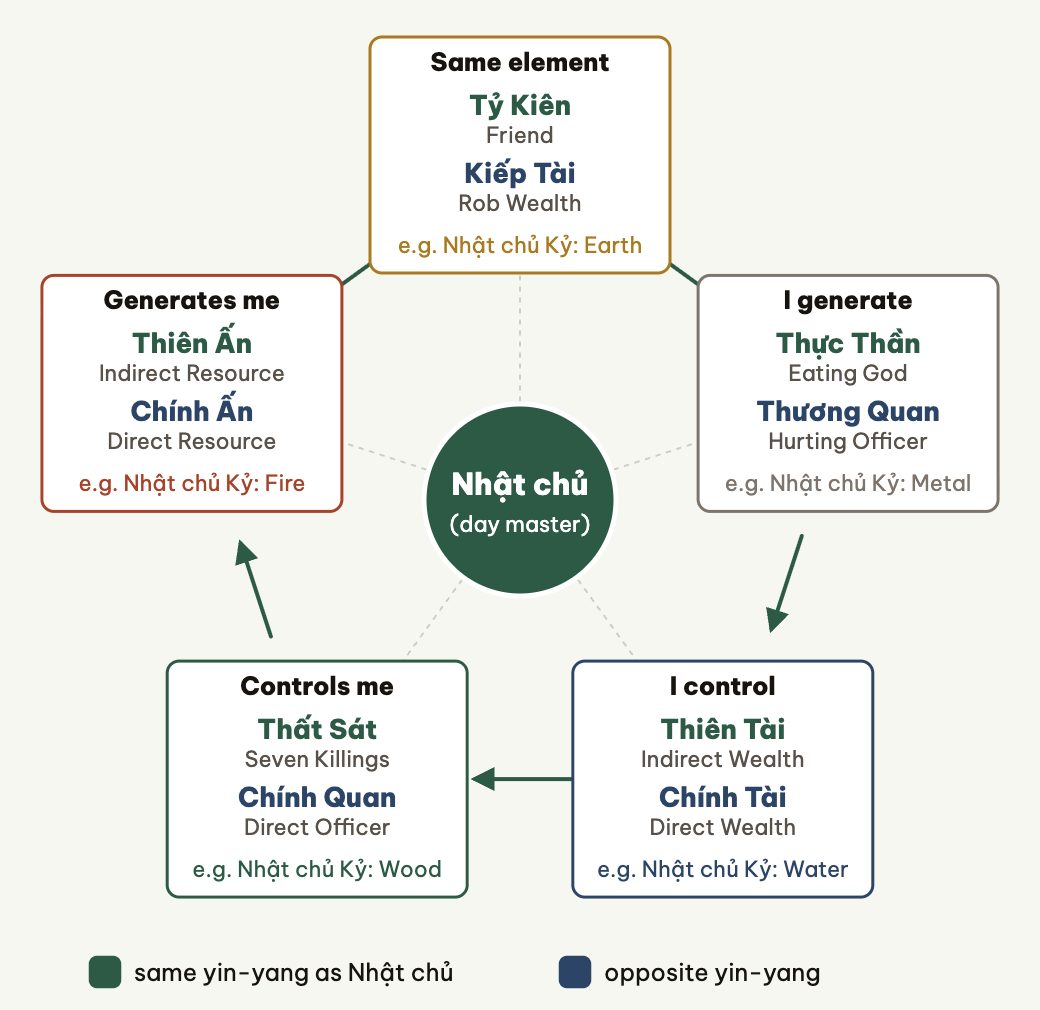
Heavenly Seal (Eccentric Seal) is the element that produces the day master with the same yin-yang polarity, differing from Direct Seal in that it produces without nurturing. When the day master is weak, it is usually favorable because it directly supports the day master, especially when the month order does not grant command and the strength leans decidedly toward weak. When the day master is strong, it becomes unfavorable because it reinforces what is already strong, unless the structure requires it for fu yi in the opposite direction or to mediate between two elements that are deadlocked. It only becomes the yong shen when the chart falls into a situation where tiao hou, bing yao, or cong ge demands exactly that producing element, not simply choosing it whenever weakness is seen. The final sentence directs readers to two full lectures: Yong shen in Bazi and Strong day master, weak day master.
How is the structure named?
The structure is the mould of the chart, named after whichever god holds the monthly command and appears in the stems. In other words, the monthly command established in the first step is used a second time, this time to define the mould rather than to measure force.
The procedure is: look at which stem the branch of the month pillar contains, then see whether that stem appears among the stems of the chart. If it appears, that god is taken as the structure, for example the Direct Officer structure, the Seven Killings structure, the Direct Wealth structure, the Hidden Seal structure. If the monthly command does not appear in the stems, the reader must find the god holding the command indirectly through the hidden stems, and this is where the schools begin to branch. The structure tells you what type the chart belongs to, but does not yet tell you whether the chart is good or bad. To know good or bad you must move to the step of choosing the useful god.
Where does the Hidden Seal sit in this chain?
The Hidden Seal, also called the Unbalanced Seal, is a stem or branch belonging to the element that generates the day master and shares the same yin or yang as the day master. Unlike the Direct Seal, which also generates the day master but differs in yin or yang, the Hidden Seal is a kind of off-direction generation in the classical view, so it carries a skewed nature, not entirely mild.
| Day master | Hidden Seal |
|---|---|
| Jia Wood (Yang Wood) | Ren Water |
| Yi Wood (Yin Wood) | Gui Water |
| Bing Fire (Yang Fire) | Jia Wood |
| Ding Fire (Yin Fire) | Yi Wood |
| Wu Earth (Yang Earth) | Bing Fire |
| Ji Earth (Yin Earth) | Ding Fire |
| Geng Metal (Yang Metal) | Wu Earth |
| Xin Metal (Yin Metal) | Ji Earth |
| Ren Water (Yang Water) | Geng Metal |
| Gui Water (Yin Water) | Xin Metal |
The position of the Hidden Seal in the chain of reasoning is in the later stretch. To know whether the Hidden Seal in a chart has a good or bad effect, one must answer in order: does it hold the monthly command, meaning does it form a Hidden Seal structure; is the day master strong or weak; which element is the useful god of the chart; and is the Hidden Seal playing the role of favourable god or unfavourable god relative to that useful god.
The same Hidden Seal gives an opposite conclusion depending on the last two answers. If the day master is weak and the useful god is an element that the Hidden Seal generates and supports, the Hidden Seal plays the role of favourable god, and its traits such as deep intelligence, non-traditional learning, and a rich inner life are counted as benefits. If the day master is already strong and the useful god is an element that the Hidden Seal controls, the Hidden Seal plays the role of unfavourable god, and those very traits are counted as harms: suspicion, indecision, isolation, dependence. This is why one cannot say the Hidden Seal is good or bad without knowing the useful god.
One more branch must be added to the chain: if the chart is diagnosed as a following structure and the element being followed is precisely the Seal, we have Following the Seal. Then the Hidden Seal is no longer assessed by support and suppress, but by the criterion of whether it goes correctly with the force already formed. This is the direct junction between the following structure section above and the Hidden Seal section here, and is also the place most easily misread.
How does the Hidden Seal interact with the other gods?
These interactions only mean something after the Hidden Seal has been determined to be favourable or unfavourable. Before that, describing the interaction is only describing the mechanism, not yet a conclusion.
With the Eating God, the Hidden Seal controls the Eating God, called the Unbalanced Seal seizing the Eating God. The mechanism is that the Hidden Seal blocks the Eating God's path of expressing outward. If the Hidden Seal is the unfavourable god, the consequence is having ability but finding it hard to express, ideas distorted, and for a male chart it may affect the line of children. If the Hidden Seal is the favourable god, the same mechanism is instead read as inner depth combined with the ability to express, provided there is also a Wealth star or an Officer and Killings star keeping the balance.
With the Direct Officer, the relationship is mutual generation, the Officer generates the Seal, forming Officer and Seal generating each other. If balanced, this is a favourable structure for study and status. If the Direct Officer is weak while the Hidden Seal is too strong, the Seal overwhelms the Officer, becoming strong Seal and weak Officer, and the consequence is read as conservatism, over-reliance, and lack of drive to strive.
With the Direct Wealth, the relationship is the Wealth controlling the Seal. When the Wealth is strong enough, it controls the negative side of the Hidden Seal and pulls the person back to reality. When the Wealth is weak and controlled by a strong Hidden Seal, the consequence is read as financial difficulty and setbacks in affection.
With the Seven Killings, the relationship is also mutual generation, forming Killings and Seal generating each other. It differs from the Direct Officer in that the Seven Killings creates stronger pressure, so this structure is read as a capacity to bear high pressure, suited to professions demanding decisiveness in tense situations.
When does the Hidden Seal become a structure of its own?
When the Hidden Seal holds the monthly command and is taken as the mould of the chart, we have the Hidden Seal structure. This is when the monthly command and the structure meet at the same god, so the Hidden Seal becomes the centre rather than a secondary god.
Another case is Following the Seal, when the chart has so many Seal stars that the day master no longer has the ability to resist and must follow the Seal. Here it must be clearly distinguished from the ordinary Hidden Seal structure: Following the Seal is a special structure in which the principle of support and suppress is reversed, because one no longer chooses an element to balance the day master but chooses an element to go in the same direction as the force already formed. This very point is one of the places where the schools disagree about the conditions for entering the structure, as said in the section above.
In what order should application to reading follow?
The mandatory order is: determine the monthly command, calculate strength or weakness by obtaining the command, obtaining the ground, and obtaining the force, define the structure by the god holding the command and appearing in the stems, consider whether the structure falls into establishing lu or the yang blade, check whether a following structure is possible, choose the useful god by one or more of the four ways, derive the favourable god and the unfavourable god, and only then place the Hidden Seal in to see whether it is favourable or unfavourable. Skipping any step in between makes the conclusion about the Hidden Seal groundless.
On study and career, if the Hidden Seal is the favourable god and is not broken by the Wealth star, the direction read is deep learning, suited to fields needing specialised or abstract research. If the Hidden Seal is the unfavourable god, the same direction is read as difficulty applying knowledge to reality.
On personality and relationships, the Hidden Seal leans inward, prefers quiet, and easily falls into solitude. Whether the degree is beneficial or harmful still depends on whether it is favourable or unfavourable, for the personality description itself is not good or bad on its own.
On health, by the classical assignment, the Hidden Seal relates to the respiratory system and the digestive system, because it controls the Eating God and the Eating God is assigned to the stomach and intestines. It must be said clearly that this is an assignment within the system, not a medical conclusion, and it should not be used to replace examination and treatment.
This article is for reference, providing background knowledge about one aspect of BaZi. Applying it to a specific reading for a chart requires combining many factors and the experience of the researcher.
Overview article on the topic: What is BaZi (Four Pillars)? How to read fate through the 8 characters of Stems and Branches


