What is Bat Trach?
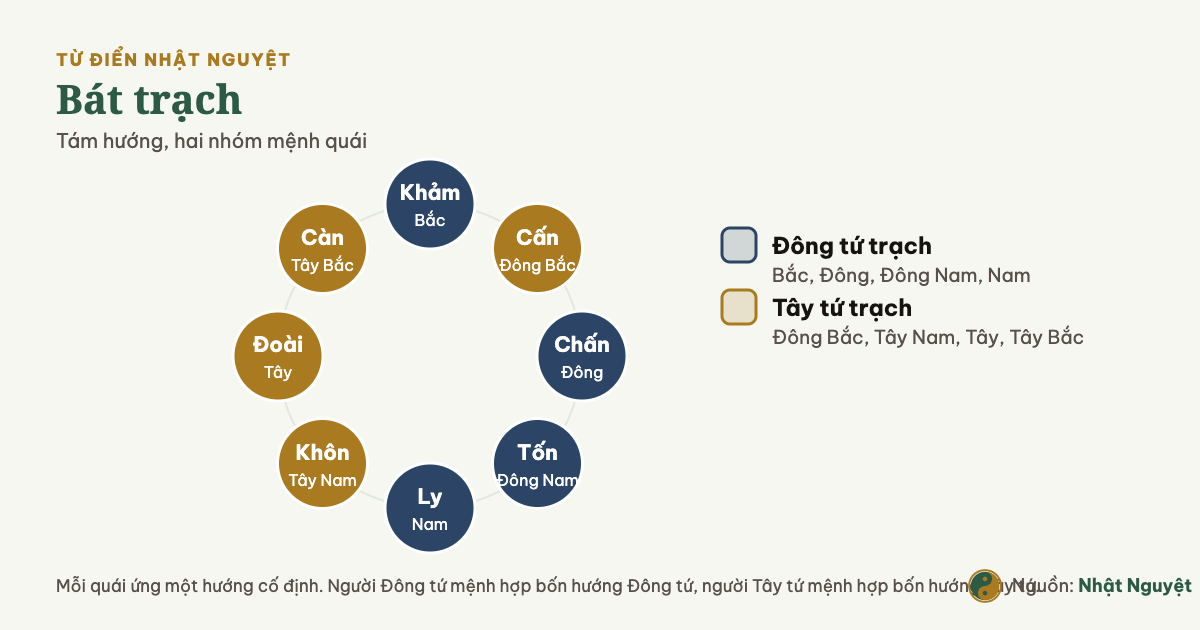
Bat Trach (八宅), or Eight Mansions, is a branch of traditional feng shui that classifies houses into eight mansion types based on the eight trigrams of the bagua: Qian, Kun, Zhen, Xun, Kan, Li, Gen, Dui. Each mansion has its own characteristics and is considered suitable for groups of people with corresponding trigram numbers. This method is often used to determine house orientation, main door direction, kitchen direction, and other important areas to optimize auspicious energy.
Origin and Principles
Bat Trach originates from ancient Eastern philosophy, based on yin-yang, the five elements, and the bagua. The eight mansions are divided into two main groups: East Four Mansions (Kan, Li, Zhen, Xun) and West Four Mansions (Qian, Kun, Gen, Dui). The core principle is the compatibility between the owner's trigram number (calculated from birth year and gender) and the house direction. Each trigram number has four auspicious directions (Sheng Qi, Tian Yi, Yan Nian, Fu Wei) and four inauspicious directions (Jue Ming, Wu Gui, Liu Sha, Huo Hai).
Practical Application
In practice, one calculates the owner's trigram number, determines the house mansion based on the main door or sitting direction, then cross-references to choose directions for doors, kitchen, bed, and altar. For example, people with East Four destiny should live in East Four mansions and prioritize North, East, Southeast, and South directions. Conversely, West Four destiny people are compatible with West Four mansions and West, Northwest, Southwest, Northeast directions.
Distinction from Similar Terms
Bat Trach differs from other feng shui methods such as Flying Star (based on time and cycles) or Form School (based on geographical shapes). Bat Trach mainly relies on personal trigram and house direction, without considering time factors. Additionally, Bat Trach is not identical to "bagua" even though both use eight trigrams; bagua is a broader symbol system, while Bat Trach is a specific application in residential feng shui.
Note: This is traditional knowledge for reference, not scientifically verified. Readers should consider carefully before applying in practice.