


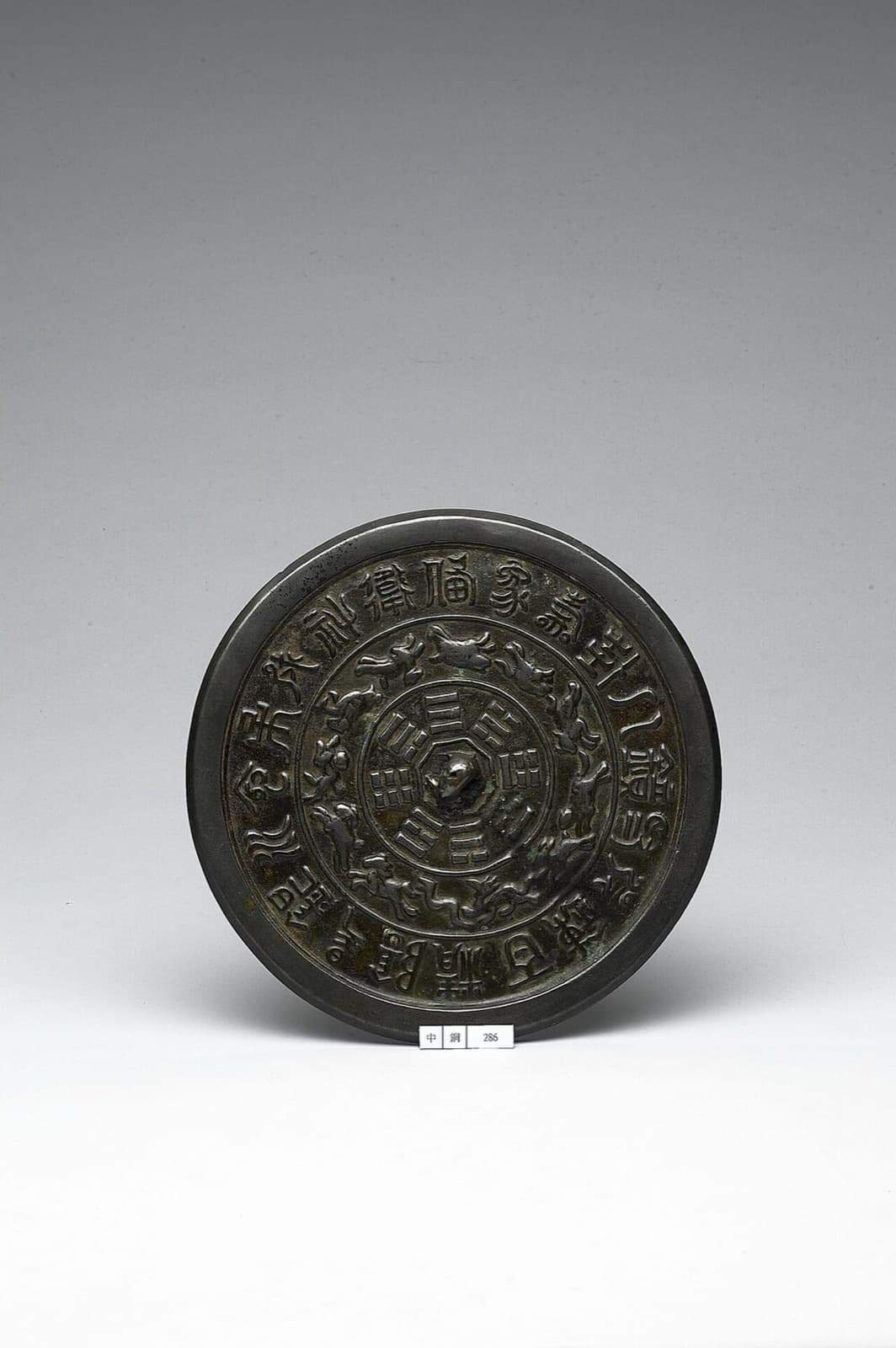
Image: Wikimedia Commons (Public Domain / CC0)
TL;DR: Khon Mountain is one of the 24 mountain directions, belonging to the Shen-Zi-Chen trine group and the Yin Earth element. This article explains its meaning, how to interpret good and bad fortune when sitting Khon facing Gen or sitting Gen facing Khon, along with important notes for practical feng shui use.
What are the 24 mountain directions and where is the Khon mountain located?
In Eastern feng shui, the system of 24 mountain directions is a foundational tool for determining the orientation of houses, graves and important structures. This system divides the 360 degree compass ring into 24 equal parts, each 15 degrees wide, called a mountain. Each mountain carries a name combining a Heavenly Stem, an Earthly Branch and a Trigram. The Khon mountain is the name of one of the 24 mountains, taken from the Khon trigram in the Bagua, representing earth, yin, nurturing and tolerance.
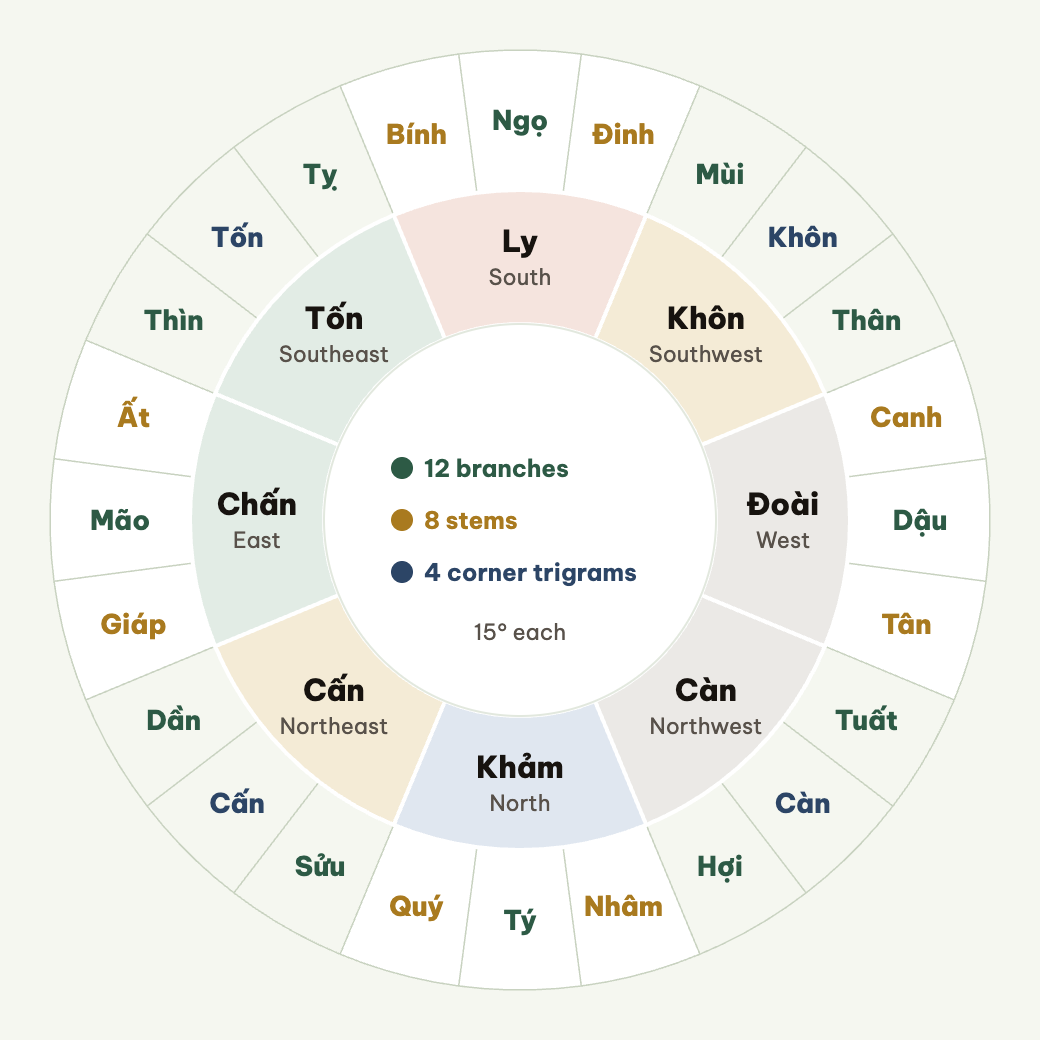
The Khon mountain lies in the Southwest sector of the compass, occupying roughly 217.5 degrees to 232.5 degrees (measured clockwise from North). Among the 24 mountains, it sits between the Mui mountain (the Southeast side of the sector) and the Than mountain (the Northwest side of the sector). Specifically, the positions of the mountains in the Southwest sector are, in order, Mui (start of the sector), Khon (middle), Than (end of the sector). The exact boundary of the Khon mountain is from 217.5° to 232.5°, with its center at 225° (the true Southwest direction).
What are the Five Elements and characteristics of the Khon mountain?
The Khon mountain belongs to the Earth element, but it is yin Earth, unlike the Can mountain which is also Earth but yang Earth. The yin nature of the Khon mountain expresses softness, endurance and nurturing, much like gentle mother earth. In the generating cycle of the Five Elements, Earth generates Metal, so mountains belonging to the Metal element such as Than, Dau, Canh and Tan are generally seen as having a good relationship with the Khon mountain. Conversely, Wood controls Earth, so mountains of the Wood element (Giap, At, Dan, Mao) can create conflict if combined carelessly.
In terms of the Three Harmonies, the Khon mountain belongs to the Than-Ty-Thin triad. This is the triad of the Water element, because Than (beginning), Ty (peak) and Thin (end) all carry Water energy. Although the Khon mountain is Earth in element, when placed within the Water triad it plays the role of a reservoir and regulator of water, like a dike holding back water. Therefore, when assessing fortune and misfortune, practitioners usually consider the Khon mountain in relation to the Than and Thin mountains, forming a stable Three Harmonies configuration. If a structure sits on the Khon mountain and faces the Can mountain (opposite), then having water (a water body, a road, an open space) at the Can direction can activate the auspicious energy of the Water triad.
How do you determine the mountain direction when sitting on Khon and facing Can?
In feng shui, saying "sitting on Khon and facing Can" means the house or grave has its back to the Southwest (the Khon mountain) and its face toward the Northeast (the Can mountain). This is one of the common orientations among the 24 mountains, often called the Can direction (or Northeast direction). Conversely, "sitting on Can and facing Khon" means the house has its back to the Northeast and faces the Southwest.
To determine this accurately, practitioners use a feng shui compass (luopan) placed at the center of the house or in front of the main door, measuring the degree of the facade. If the measured degree falls within 217.5° to 232.5°, that is the Khon mountain. When the facade lies in this band, the house faces Khon; conversely, if the back of the house lies in this band, the house sits on Khon. The boundaries between mountains matter greatly, because if the reading falls outside the 15 degree band, the mountain direction changes, leading to a different interpretation.
What does the Khon mountain mean in choosing a house direction?
The Khon mountain belongs to the Southwest, the sector of the earth mother, symbolizing the mother, tolerance, care and fertility. In Bát Trạch (the Eight Houses system), the Southwest is one of the four West-group directions (along with Northwest, Northeast and West). Therefore, people belonging to the West-group destiny (the group of trigram numbers whose destiny sector belongs to the West) are usually advised to choose the Southwest as a favorable direction, especially as the Sheng Qi (life-generating) or Yan Nian (longevity) direction. Conversely, people of East-group destiny may encounter many challenges when choosing this direction.
Specifically, if a person has a trigram number belonging to the West-group destiny, such as trigram number 2 (Khon) or trigram number 8 (Can), then the Khon direction can be the Sheng Qi direction (for Can destiny) or the Yan Nian direction (for Khon destiny). Sheng Qi brings prosperity and good health, while Yan Nian strengthens family affection and harmony. However, if a person of East-group destiny such as trigram number 3 (Chan) or 4 (Ton) chooses the Khon direction, this direction can be Huo Hai (mishap) or Wu Gui (five ghosts), bringing gossip, illness or loss of wealth. Therefore, determining one's destiny sector is a step that cannot be skipped.
How do you assess fortune and misfortune when sitting on Khon and facing Can?
When a house sits on Khon and faces Can, feng shui usually considers the following factors:
- The Can direction belongs to the Northeast, the element of yang Earth. The Can mountain is mountains and highlands, still and quiet, symbolizing solidity and rest. When facing Can, the house receives the energy of the mountain, which can bring stability and safety, suitable for people in professions requiring perseverance, or those seeking peace.
- However, Earth with Earth neither generates nor controls, so one must examine the water mouth (where water flows out) and the bright hall (the open space in front of the house). If the bright hall is spacious and has gathered water (a lake, a pond, a curving road), that is good, because Earth that obtains water can nourish all things. Conversely, if the bright hall is cramped, or there is hostile energy such as a road stabbing straight in or a utility pole, then even a good direction is hard to bring into play.
- The Than-Ty-Thin triad: Because the Khon mountain belongs to the Water triad, if in front of the house (the Can direction) there is water (a river, a lake, or a winding road), that is very good, forming the pattern of "water gathered in the bright hall", signifying abundant wealth. Conversely, if a high mountain blocks directly in front, it can obstruct development.
- Considered by Xuan Kong Flying Stars: Each period (20 years) has a star number entering the central palace, creating star combinations at the Khon and Can directions. For example, in period 8 (2004-2023), the Can direction has star 8 (prosperous energy) if the house sits on Khon and faces Can, which is very good for wealth luck. In period 9 (2024-2043), the Khon direction has star 9 (Right Assistant) if the house sits on Can and faces Khon, which is also prosperous energy. However, one must also examine the facing star and the sitting star to know fortune and misfortune precisely.
How do you assess fortune and misfortune when sitting on Can and facing Khon?
Conversely, when a house sits on Can and faces Khon (turned toward the Southwest), the meaning is somewhat different:
- The Khon direction (Southwest) is the sector of the earth mother, governing family relationships, especially the mother and the wife. This direction is good for strengthening affection and care, but it can cause the head of the household (if male) to be influenced by female authority, or to become indecisive without balance.
- According to Bát Trạch, the Khon direction is the Sheng Qi direction for people of Can destiny (trigram number 8), and the Fu Wei (self-restoring) direction for people of Khon destiny (number 2). Sheng Qi brings luck and wealth; Fu Wei helps strengthen inner strength and health. But for people of Chan destiny (number 3), the Khon direction is Jue Ming (severed fate), very bad, and should be avoided.
- Water mouth and bright hall: When facing Khon, if the Southwest has water (a pond, a lake) or a wide open space, that is good for business and trade, because Water generates wealth. However, if the Southwest is a high mountain or blocked by tall buildings, it can create stagnation, making advancement difficult.
- In Xuan Kong, sitting on Can and facing Khon in period 9 (2024-2043) is rated fairly good because star 9 arrives at the facing direction, but one must check the combination with the sitting star at Can. If there is a mountain (a hill, a tall building) at Can (behind), that is good, forming "the mountain governs people, the facing direction governs wealth".
What does the Khon mountain mean in building graves?
For graves, the Khon mountain is often used to choose the orientation for the grave of the mother or a woman in the family. According to yin dwelling feng shui, the grave orientation must match the dragon vein and the water method. A grave sitting on Khon and facing Can is often used when the dragon vein comes from the Southwest and water gathers at the Northeast. This can bring support to descendants in spirit and intellect. Conversely, a grave sitting on Can and facing Khon is less common, because the Khon direction is yin and can easily make the grave too strongly yin, requiring a good mountain facing (an mountain) to control it.
However, assessing graves is very complex, requiring examination of the whole landscape of mountains and water, not just the mountain direction. A good mountain direction but a weak dragon vein, or an incorrect water method, can still fall into hostile energy.
How does the Khon mountain compare with the neighboring Mui and Than mountains?
| Mountain | Degree range | Five Elements | Three Harmonies | Characteristics |
|---|---|---|---|---|
| Mui | 202.5° to 217.5° | Yang Earth | Hoi-Mao-Mui (Wood triad) | Often used for the Southwest direction but carries Wood energy, can be good for people of Wood destiny |
| Khon | 217.5° to 232.5° | Yin Earth | Than-Ty-Thin (Water triad) | Pure Earth, leaning toward stability and durability rather than rapid growth |
| Than | 232.5° to 247.5° | Metal | Than-Ty-Thin (Water triad) | Often used for the Southwest direction but carries Metal energy, can enhance wealth when combined with water |
Compared with these two mountains, the Khon mountain is pure Earth, leaning toward stability and durability rather than rapid growth. If the household needs peace and longevity, the Khon mountain is a good choice. If breakthroughs are needed, one might consider the Than mountain (Metal) or the Mui mountain (Wood) depending on destiny.
Notes when applying the Khon mountain in practice
- Do not treat the mountain direction as absolute: The mountain direction is only one factor within the whole of feng shui. It must be combined with the year's period, the destiny of the occupant, the terrain and the surrounding environment.
- Check the accuracy of the compass: One should measure several times, at different times, avoiding magnetized objects such as phones and large metal items.
- Consult an expert: For important structures, one should ask an experienced feng shui master to interpret accurately, avoiding mistaken self-interpretation.
- Combine with modern science: Feng shui cannot replace design factors, lighting and ventilation. A house that suits feng shui but lacks light and is damp will still harm health.


